The rise of the student movement demonstrates how sustained civic resistance can develop into a serious political alternative.
From Public Anger to a National Movement
The roots of Serbia’s student-led movement can be traced to the deadly collapse of a concrete canopy at a railway station in Novi Sad in November 2024. The disaster killed 16 people and triggered widespread outrage across the country.
For many Serbians, the tragedy raised troubling questions about construction standards, public safety and the accountability of officials involved in infrastructure projects. Critics linked the disaster to alleged corruption, political favouritism and failures in oversight during renovation work.
University students soon became central figures in the protests, organising demonstrations and demanding greater transparency. Their movement extended beyond university campuses, attracting support from citizens who were frustrated with the government’s record on corruption and democratic institutions.
What began as a demand for accountability over a deadly disaster evolved into a wider challenge to Serbia’s political establishment.
Rather than remaining confined to a single incident, the protests became a platform for broader concerns about the country’s political direction. Students called for institutions to function independently, public officials to face scrutiny and the government to respond to citizens’ demands.
The Challenge to Vučić’s Political Dominance
Aleksandar Vučić has been one of the most influential figures in Serbian politics for more than a decade. As president and previously as prime minister, he built a powerful political network around the SNS, which maintained a dominant position in national politics.
His supporters have credited him with maintaining political stability, pursuing infrastructure development and balancing Serbia’s relationships with major international powers. However, critics have repeatedly accused his government of weakening democratic checks and balances, exerting pressure on independent media and allowing political influence to extend into public institutions.
These tensions created an environment in which the student movement could gain momentum.
The election became a test of whether a well-established ruling party could withstand a broad-based challenge led by a generation demanding political accountability.
The opposition movement also presented a different kind of political challenge. Instead of relying exclusively on established opposition politicians, it drew strength from students, civic activists and citizens united by concerns about governance. This helped it appeal to voters who had become disillusioned with conventional political competition.
Students Turn Protest into Political Power
One of the most striking aspects of the reported election result was the transformation of student activism into electoral strength.
Protest movements can attract large crowds, but converting public anger into votes requires organisation, coordination and a clear political message. Serbia’s student-backed movement sought to bridge that gap by turning demands for accountability into a direct challenge at the ballot box.
According to the election-night figures cited in the report, Vučić acknowledged that the opposition’s Students’ List was projected to secure between 135 and 140 seats in the 250-member parliament. His SNS party was expected to win approximately 105 seats.
Vučić also cited an estimated 2.2 million votes for the Students’ List, compared with around 1.7 million for his party.
If confirmed by official results, such figures would represent a major political reversal and give the student-backed opposition a potentially decisive parliamentary advantage.
The reported outcome also illustrates how public mobilisation can move beyond demonstrations and influence the institutions through which political power is exercised. For the students involved, the challenge would not end with winning an election. It would continue through the difficult process of translating campaign demands into policies and institutional reforms.
A Victory Shaped by Demands for Accountability
Corruption emerged as one of the central issues in the political contest. The Novi Sad tragedy gave this concern a human cost, intensifying questions about whether public institutions were adequately protecting citizens.
For many protesters, the issue was not simply whether individual officials had made mistakes. It was whether the political system could investigate failures independently, establish responsibility and prevent similar tragedies in the future.
The student movement’s broader appeal reflected a desire for institutions that operate transparently and apply the law fairly.
The central message of the protests was that public safety, accountability and democratic oversight should take precedence over political loyalty.
The election therefore became a referendum, in part, on the relationship between citizens and the state. Voters dissatisfied with the existing system were presented with an opportunity to express their concerns through democratic participation.
However, an electoral victory alone cannot guarantee that corruption will disappear or institutions will immediately become stronger. The opposition would need to demonstrate that it could investigate allegations fairly, protect judicial independence and establish transparent procedures for public spending and infrastructure projects.
Political Tensions and the Battle Over the Result
The election took place amid heightened tensions, according to the account of voting day. Police in riot gear reportedly secured areas around the election commission headquarters in Belgrade, while groups of black-clad men gathered at several locations in the capital.
The presence of security personnel reflected the sensitivity of a contest that had become a confrontation between a long-dominant ruling party and a movement rooted in months of public protest.
Following his concession, Vučić blamed independent media and alleged foreign interference for his party’s defeat. He referred to unnamed European countries and what he described as an “American deep state”.
Such claims underline another challenge facing Serbia: maintaining public confidence in electoral institutions during a period of political transition. Transparent vote counting, independently verified results and peaceful acceptance of democratic outcomes will be essential to sustaining public trust.
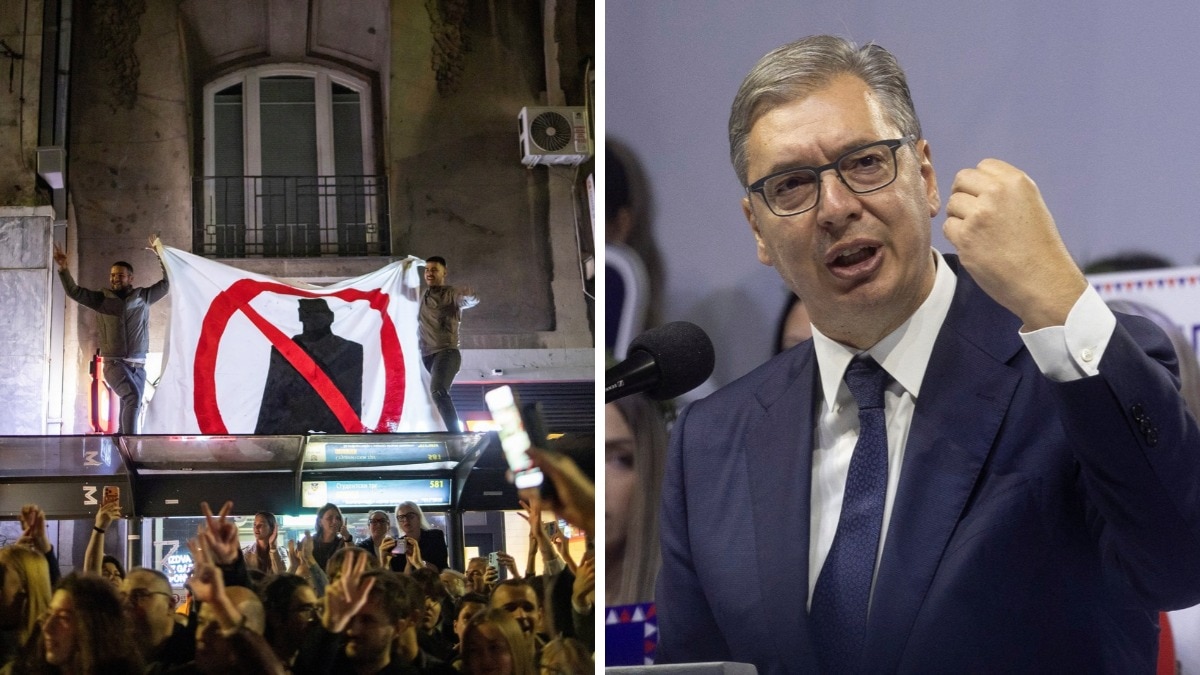
Supporters of the Students’ List reportedly celebrated in Belgrade and other cities after the concession, chanting slogans against Vučić. Their reaction reflected the emotional significance of a campaign that had brought students and other citizens into a prolonged confrontation with the political establishment.
Serbia’s Foreign Policy in Focus
A political transition in Belgrade could also attract attention beyond Serbia’s borders. The country occupies an important position in the Western Balkans and has long attempted to maintain relations with both Western governments and Russia.
Vučić has cultivated ties with Moscow, including receiving support from Russian President Vladimir Putin, while also engaging with European institutions and pursuing Serbia’s stated European Union membership ambitions.
A change in parliamentary leadership could influence the country’s approach to foreign policy, regional cooperation and relations with European partners. Nevertheless, a domestic electoral shift should not automatically be interpreted as a complete reversal of Serbia’s international relationships.
The priorities of a new political leadership would depend on its programme, parliamentary strength and ability to build consensus on issues ranging from European integration to relations with neighbouring countries.
For the European Union and other international partners, the central question would be whether political change produces measurable improvements in democratic governance, judicial independence and media freedom.
The Road Ahead: From Victory to Responsibility
The student-led movement now faces a challenge that could prove more difficult than organising protests: governing effectively.
A diverse coalition can unite around opposition to a government, but governing requires agreement on budgets, economic priorities, institutional reform and foreign policy. Differences within the movement could become more visible once it must make concrete decisions.
Citizens will also expect progress on the concerns that originally brought them into the streets. That includes accountability for the Novi Sad disaster, credible investigations into corruption allegations and stronger safeguards against the misuse of public authority.
The real measure of the movement’s success will not be the defeat of a political rival alone, but whether it can build institutions that remain accountable regardless of who holds power.
Serbia’s political future will therefore depend on more than the result of a single election. It will depend on whether the country’s emerging political forces can preserve democratic participation, respect the rule of law and deliver meaningful reforms.
In Summary
The reported defeat of Vučić’s ruling party marks a potentially historic moment for Serbia. The student movement’s journey from public demonstrations to electoral competition illustrates the political influence that younger generations can exercise when their concerns resonate across society.
The protests that followed the Novi Sad tragedy gave voice to demands for accountability that extended far beyond one infrastructure project. They challenged the assumption that a deeply established political leadership could remain secure despite mounting public dissatisfaction.
From the streets to the ballot box, Serbia’s students have demonstrated the potential of civic mobilisation to reshape national politics.
Yet the next chapter remains uncertain. Winning power is only the beginning; rebuilding public trust, strengthening democratic institutions and delivering accountable government will require sustained effort.
If the reported results are confirmed and the student-backed movement successfully translates its electoral gains into lasting reforms, Serbia could enter a new phase in its democratic development. The significance of this moment will ultimately be determined not simply by who leaves office, but by whether the country emerges with a political system that listens more closely to its citizens.
Important editorial note: The article above is based on the supplied passage. Before publication, independently verify the reported election, the concession, the parliamentary seat projections and the vote totals. These are major political claims and should not be presented as confirmed facts without reliable sourcing.