How do scientists turn raw space images into real colors? When you see striking images of space filled with vivid blues, reds, and glowing structures, it is easy to assume a spacecraft or telescope simply “took a color photo.” In reality, most space images do not begin in color at all. What we see as colorful pictures are carefully constructed visual representations made from scientific data.
Turning raw space data into recognizable images is a detailed process that combines physics, imaging technology, and careful interpretation. Here is how it works.
Space cameras do not capture images like phone cameras
A smartphone camera captures light in three basic channels:
- Red
- Green
- Blue
These are combined instantly to form a full-color image.
Space instruments often work differently. Instead of producing a finished photograph, they measure:
- Light intensity at specific wavelengths
- Radiation beyond visible light, such as infrared or ultraviolet
- Separate datasets through different filters
A well-known example is the data collected by the Hubble Space Telescope.
What comes down to Earth is not a ready-made picture, but structured numerical information describing how much light was detected in different bands.
Step 1: Raw data is transmitted to Earth
When a space telescope or probe captures an image, it sends back digital signals instead of a conventional image file. These signals include:
- Measurements of brightness
- Information from multiple filters
- Separate exposures of the same region in different wavelengths
Each filter isolates a specific portion of the electromagnetic spectrum, such as blue light, red light, or infrared radiation.
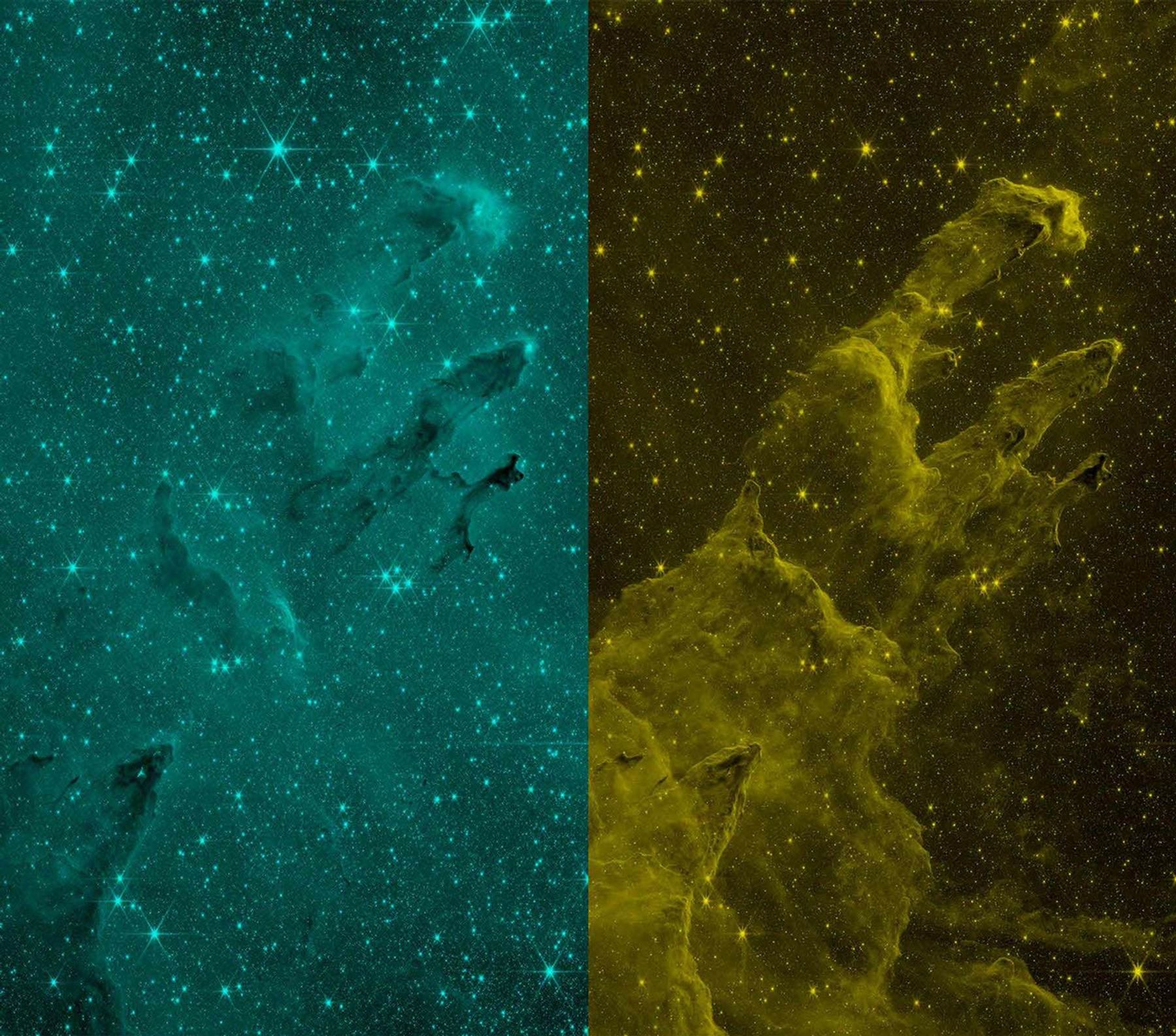
Step 2: Each filter becomes a grayscale image
Once the data reaches Earth, each wavelength channel is converted into a grayscale image.
These images are not black-and-white photographs in the artistic sense. Instead:
- Brighter areas indicate stronger light detection
- Darker areas indicate weaker signals
Each grayscale image represents a different physical property of the object being observed. For example, one filter may highlight hydrogen gas, while another shows dust or hotter regions.
At this stage, there is still no color information.
Step 3: Assigning colors to data
To create a visible image, scientists assign colors to each grayscale channel. This step is known as color mapping.
A typical assignment might be:
- Shorter wavelengths (such as ultraviolet) mapped to blue
- Mid-range wavelengths mapped to green
- Longer wavelengths (such as infrared) mapped to red
This creates what is called a composite image.
It is important to understand that these colors are not always what the human eye would naturally see. Instead, they are used to make invisible information visible and meaningful.
Step 4: Combining the channels
After color assignment, the separate images are layered together using specialized software. This process involves:
- Aligning all channels so they match spatially
- Adjusting brightness and contrast for clarity
- Merging the layers into a single image
The result is a complete visual representation built from multiple scientific datasets.
Step 5: Enhancing clarity
Space images often require additional processing because:
- Objects are extremely faint
- Background noise from sensors can interfere
- Contrast between features may be very low
To improve readability, scientists may adjust:
- Brightness levels
- Contrast between structures
- Sharpness of details
These adjustments are made carefully to preserve scientific accuracy while making the image easier to interpret.
True color versus false color
Space images generally fall into two categories.
True color images
These attempt to approximate what the human eye would see if it were present at the location. However, even these are not perfect because:
- Space cameras may detect wavelengths more precisely than human vision
- Lighting conditions in space differ significantly from Earth
- Instrument calibration is still required
So “true color” is always an approximation.
False color images
These are more common in scientific work. In false color images:
- Colors represent scientific properties rather than visual appearance
- Different materials or temperatures are assigned distinct colors
- The goal is interpretation, not visual realism
For example, hydrogen gas, oxygen emissions, and dust regions may each be shown in different colors to highlight structure and composition.
A major contributor to this type of imaging is the James Webb Space Telescope, which captures primarily infrared light that must be translated into visible colors for human interpretation.
Why scientists use color mapping
Color mapping is not artistic decoration. It serves scientific purposes such as:
- Identifying chemical elements in space clouds
- Distinguishing between hot and cold regions
- Revealing hidden structures in galaxies or nebulae
- Highlighting differences in radiation intensity
Without this process, much of the scientific meaning would remain invisible to the human eye.
Why space images look so dramatic
The striking appearance of space images is not artificial invention. It comes from real physical processes:
- Gas clouds emit light at specific wavelengths
- Dust scatters light differently depending on composition
- Stars illuminate surrounding material unevenly
When these natural signals are mapped into visible colors, they produce highly detailed and often dramatic visuals.
A common misconception
A frequent misunderstanding is that space agencies “paint” images manually. In reality:
- The structure of the image comes directly from measured data
- Colors are assigned according to scientific rules
- The process is standardized to maintain consistency across missions
This is closer to translating data into a visual language than creating artwork.Do scientists choose colors freely?
There is some flexibility in color assignment, but it is not arbitrary. Scientists follow conventions so that:
- Similar phenomena are represented consistently
- Data can be compared across missions
- Physical meaning is preserved in the visualization
Different research goals may use different color schemes, but all are grounded in the underlying data.
A simple way to understand the processRaw space data can be compared to separate tracks in a recording:
- Each filter is like a separate instrument track
- Scientists isolate each component
- They then assign “visual notes” (colors) to each track
- Finally, everything is combined into a single composition
The result is a structured interpretation of data, not a direct photograph.
Wrap-up
Space images begin as scientific measurements, not photographs. Telescopes such as the Hubble Space Telescope and the James Webb Space Telescope collect data across multiple wavelengths, which is then processed into grayscale images, color-mapped, and carefully combined.
The final images we see are not “painted” versions of space, but carefully constructed visual translations of complex physical data. They allow scientists—and everyone else—to see patterns in the universe that would otherwise remain invisible.
Smart Kitchen Cooking & IoT Food Tech: The Future of Home Meals | Maya