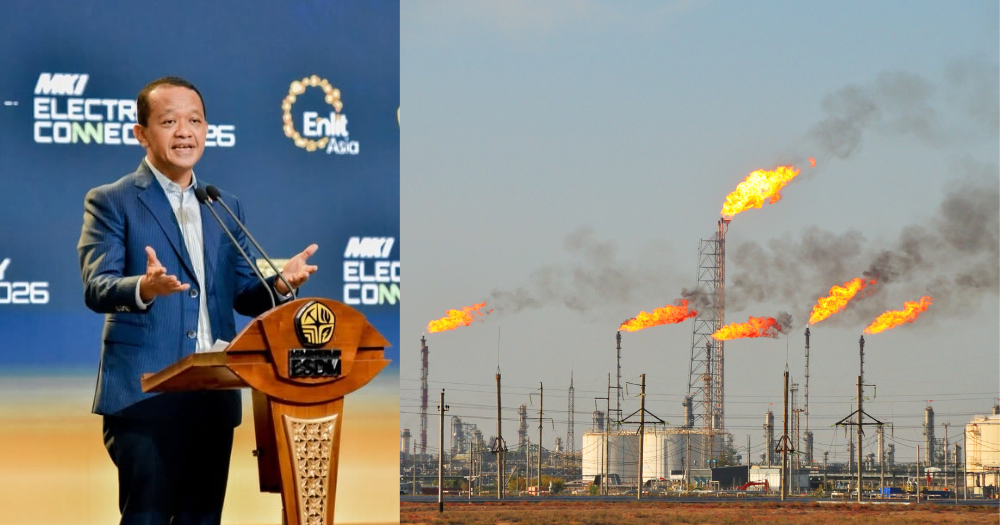
Coordinating Minister for Downstreaming and Energy Transition Bahlil Lahadalia said the government would review existing energy export arrangements and would not rule out suspending supplies to countries that failed to demonstrate mutual respect. He made the remarks on Oct 22 at an event in Jakarta marking the commissioning of new gas production facilities.
“I will conduct an evaluation. I will not hesitate to consider stopping exports to countries that do not respect Indonesia,” said Bahlil, who also serves as energy and mineral resources minister and chairs the Golkar Party.
He did not identify any country as the target of the warning or specify a particular dispute behind his comments.
Bahlil stressed that disagreements between governments should be addressed through dialogue and mutual respect. Indonesia, he added, remained willing to enter into energy supply agreements with countries that regarded it as an equal, including those without existing contracts with Jakarta.
His remarks followed an earlier suggestion on Oct 21 that Indonesia could decline to renew natural gas export contracts with neighbouring countries if doing so became necessary to meet domestic demand.
“I am also perhaps thinking of not extending gas exports to neighbouring countries, because we have to survive and meet domestic needs,” he told reporters after a Cabinet meeting.
Prabowo Calls for Resources to Serve Indonesia First
The minister’s statements followed President Prabowo Subianto’s call for Indonesia to protect its natural wealth and ensure that the benefits reach its own population.
Prabowo has described the country’s natural resources as essential to national survival, comparing them to blood in the human body. His message to ministers was that Indonesia could not afford to allow valuable resources to flow out continuously without adequately meeting the needs of its people.
The administration’s position reflects a broader policy priority: securing sufficient domestic energy supplies while ensuring that exports deliver meaningful economic benefits to Indonesia.
However, the extent to which this approach will lead to changes in existing contracts remains unclear. Bahlil’s comments were framed as a warning and a possible policy direction, rather than an announcement that any particular export agreement had been cancelled.
Japan, China and Singapore Among Indonesia’s Gas Buyers
Indonesia supplies natural gas to several major Asian markets, making its export policy relevant to regional energy security.
Data from Statistics Indonesia showed that Japan received approximately 3.8 million tonnes of Indonesian natural gas in 2025, followed closely by China at 3.79 million tonnes. Singapore imported about 3.22 million tonnes, while South Korea received approximately 2.27 million tonnes.
Other regional buyers included Thailand, which received around 291,000 tonnes, and the Philippines, with imports of about 138,000 tonnes.
Despite naming no specific country, Bahlil’s warning has implications for these established trading relationships. Any decision to alter export volumes or decline contract renewals could affect buyers’ efforts to secure reliable supplies, depending on the scale and timing of the changes.
At the same time, Indonesia must balance its domestic requirements against the economic value of exports and the importance of maintaining confidence among long-standing trading partners.
Singapore Faces a Key Question Over Future Gas Supplies
Singapore has a particular interest in Jakarta’s energy policy because Indonesia remains one of its principal sources of natural gas.
Singapore Deputy Prime Minister Gan Kim Yong told Parliament in September 2025 that existing gas import contracts with Indonesia were due to expire at the end of 2028.
The approaching deadline gives both governments an important window to negotiate future supply arrangements. Although Bahlil has not announced that Singapore will lose access to Indonesian gas, his comments highlight the possibility that future agreements could be shaped by Indonesia’s domestic priorities and expectations of greater economic returns.
Singapore is also working with Indonesia to develop cross-border electricity supplies, offering another potential area of cooperation.
However, negotiations over electricity exports have not been straightforward. On Oct 19, Bahlil said discussions had yet to produce an agreement because the two sides differed over pricing.
Earlier, on Oct 7, he said Indonesia would review electricity export arrangements to ensure the country received greater economic benefits, including a stronger role in setting prices and determining project development.
Electricity Cooperation Continues Despite Pricing Differences
Singapore’s Energy Market Authority has granted conditional licences to six Indonesian electricity import projects with a combined capacity of 3 gigawatts.
The two countries are also pursuing plans to develop at least 3.4 gigawatts of cross-border electricity projects by 2035.
Indonesia’s willingness to reconsider the commercial terms of electricity exports suggests that the issue extends beyond natural gas. Jakarta appears keen to ensure that exporting energy, including lower-carbon electricity, contributes to domestic development and provides benefits that it considers proportionate to the resources involved.
According to Reuters, Singapore is the only country with which Indonesia has signed an electricity export agreement, although Jakarta is also exploring wider regional electricity grid connections with its neighbours.
The projects could create opportunities for both countries, but progress will depend on resolving differences over pricing, investment, infrastructure and the distribution of economic benefits.
A Tougher Energy Policy, but No Export Ban Announced
Indonesia’s latest statements point towards a more assertive approach to energy diplomacy, with domestic security, fair commercial terms and reciprocal respect emerging as central themes.
For Jakarta, reviewing export agreements could provide greater flexibility to manage domestic supply and strengthen its negotiating position. Yet any substantial reduction in exports would also need to be weighed against the revenue generated by overseas sales and the value of maintaining stable regional partnerships.
For Singapore and other buyers, the immediate issue is whether Indonesia’s warnings will translate into concrete changes when existing contracts come up for renewal.
For now, Indonesia has threatened a possible change in policy, not announced a blanket halt to energy exports. No country has been publicly singled out, and the government has not confirmed that any existing gas or electricity agreement will be terminated.
The next phase of negotiations will reveal whether Jakarta’s tougher rhetoric leads primarily to stronger bargaining terms, a greater emphasis on domestic energy security, or significant changes to its established export relationships.