
The suspension triggered an immediate backlash from the right-wing opposition Law and Justice (PiS) party, whose leader, Jarosław Kaczyński, denounced the development as an attack on the court. The opposition accused the government of undermining the country’s constitutional framework and attempting to take control of an institution that has become a major battleground in Poland’s political struggle.
The confrontation took an unexpected turn when conservative President Karol Nawrocki abandoned his journey to Senegal, where he was scheduled to undertake a state visit, and returned to Warsaw to intervene in the escalating crisis.
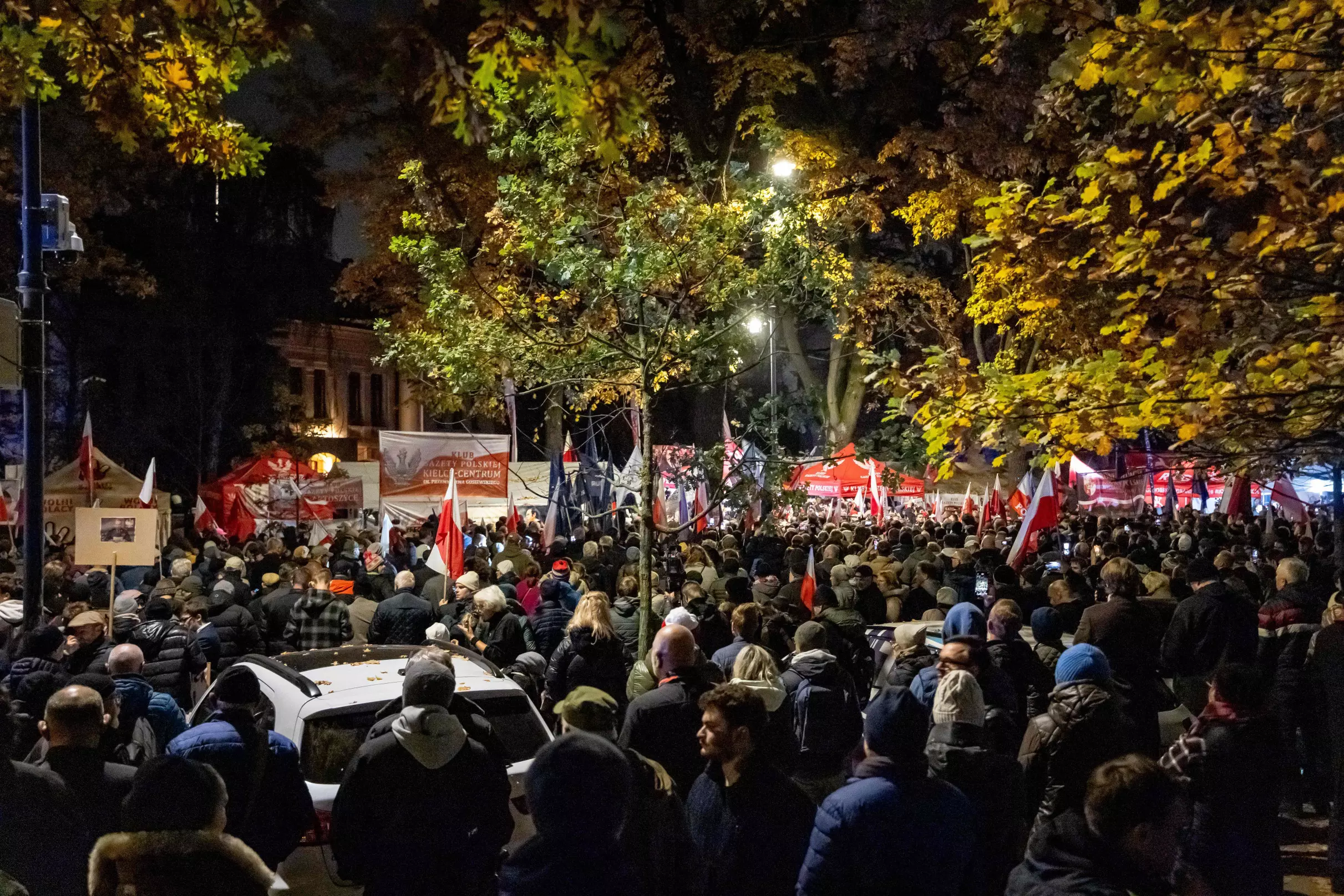
Nawrocki, who is closely aligned with PiS and maintains strong political links with US President Donald Trump, arrived at the tribunal as hundreds of demonstrators gathered outside the building. The protesters, including opposition lawmakers, had assembled to express solidarity with the suspended judicial leaders and challenge the actions of the government-appointed judges.
Tensions between demonstrators and police escalated during the evening. According to police, three people were detained after some protesters breached the tribunal’s perimeter fence, while others allegedly threw objects at officers deployed to maintain order.
The situation became increasingly dramatic shortly before 1am on Saturday, when Nawrocki appeared outside the court and moved through the police cordon towards the building. Video footage circulating online appeared to show the president struggling with security personnel and other judges as he attempted to enter the premises.
The president subsequently made his way inside, where he remained as of 4am local time. His intervention transformed an already contentious judicial dispute into a direct confrontation involving the country’s highest political office.
In a video clip shared online, Nawrocki was heard challenging the legitimacy of the government-appointed judges, declaring that they were not legitimate members of the Constitutional Tribunal.
A statement delivered on his behalf outside the building at approximately 5am further sharpened the political rhetoric. Nawrocki accused those involved of violating Poland’s constitutional order and described the developments as the forceful seizure of a constitutional institution. He also demanded that security forces withdraw from the tribunal’s premises.
The latest confrontation reflects deeper disagreements surrounding Poland’s judicial system, particularly the legal status and composition of the Constitutional Tribunal. The dispute dates back to the period when PiS governed the country and introduced controversial judicial changes that critics said weakened judicial independence.
The tribunal frequently upheld legislation supported by the PiS-led government, sometimes ruling in favour of Polish national law over European Union legal principles. The European Union repeatedly raised concerns about the country’s judicial reforms, arguing that changes introduced under the nationalist administration threatened the independence of the judiciary and brought the Constitutional Tribunal too close to political power.
Although Poland has since undergone a change of government, disagreements over judicial appointments, institutional authority and the legitimacy of court decisions have continued to complicate efforts to restore confidence in the legal system.
Friday night’s events demonstrate how deeply entrenched those divisions remain. The suspension of the tribunal’s leadership has exposed competing claims over who has the authority to determine the institution’s legitimate composition and leadership.
The political consequences could extend well beyond the immediate confrontation in Warsaw. With Poland approaching its next parliamentary election in 2027, the escalating dispute is likely to become a major issue in the campaign.
Opinion polls suggesting that the populist right could potentially return to power have added further significance to the standoff. PiS and its allies are likely to use the confrontation to strengthen their argument that the current government is undermining constitutional safeguards, while its opponents face mounting pressure to demonstrate that judicial reforms can be implemented without creating further institutional instability.
For now, the crisis has placed Poland’s constitutional institutions under renewed scrutiny, raising serious questions about judicial independence, political accountability and the rule of law. What began as a dispute over the suspension of two senior judges has rapidly developed into a wider struggle over the country’s constitutional future.


