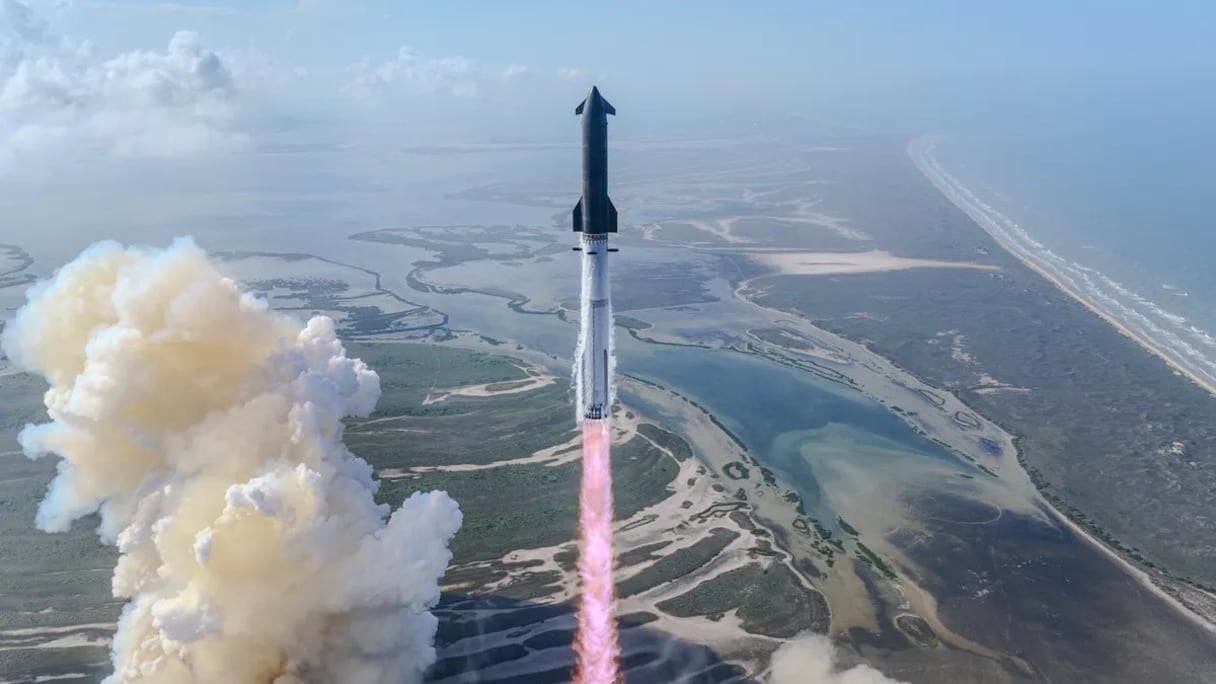
SpaceX Targets First-Ever Starship Orbital Mission with Operational Starlink Satellite Launch: SpaceX is preparing for what could become one of the most important launches in the company’s history as it readies Starship for its first attempt to reach a stable orbit around Earth while carrying an operational payload. Scheduled for Monday from the company’s Starbase launch site in South Texas, the mission represents a major step in moving Starship from an experimental rocket to a vehicle capable of serving commercial customers.
The launch window is expected to open at 8:15 a.m. ET, giving SpaceX a 75-minute opportunity to send the world’s largest and most powerful rocket into orbit. While previous Starship flights have tested the vehicle’s ability to launch, separate stages, and survive reentry, this mission is designed to accomplish something far more ambitious—complete an orbital flight and deploy satellites into space.
At the center of the mission is the deployment of the first batch of next-generation Starlink satellites. These satellites are expected to play an important role in expanding SpaceX’s global broadband internet network, which already serves millions of customers across dozens of countries. The latest generation is designed to deliver greater capacity, improved efficiency, and faster internet speeds, helping meet growing demand for satellite-based connectivity.
Unlike earlier Starship test flights that followed suborbital paths before returning to Earth, this mission aims to place the upper stage into a stable orbit. Once the spacecraft reaches the planned altitude, it will begin releasing a batch of Starlink satellites into low Earth orbit. Successfully deploying operational satellites would mark the first time Starship has carried revenue-generating cargo, signaling that the vehicle is beginning the transition from testing to commercial operations.
The mission is expected to last several hours. After liftoff, the Super Heavy booster will separate from the Starship upper stage and follow a controlled descent toward a splashdown area. Meanwhile, Starship will ignite its engines again to complete orbital insertion before beginning preparations for satellite deployment. Following the release of the satellites, the spacecraft is expected to perform a controlled deorbit burn and reenter Earth’s atmosphere before splashing down in the Pacific Ocean.
Although the booster and spacecraft are not expected to be recovered using the launch tower’s mechanical arms during this mission, SpaceX will collect valuable data on flight performance, engine reliability, orbital operations, satellite deployment, and atmospheric reentry. Engineers will use this information to improve future versions of the rocket and prepare for increasingly complex missions.
The success of this launch carries significance well beyond the Starlink program. Starship is central to SpaceX’s long-term vision of dramatically lowering the cost of reaching space. The fully reusable launch system has been designed to carry more cargo than any rocket currently in operation while flying more frequently than traditional launch vehicles. If those goals are achieved, the economics of satellite launches, deep-space exploration, and human spaceflight could change dramatically.
NASA is also closely watching Starship’s progress. The agency has selected a modified version of the spacecraft to serve as the lunar lander for the Artemis program, which aims to return astronauts to the Moon later this decade. Before astronauts can safely fly aboard Starship, however, the vehicle must demonstrate reliable orbital operations, controlled reentry, and repeated successful missions.
Beyond the Moon, Starship is considered the foundation of SpaceX’s long-term plans for missions to Mars. Company founder Elon Musk has repeatedly described the rocket as the transportation system that could eventually carry people and cargo to the Red Planet. While those ambitions remain years away, every successful test flight moves the program closer to that objective.
The launch also highlights the increasingly important role of the Starlink network in SpaceX’s business strategy. Revenue generated from Starlink has become a significant source of funding for the company’s ambitious space projects. A successful deployment of the latest satellites using Starship could allow SpaceX to launch far larger batches in the future, reducing costs while expanding global internet coverage more rapidly.
Even if some mission objectives are not fully achieved, the flight will provide engineers with valuable information for future improvements. SpaceX has traditionally followed a rapid development strategy, using data from each launch to refine hardware and software before the next test. This approach has helped the company transform Falcon 9 into one of the world’s most reliable rockets, and it hopes to repeat that success with Starship.
As countdown preparations continue, the global space community will be watching closely. A successful orbital mission combined with the deployment of operational Starlink satellites would represent a defining milestone for SpaceX and could mark the beginning of a new era in commercial space transportation. It would demonstrate that Starship is no longer just an experimental rocket but a launch system capable of supporting commercial satellite missions, future lunar exploration, and eventually humanity’s ambitions beyond Earth.