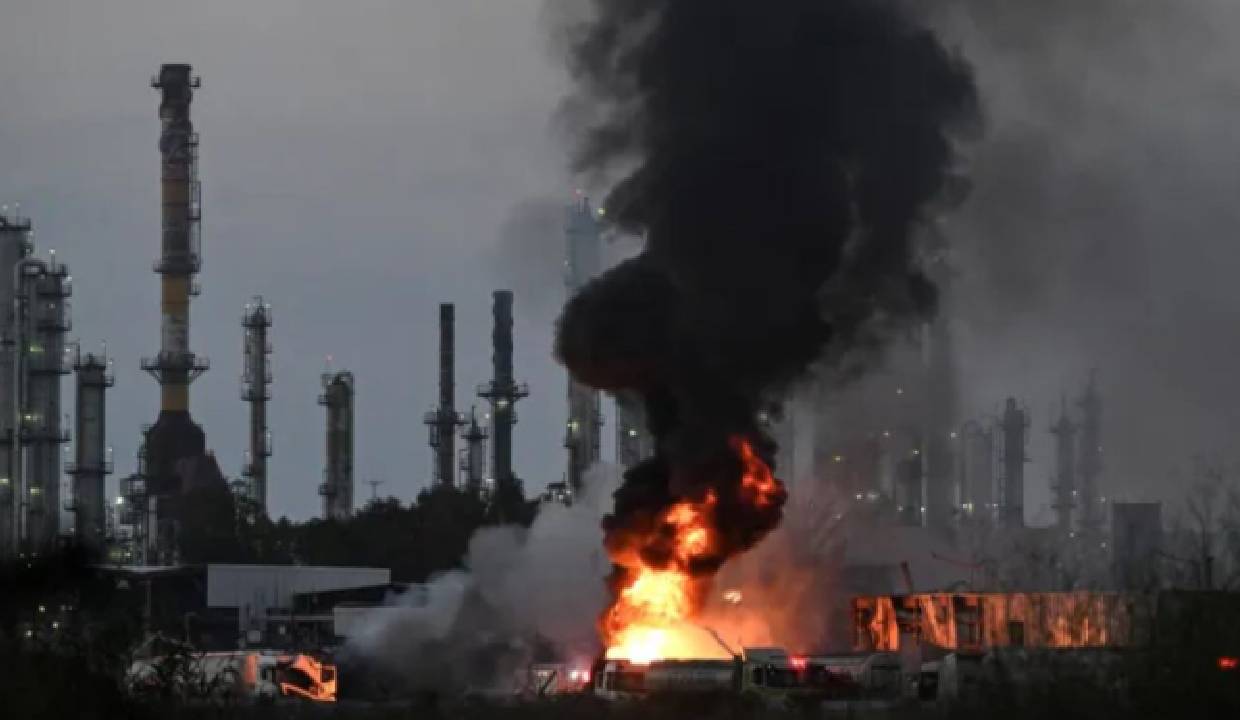
UAE Nuclear Plant Hit by Drone Attack; Israel Launches 100 Strikes in Lebanon- A drone strike that triggered a fire near the Barakah Nuclear Energy Plant in the United Arab Emirates has intensified fears of a wider regional conflict, as Israel simultaneously escalated military operations in southern Lebanon with nearly 100 strikes over two days despite an extended ceasefire agreement.
UAE authorities confirmed on Sunday that a drone attack struck an electrical generator located at the perimeter of the Barakah Nuclear Energy Plant in the al-Dhafra region, causing a fire that was later brought under control. Officials said there were no casualties, no radiation leaks, and no damage to the plant’s reactor systems.
The UAE’s Federal Authority for Nuclear Regulation stated that all four reactors at the facility remained safe and operational. Emergency response teams were deployed immediately after the incident, and engineers were able to isolate the damaged generator before the fire spread further into the complex.
The Barakah plant, located along the Gulf coast west of Abu Dhabi, is the Arab world’s first operational nuclear power station and supplies a significant portion of the UAE’s electricity needs. The attack has raised serious concerns about the vulnerability of critical energy infrastructure in the Gulf amid escalating regional tensions.
International observers reacted with alarm to the incident. The International Atomic Energy Agency urged restraint and warned against military operations near nuclear facilities, emphasizing the potentially catastrophic consequences of any strike affecting sensitive nuclear infrastructure.
Although no group immediately claimed responsibility for the drone attack, the incident comes at a time of rapidly rising tensions across the Middle East. Security analysts believe the strike reflects a growing pattern of attacks targeting strategic infrastructure linked to states perceived as supporting Israel or the United States.
The UAE has increasingly found itself navigating a delicate position in regional politics, balancing security partnerships with Western allies while attempting to avoid direct involvement in expanding conflicts across the region.
Meanwhile, violence continued to intensify along the Israel-Lebanon border. Israeli military officials announced that fighter jets and artillery units had struck approximately 100 sites in southern Lebanon over the last 48 hours. According to the Israeli military, the targets included weapons depots, rocket launchers, tunnels, and command positions allegedly linked to Hezbollah.
The latest attacks occurred despite negotiators from Israel and Lebanon reportedly agreeing to extend an existing ceasefire arrangement for another 45 days. The agreement had been viewed as a fragile attempt to prevent a broader war after months of cross-border exchanges and escalating rhetoric.
Israeli officials defended the strikes as “preemptive operations” designed to prevent attacks on northern Israeli communities. Military spokespersons accused Hezbollah fighters of attempting to regroup and expand operations near the border despite ongoing diplomatic efforts.
Lebanese authorities, however, condemned the strikes as violations of the ceasefire understanding and accused Israel of deliberately undermining mediation efforts. Lebanese officials reported extensive damage in several southern towns, with residential areas and infrastructure affected by the bombardment.
Residents in southern Lebanon described scenes of panic as explosions echoed across villages overnight. Thousands of civilians have already been displaced from border regions in recent months, and humanitarian organizations warn that renewed escalation could deepen an already severe humanitarian crisis.
The latest developments come amid mounting instability across the wider Middle East. Regional tensions have surged following ongoing conflicts involving Israel, Iran-backed armed groups, and Western military alliances operating in the Gulf and eastern Mediterranean.
Military analysts say the combination of attacks on energy infrastructure and intensifying border warfare points to a dangerous expansion of conflict zones beyond traditional front lines. Strategic facilities such as oil terminals, ports, and power plants are increasingly becoming targets in asymmetric warfare involving drones and long-range missiles.
The Barakah incident, in particular, has triggered international concern because of the risks associated with nuclear facilities during wartime conditions. Experts note that even limited damage to external infrastructure around nuclear sites can create panic, disrupt energy supplies, and heighten fears of environmental contamination.
Global markets also reacted cautiously to the latest developments. Energy traders are closely monitoring security conditions in the Gulf, a region responsible for a major share of global oil exports. Any sustained escalation involving critical infrastructure could impact shipping routes and international energy prices.
Diplomatic efforts to contain the violence continue, with several countries urging restraint from all sides. However, observers warn that the simultaneous escalation in the Gulf and along the Israel-Lebanon border signals an increasingly volatile regional landscape where isolated incidents could rapidly trigger broader confrontation.
As investigations continue into the drone strike near the UAE nuclear facility, security forces across the Gulf are reportedly increasing surveillance around critical infrastructure sites. Meanwhile, civilians in southern Lebanon remain caught between ceasefire diplomacy and ongoing military operations, uncertain whether the fragile truce can survive the latest wave of violence. Gemini Spark Leak Shows Google Going All-In on AI Agents | Maya