
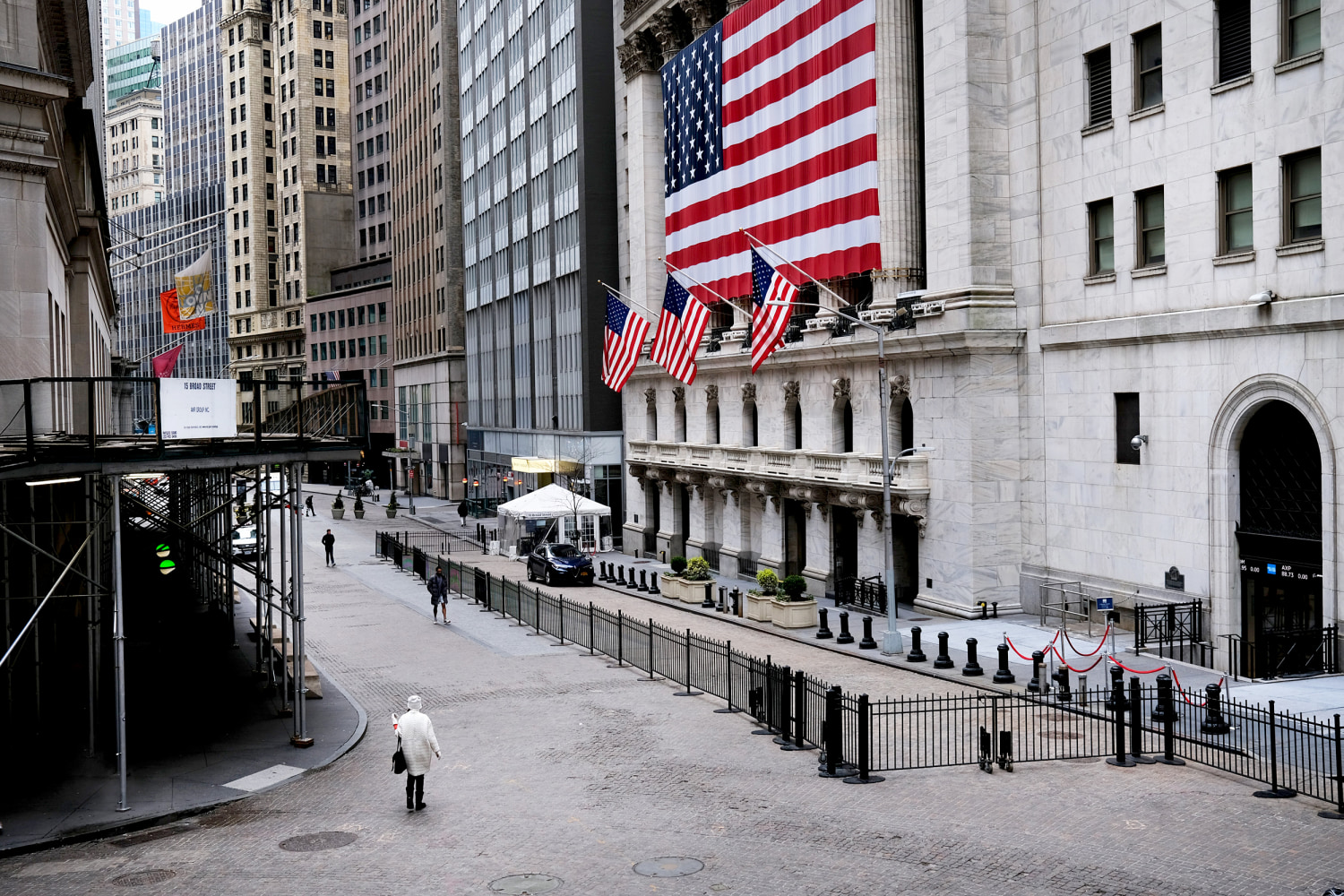
Wall Street Slides as Tech Stocks Retreat and Treasury Yields Surge- U.S. stock markets ended sharply lower on Friday as investors pulled back from major technology shares and growing Treasury yields added pressure to equities. Market sentiment also weakened after a closely watched summit between President Donald Trump and Chinese President Xi Jinping concluded without any major policy breakthroughs, leaving traders disappointed.
The broad sell-off pushed all three major U.S. indexes into negative territory. The S&P 500 dropped 0.9%, while the tech-heavy Nasdaq Composite declined 1.3%. The Dow Jones Industrial Average also fell significantly, losing more than 400 points during the session.
Technology companies, which had driven much of the market’s recent rally, were among the hardest hit as investors locked in profits after weeks of strong gains linked to enthusiasm around artificial intelligence and semiconductor demand.
Shares of Intel dropped 6%, while Advanced Micro Devices (AMD) fell roughly 3%. Micron Technology lost nearly 5%, and AI giant Nvidia declined around 3%. Meanwhile, Cerebras Systems, which had surged dramatically during its Nasdaq debut a day earlier, gave back some of those gains and slid 5%.
Market analysts suggested the decline reflected concerns that the rapid rise in technology shares had become difficult to sustain. Investors who had benefited from the sector’s powerful rally appeared eager to secure profits amid rising economic uncertainty and concerns over interest rates.
One exception in the technology sector was Microsoft. The company’s stock climbed roughly 3% after billionaire investor Bill Ackman revealed that his hedge fund, Pershing Square, had established a position in the software giant. The announcement boosted investor confidence and helped Microsoft outperform the broader market.
Another major factor weighing on Wall Street was the sharp increase in U.S. Treasury yields. The yield on the 30-year Treasury bond climbed above 5.1%, reaching its highest level since 2025. Rising bond yields typically create pressure for stocks, especially high-growth technology companies, because they increase borrowing costs and reduce the appeal of future earnings.
Investor concerns about inflation also intensified throughout the week. Several economic reports pointed to renewed price pressures, while ongoing tensions in the Middle East continued to push oil prices higher. Rising energy costs have fueled fears that inflation could remain elevated for longer than expected, potentially forcing the Federal Reserve to maintain tighter monetary policy.
Oil prices continued their upward momentum on Friday. U.S. crude futures rose around 3%, climbing above $104 per barrel, while Brent crude, the global benchmark, also gained about 3% to trade near $109 per barrel.
The increase followed comments from Trump regarding Iran and the ongoing geopolitical tensions in the region. During an interview with Fox News, Trump stated that he was “not going to be much more patient” with Iran and emphasized that Tehran “should make a deal.” Investors interpreted the remarks as a sign that geopolitical risks in the energy market may remain elevated in the near term.
Meanwhile, traders were left underwhelmed by the outcome of the Trump-Xi summit. While both leaders reportedly agreed that the Strait of Hormuz should remain open to ensure stable global energy flows, investors had hoped for broader economic agreements or progress on trade-related issues between the world’s two largest economies.
Among the few announcements emerging from the summit was news involving Boeing. Trump stated that China had agreed to purchase 200 Boeing aircraft. However, the market reaction was muted because the figure represented only a modest increase from previous expectations. Boeing shares extended their recent decline, falling another 2% after dropping nearly 5% in the prior session.
The market downturn came just one day after U.S. indexes reached fresh milestones. On Thursday, the Dow Jones Industrial Average reclaimed the 50,000 mark, while the S&P 500 closed above 7,500 for the first time in history.
Despite the recent weakness, investor sentiment around artificial intelligence and technology remains broadly optimistic. However, some analysts are beginning to warn that the market rally has become increasingly narrow, with gains heavily concentrated in a handful of large technology companies.
Portfolio managers say the broader market has not kept pace with the explosive rise of mega-cap tech stocks, creating concerns about the durability of the rally. Investors are closely watching whether leadership will expand into other sectors or whether continued dependence on a small group of companies could leave markets vulnerable to sharper corrections.
As Wall Street heads into the coming weeks, traders are expected to remain focused on inflation data, Federal Reserve policy signals, Treasury yields, and geopolitical developments that could influence both energy prices and global investor confidence. NVIDIA Could Be About to Reclaim Billions From China | Maya

:max_bytes(150000):strip_icc()/stock-market-169975453-0cb2eb62ac80438395b9bc6cd10c7235.jpg "What Caused Black Monday? Why Black Monday Was the Day Wall Street Almost Collapsed!")