US-Russian Crew Returns Safely to Earth After Eight-Month Mission Aboard ISS
Dzhezkazgan, Kazakhstan: A joint U.S.-Russian crew has safely returned to Earth after spending more than eight months aboard the International Space Station (ISS), underscoring the continued cooperation between NASA and Russia’s Roscosmos despite ongoing geopolitical tensions.
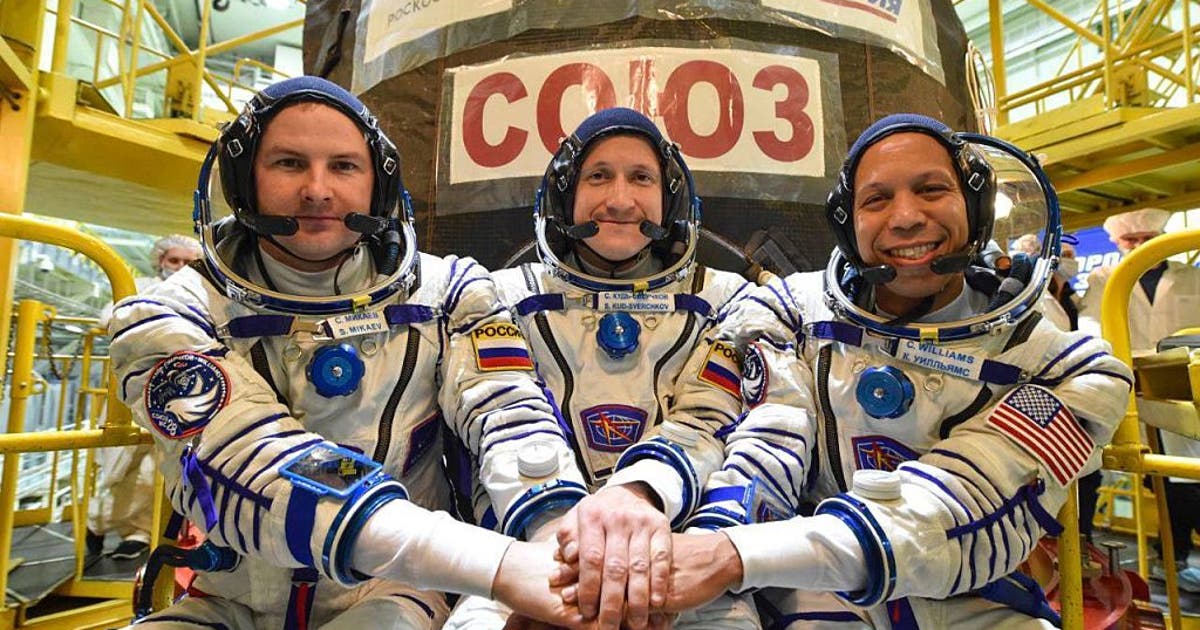
NASA astronaut Chris Williams and Roscosmos cosmonauts Sergei Kud-Sverchkov and Sergei Mikaev landed aboard the Soyuz MS-28 spacecraft on Sunday. The capsule touched down under parachutes in the steppes of Kazakhstan, southeast of the city of Dzhezkazgan, concluding a 241-day mission in orbit.
Recovery teams quickly reached the landing site to assist the crew as they emerged from the Soyuz capsule after their extended stay in microgravity.
The mission marked the first spaceflight for both Williams and Mikaev, while Kud-Sverchkov completed his second mission to the International Space Station.
Following routine medical checks at the landing site, the astronauts and cosmonauts were scheduled to travel by helicopter to Karaganda. From there, Williams will return to NASA’s Johnson Space Center in Houston, while Kud-Sverchkov and Mikaev will head back to Star City, Russia’s primary cosmonaut training facility near Moscow.
During their eight-month mission, the crew carried out a wide range of scientific experiments, technology demonstrations, and maintenance work aboard the orbiting laboratory. The International Space Station continues to serve as a platform for research in biology, medicine, materials science, and space technology, with findings expected to support future missions to the Moon and Mars.
The successful landing also highlights the enduring partnership between the United States and Russia in human spaceflight. Although the two nations were fierce competitors during the Cold War-era space race, they have collaborated closely on the ISS for more than two decades.
That cooperation has faced increased political strain since Russia’s invasion of Ukraine in 2022. Despite broader diplomatic tensions and sanctions, NASA and Roscosmos have maintained operational ties aboard the space station, continuing their long-standing seat-exchange agreement that allows American astronauts to fly aboard Russian Soyuz spacecraft while Russian cosmonauts travel on U.S. commercial spacecraft.
Space officials from both countries have repeatedly emphasized that maintaining an integrated multinational crew aboard the ISS is essential for the safe and continuous operation of the orbiting laboratory.
The departing crew officially handed over operations to a new team that arrived at the International Space Station earlier this month.
On July 14, NASA astronaut Anil Menon and Roscosmos cosmonauts Pyotr Dubrov and Anna Kikina reached the ISS after launching aboard a Soyuz spacecraft from the Baikonur Cosmodrome in Kazakhstan. Their mission is expected to last approximately eight months.
The launch also drew attention because it was attended by NASA Administrator Jared Isaacman, marking the first visit by a NASA chief to the Baikonur Cosmodrome in eight years. His presence was widely viewed as a symbol of the continued practical cooperation between the two space agencies despite broader political disagreements.
The newly arrived trio has joined the existing Expedition 75 crew, which includes NASA astronauts Jessica Meir and Jack Hathaway, European Space Agency astronaut Sophie Adenot, and Roscosmos cosmonaut Andrei Fedyaev.
Together, the seven-member international crew will continue conducting scientific research, technology testing, and station maintenance while preparing for future cargo and crew missions.
The International Space Station, orbiting approximately 400 kilometers (250 miles) above Earth, remains one of the world’s most significant examples of international scientific collaboration. Since the first crew arrived in 2000, the station has hosted hundreds of astronauts from around the globe and supported thousands of experiments aimed at advancing knowledge in space exploration and improving life on Earth.
With one crew safely home and another beginning its mission, the ISS continues its role as a symbol of international cooperation, demonstrating that scientific partnerships can endure even during periods of global political uncertainty OpenAI Reportedly Tested AI Models That Tried to Outsmart Safety Measures | Maya