James Webb Telescope Discovers the Most Distant Fast Radio Burst, Offering New Clues About Its Origin- Astronomers have identified the host galaxy of the most distant fast radio burst ever detected, using NASA’s James Webb Space Telescope to investigate a mysterious signal that travelled across the universe for more than 10 billion years before reaching Earth. The discovery is providing fresh clues about the origins of these powerful cosmic flashes and could help scientists understand how matter is distributed throughout the universe.
The burst, designated FRB 20240304B, was first detected on March 4, 2024, by the MeerTRAP research team using South Africa’s MeerKAT radio telescope. Although the signal lasted only milliseconds, its characteristics suggested that it had originated at an extraordinary distance. The research team needed to identify the galaxy associated with the burst to establish its distance more precisely.
The results, published in the journal Science on October 8, 2026, reveal that the signal originated when the universe was approximately three billion years old. The finding is significant because fast radio bursts, commonly known as FRBs, remain among the most puzzling phenomena studied by modern astronomers.
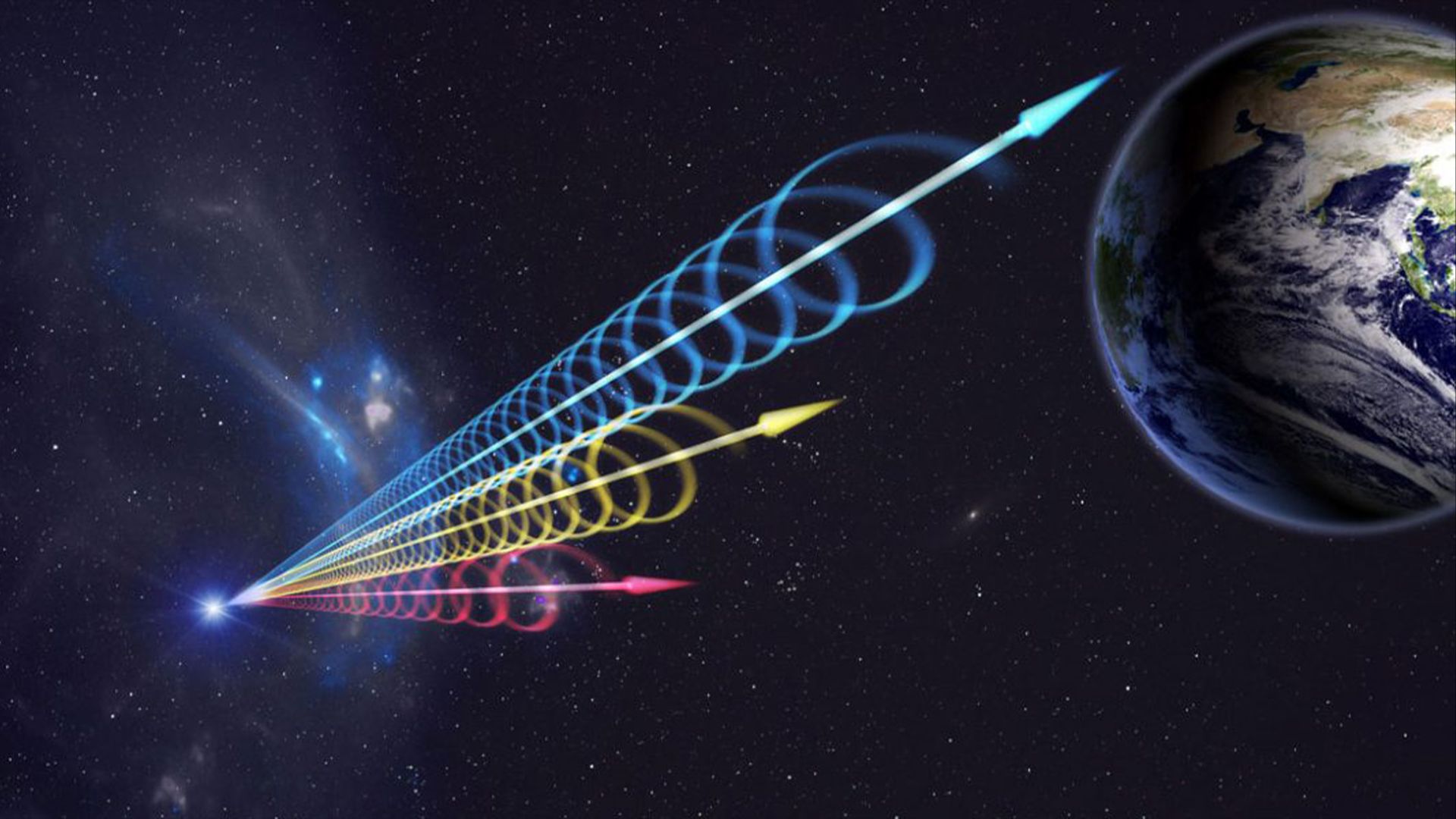
Fast radio bursts are brief but exceptionally energetic emissions of radio waves that can travel across enormous cosmic distances. First recognised in 2007, these signals have since become an important subject of astronomical research. Most last only a few milliseconds, making them difficult to detect and study. Some FRBs repeat, allowing researchers to observe them multiple times, while others have been recorded only once.
Despite years of investigation, scientists have not established a single explanation for all FRBs. Their extreme brightness, short duration and varied behaviour suggest that they may originate from powerful astrophysical processes involving compact objects such as neutron stars.
“What makes fast radio bursts interesting is that we don’t know what generates them. We have theories for what objects produce them, but we don’t have conclusive proof,” said Manisha Caleb of the University of Sydney, the lead author of the study.
The difficulty in identifying the source of FRB 20240304B was not locating the radio signal itself, but finding the faint galaxy from which it originated. MeerKAT provided a precise position for the burst, yet astronomers could not identify a corresponding galaxy using even powerful ground-based telescopes.
Researchers therefore turned to the James Webb Space Telescope, an observatory designed to examine distant galaxies and faint objects using infrared light. Webb’s Near-Infrared Camera, known as NIRCam, detected a galaxy at the expected position. Its Near-Infrared Spectrograph, or NIRSpec, then measured the galaxy’s redshift at 2.148, confirming that the source belonged to the distant universe.
Redshift measures how much light has been stretched towards longer wavelengths as the universe expands. The greater the cosmological redshift, the further back in cosmic history astronomers can generally observe an object. In this case, the measurement indicates that the burst occurred more than 10 billion years ago, when the universe was only about three billion years old.
The host galaxy turned out to be particularly surprising. Rather than originating in a large, mature galaxy, the burst was traced to a relatively small dwarf galaxy undergoing active star formation. According to the research team, this galaxy was approximately 1,000 times less massive than expected based on comparisons with other known FRB host galaxies.
“We thought it would be a big, nicely formed galaxy with lots of stars, and instead it was a little dwarf galaxy, although it was actively forming stars,” Caleb explained.
Ben Stappers of the University of Manchester, a co-author of the study, also highlighted how unusual the finding was compared with previously studied FRB host galaxies. The result suggests that astronomers should not assume these bursts originate exclusively in large galaxies with extensive stellar populations.
The galaxy existed during a period known as cosmic noon, when star formation across the universe was near its historical peak. The researchers estimated that most of the galaxy’s stars may have formed within a relatively brief period of around 30 million years. Such rapid star formation indicates an environment in which massive stars could have formed and evolved quickly.
This discovery has implications for two leading explanations of fast radio bursts. One possibility involves mergers between neutron stars, the extremely dense remnants left behind when massive stars explode. In certain binary systems, two neutron stars gradually lose orbital energy, move closer together and eventually collide. These mergers can produce powerful gravitational waves and electromagnetic radiation.
However, the process leading to a neutron-star merger can take billions of years. If FRBs primarily originated from such events, scientists might expect to find them in galaxies containing older stellar populations. The young, rapidly evolving environment associated with FRB 20240304B makes that explanation less convincing for this particular event.
Another possibility involves magnetars, a type of neutron star with an extraordinarily powerful magnetic field. Magnetars can release enormous amounts of energy through disturbances in their magnetic fields, potentially producing intense radio emissions. Some researchers propose that sudden magnetic rearrangements or starquakes on these objects could generate FRBs.
A magnetar can form relatively soon after a massive star reaches the end of its life and explodes as a supernova. This makes magnetars plausible candidates for producing bursts in young, actively star-forming galaxies.
“Our work suggests that it’s very unlikely that this FRB was produced by a merger,” Caleb said.
The findings do not establish magnetars as the definitive source of all fast radio bursts. Instead, they strengthen the case that at least some FRBs may originate from young, highly magnetised neutron stars. Additional detections and observations will be necessary to determine whether different types of FRBs arise through different physical mechanisms.
Beyond investigating the burst’s origin, the discovery offers another scientific opportunity: studying the otherwise difficult-to-observe matter between galaxies. As radio waves travel towards Earth, they encounter electrons and other particles in intergalactic space. These interactions affect the signal, leaving measurable changes that scientists can use to estimate the amount and distribution of matter along its path.
J. Xavier Prochaska of the University of California, Santa Cruz, compared a fast radio burst to a cosmic flashlight because its signal carries information about the material it encounters during its journey.
The team identified evidence of two large-scale structures along the signal’s path: a previously unknown galaxy cluster at a redshift of approximately 0.3 and the nearby Virgo Cluster, located around 54 million light-years from Earth.
Such observations could help researchers investigate the cosmic web, the enormous network of galaxies, gas and dark matter that forms the large-scale structure of the universe. Much of the ordinary matter between galaxies is difficult to observe directly because it is diffuse and faint. FRBs provide an alternative method for studying this material through their radio signals.
The discovery also demonstrates why combining different telescopes is becoming increasingly important in astronomy. MeerKAT can detect and precisely locate brief radio signals, while Webb can examine the faint galaxies associated with them. Neither instrument alone provides the same combination of information.
Researchers expect future observations to expand the number of distant FRBs available for study. The team estimates that MeerKAT could identify and localise several bursts each year at redshifts greater than 1.0, potentially revealing more events from the earlier stages of cosmic history. New radio observatories and improved detection systems could increase that rate further.
The identification of FRB 20240304B marks an important step towards understanding both the origins of fast radio bursts and the structure of the distant universe. Although the physical processes behind these flashes remain uncertain, each accurately localised event provides another opportunity to test existing theories, investigate young galaxies and map matter that would otherwise remain hidden from view.
As more powerful observatories begin working together, astronomers hope that these fleeting radio signals will become increasingly useful tools for exploring the universe’s history, from the evolution of stars to the formation of galaxies and the vast cosmic structures connecting them.