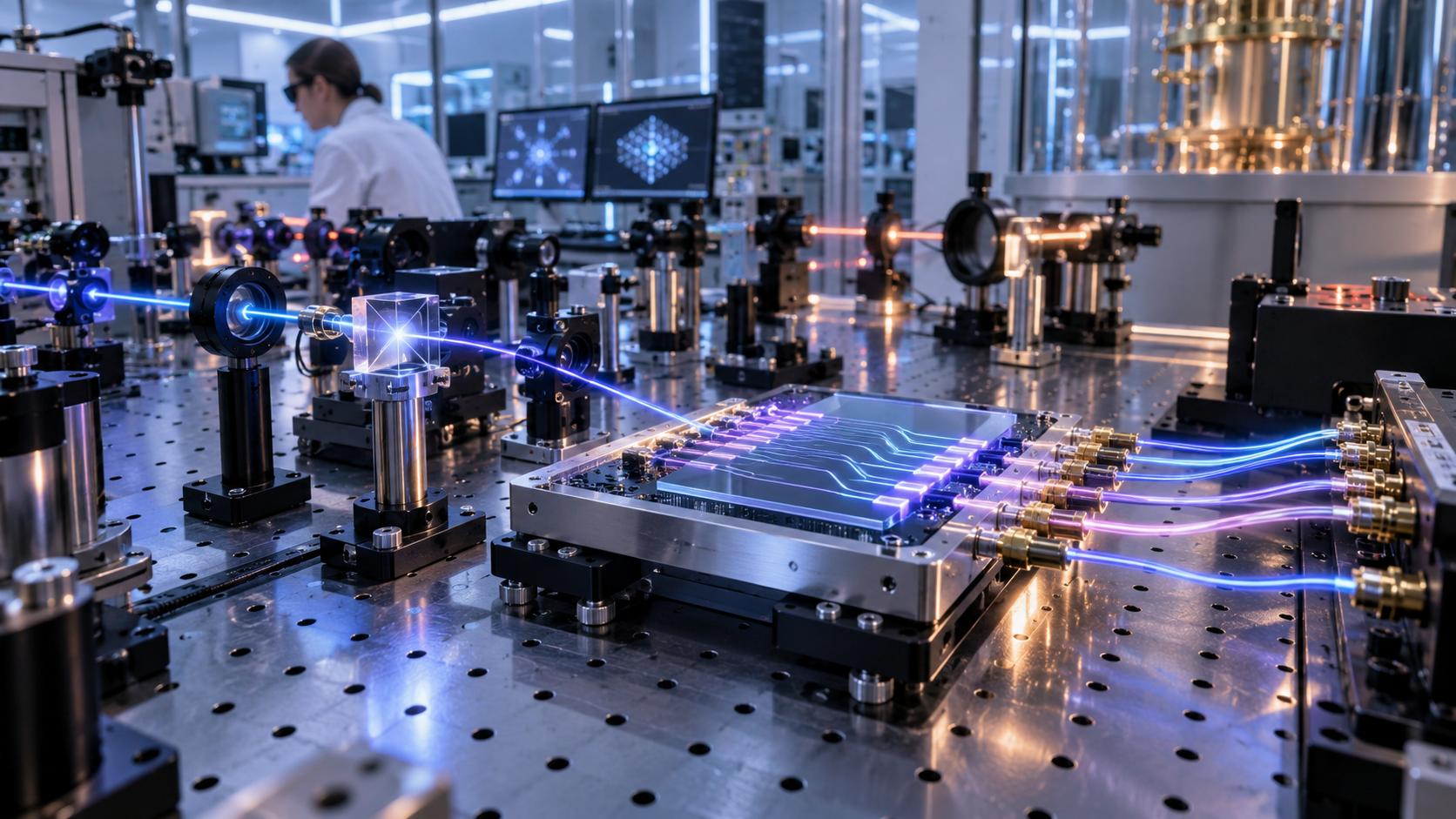
Could Photonic Quantum Chips Make Future Quantum Computers Faster and More Energy-Efficient? What if future quantum computers could process information using individual particles of light, operate at room temperature, and consume significantly less energy than today’s experimental quantum systems? Could this technology help overcome some of the biggest limitations preventing quantum computers from becoming practical?
Engineers at Purdue University are working toward making that possibility a reality by developing new technologies for quantum photonic integrated circuits. Their research addresses several major challenges involving the generation, control, and stability of individual photons, potentially bringing scalable photonic quantum computers closer to reality.
Quantum computers have attracted considerable attention because of their ability to solve certain complex problems that would be extremely difficult for conventional computers. However, building machines capable of performing useful calculations remains a major engineering challenge.
Purdue researchers believe that using photons, the fundamental particles of light, as quantum bits could offer a promising alternative to existing approaches.
But why are photons considered so important, and what is preventing scientists from building large-scale quantum photonic chips?
Why Could Photons Make Quantum Computers More Powerful?
Conventional computers process information using bits, which represent either zero or one. Quantum computers use quantum bits, commonly called qubits, which can exist in a combination of zero and one states through a phenomenon known as superposition.
This property allows quantum systems to perform certain types of calculations in fundamentally different ways from classical computers.
However, not all qubits are built using the same physical systems. Researchers are investigating several possibilities, including superconducting circuits, trapped ions, and photons.
Photons offer some particularly attractive advantages.
Because they are particles of light, photons can travel through optical circuits at extremely high speeds. They are also relatively resistant to environmental disturbances, making them promising candidates for quantum information processing.
Another major advantage is their potential to operate at room temperature. Many competing quantum technologies require extremely low temperatures to maintain stable quantum states, demanding sophisticated cooling equipment and additional energy.
Could photon-based quantum computers avoid some of these complications?
Potentially, yes. However, building reliable chips capable of generating and controlling individual photons remains a significant obstacle.
What Is Preventing Scientists From Building Large-Scale Photonic Quantum Chips?
Quantum photonic integrated circuits are specialized chips designed to generate, manipulate, and process photons for quantum computing applications.
Although researchers have demonstrated systems capable of working with relatively small numbers of qubits, practical quantum computing will require hundreds or potentially thousands of reliable qubits.
Achieving that scale is difficult because photons do not naturally interact with one another very strongly. Scientists must also develop reliable sources that generate individual photons consistently and technologies that prevent errors during quantum operations.
Vladimir Shalaev, Bob and Anne Burnett Distinguished Professor of Electrical and Computer Engineering at Purdue, identifies the development of dependable single-photon sources as one of the biggest challenges facing the field.
Working alongside Alexandra Boltasseva, Ron and Dotty Garvin Tonjes Distinguished Professor of Electrical and Computer Engineering, Shalaev is investigating ways to overcome these limitations.
Their research focuses on improving three critical areas: single-photon generation, photon switching, and quantum decoherence.
Can Scientists Generate Exactly One Photon at a Time?
One of the most important requirements for photonic quantum computing is the ability to produce individual photons reliably.
Traditional approaches, including spontaneous parametric down-conversion, can generate photon pairs, but producing single photons on demand with high efficiency and consistency remains challenging.
Purdue researchers have been exploring an alternative method using silicon nitride, a material widely used in photonic integrated circuits.
In a study published in Science Advances in 2021, Shalaev, Boltasseva, and their colleagues demonstrated a technique that uses specially engineered atomic defects within silicon nitride to generate individual photons.
How does the process work?
The researchers introduce carefully designed imperfections into the material’s atomic structure. These defects create locations where light emission can be restricted to individual photons.
When a laser beam illuminates the platform, these engineered locations can emit one photon at a time, including at room temperature.
An important advantage is that the technique allows photon emission from multiple locations across the same silicon nitride platform.
But generating photons is only part of the challenge. Scientists must also control where these sources are positioned to manufacture consistent and scalable quantum chips.
In subsequent research presented at the 2022 Conference on Lasers and Electro-Optics, the team demonstrated that the placement and number of defects could be controlled by incorporating them into nanoscale pillars.
This approach could make photon sources more uniform and improve the prospects of manufacturing larger quantum photonic circuits.
How Could a Single Photon Control a Quantum Circuit?
Another major challenge is controlling photons after they have been generated.
In conventional computers, transistors act as switches that control electrical signals and process information. Quantum photonic circuits require similar switching technologies capable of operating at the single-photon level.
However, photons rarely interact directly with one another, making it difficult to develop conventional optical switching mechanisms for quantum applications.
Purdue researchers have addressed this problem by developing a proof-of-concept switch designed to operate using individual photons.
Their research, reported in Nature Nanotechnology, adapts a phenomenon known as optical nonlinearity.
Normally, optical nonlinearities allow one light beam to influence how another light beam travels through a material. However, conventional approaches generally require relatively powerful control beams, making them unsuitable for applications involving individual photons.
The Purdue approach uses silicon to overcome this limitation.
When a single photon from the control beam interacts with the silicon device, it can generate an electron. That electron triggers an avalanche process, producing additional electrons and changing the material’s optical properties.
This changes the silicon’s refractive index, which determines how light travels through the material.
As a result, the device can control whether a separate probe beam passes through, effectively allowing a single photon to switch the optical signal on or off.
Could this technology eventually provide the switching capabilities required for large photonic quantum processors? It represents an important experimental step toward that goal.
Can Artificial Intelligence Predict Quantum Errors Before They Happen?
Even if researchers solve the problems of generating and switching individual photons, another major challenge remains: quantum decoherence.
Quantum computers depend on delicate properties such as superposition and entanglement. However, interactions with the surrounding environment can disturb these states, introducing errors into quantum calculations.
This process is known as decoherence.
Although photons are relatively resistant to environmental disturbances, they are not completely immune to them.
Purdue researchers have now demonstrated an approach that uses statistical physics and machine learning to identify patterns in quantum decoherence and predict how certain disturbances may develop.
The research was led by Purdue electrical and computer engineering professor Alexander Kildishev and graduate student Pranshu Maan, with Shalaev and Boltasseva among the collaborators. The findings were published in Nature Communications in May of the reported research year.
According to Boltasseva, decoherence may appear random, but its behavior can contain recognizable patterns that machine learning systems can identify.
The researchers investigated a phenomenon called spectral diffusion, in which the frequency of an emitted photon changes over time because of fluctuations in its surrounding environment.
Why is this a problem?
For many photonic quantum computing applications, photons must remain indistinguishable in important properties, including their frequency. If their energy levels shift, maintaining the required quantum interference and synchronization becomes more difficult.
The researchers discovered that these frequency changes contain information about how the photon has behaved previously.
They used this observation to develop a machine-learning algorithm with a memory mechanism that analyzes past frequency fluctuations and predicts future changes.
By anticipating spectral shifts, the system can potentially enable corrective control before disturbances significantly affect the quantum state.
In their experiments, the researchers demonstrated that this predictive approach could reduce spectral shifts by as much as 20 times in the quantum systems they studied.
Could Predicting Decoherence Reduce the Number of Qubits Needed?
One of the most interesting implications of this research is its potential impact on quantum error correction.
Quantum computers often require additional physical qubits to compensate for errors caused by environmental disturbances.
For example, a system designed to perform calculations using a relatively small number of logical qubits may need many more physical qubits to maintain reliable operations.
If researchers can reduce the frequency of quantum errors, they may also reduce the hardware overhead required for error correction.
Shalaev has emphasized that decoherence cannot be completely eliminated because fluctuations are an unavoidable part of nature. However, recognizing its patterns and controlling its effects could make quantum systems significantly more stable.
Could this eventually make large-scale quantum computers easier to build? That remains an important possibility for future research.
What Happens Next for Purdue’s Quantum Computing Research?
The Purdue team plans to investigate how statistical physics can reveal hidden characteristics of fluctuating quantum environments.
Researchers also want to improve their machine-learning models so they can identify the physical processes responsible for spectral changes and predict disturbances more accurately.
Another long-term objective is combining predictive models with active control systems to keep different photon emitters synchronized and their optical properties more closely aligned.
Such capabilities could become essential for developing scalable quantum photonic architectures containing hundreds or thousands of qubits.
Although considerable engineering challenges remain, Purdue’s research demonstrates progress across several critical areas of photonic quantum computing.
From creating more reliable single-photon sources to developing switches and predicting quantum errors with machine learning, the researchers are addressing problems that have limited the development of large-scale photonic systems.
Could photons eventually become the foundation of faster, more energy-efficient quantum computers?
There is still no guarantee that photonic systems will outperform every competing quantum architecture. However, by combining advances in nanotechnology, optical engineering, and artificial intelligence, Purdue researchers are helping move the technology closer to practical applications.
The next major breakthrough may not simply involve making quantum computers more powerful, but making their delicate quantum operations reliable enough to work at a much larger scale. Astronomers Discover a ‘Disappearing Planet’ 1,000 Light-Years Away as Its Orbit Dramatically Shifts | Maya