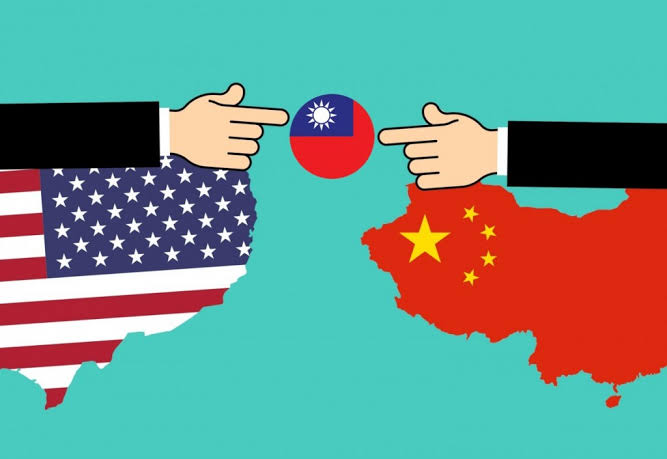
Taiwan Caught in the Middle of a Dangerous US-China Power Game: Taiwan is once again emerging as one of the most dangerous flashpoints in global politics. As competition between the United States and China intensifies across trade, technology, military power, and diplomacy, the island has become a symbol of the growing struggle between the world’s two strongest nations.
For decades, Taiwan has occupied a politically sensitive position. China considers the island part of its territory and has repeatedly promised that reunification will eventually happen, with force if necessary. Taiwan, however, functions independently with its own democratic government, military, economy, and elections. Most people living there increasingly see Taiwan as separate from mainland China, creating a widening political divide between Taipei and Beijing.
The United States has long played a complicated role in this situation. Washington officially follows the “One China” policy, which acknowledges Beijing’s position that Taiwan is part of China. However, the US has never formally accepted Chinese sovereignty over the island. Instead, America maintains close unofficial ties with Taiwan and remains its most powerful international supporter.
This carefully balanced arrangement has prevented major conflict for many years. But rising tensions between Washington and Beijing are now placing enormous pressure on that fragile system.
Concerns have recently grown over how President Donald Trump could manage relations with Chinese President Xi Jinping if geopolitical tensions continue to escalate. Several analysts and former US officials fear that Trump’s deal-oriented approach to foreign policy could create uncertainty around America’s long-standing commitment to Taiwan.
These worries have become more intense as speculation grows that Trump may seek Beijing’s cooperation in resolving broader international crises, including the ongoing conflict involving Iran. Some experts question whether Taiwan could become part of wider negotiations between Washington and Beijing if larger strategic interests come into play.
Although there is no evidence that such negotiations are happening, even the possibility has triggered concern among security analysts. Taiwan’s defense strategy has depended heavily on consistent American backing. If Beijing senses hesitation or confusion in Washington’s support, it could shift the balance of power in the region.
Taiwanese officials have attempted to reassure the public by highlighting the strong bipartisan support Taiwan receives in the United States. Leaders in Taipei argue that American support for Taiwan is deeply rooted within Congress, the military, and national security institutions, regardless of which administration is in power.
Over the years, the US has approved billions of dollars in military sales to Taiwan. These include advanced fighter aircraft, missile defense systems, surveillance technology, naval equipment, and defensive weapons designed to strengthen the island’s ability to resist possible Chinese military action.
Yet America’s security policy toward Taiwan remains intentionally unclear. Washington has never openly promised that US troops would defend Taiwan if China launched an invasion. This strategy is known as “strategic ambiguity.”
The idea behind strategic ambiguity is to keep both Beijing and Taipei uncertain. China cannot be fully sure whether military action against Taiwan would trigger direct American intervention. At the same time, Taiwan is discouraged from making any formal declaration of independence that could provoke a severe response from Beijing.
For decades, this uncertain balance helped preserve peace in the Taiwan Strait. However, many experts now believe China’s growing military strength is challenging the effectiveness of that strategy.
Under Xi Jinping, China has rapidly modernized its armed forces and increased military pressure on Taiwan. Chinese fighter jets frequently enter Taiwan’s air defense zone, while warships regularly conduct exercises near the island. Large-scale military drills surrounding Taiwan have become increasingly common, especially after high-profile meetings between Taiwanese and American officials.
China has also expanded its missile systems, cyber warfare programs, and naval capabilities with the clear objective of strengthening its position in the Pacific. Many defense experts believe Beijing is preparing for the possibility of a future confrontation over Taiwan.
Xi has repeatedly stated that reunification with Taiwan is a historic mission that should not be delayed indefinitely. While Chinese officials continue to say they prefer a peaceful outcome, Beijing has never ruled out the use of force.
The growing danger lies not only in deliberate military action but also in the possibility of miscalculation. With military aircraft and naval vessels operating so closely together, even a small incident could rapidly escalate into a major crisis involving both China and the United States.
Taiwan’s significance is not limited to military concerns. The island also plays a critical role in the global economy because of its dominance in semiconductor manufacturing. Taiwan is home to Taiwan Semiconductor Manufacturing Company, widely regarded as the world’s leading producer of advanced microchips.
These chips are essential for smartphones, artificial intelligence systems, vehicles, telecommunications equipment, and military technology. A serious disruption involving Taiwan could trigger massive economic consequences across global markets and supply chains.
This has made Taiwan even more strategically important. The United States increasingly views semiconductor security as a national priority, while China is aggressively trying to reduce its dependence on foreign chip producers. As a result, Taiwan sits directly at the center of the technological rivalry shaping the future global economy.
Countries throughout Asia are closely monitoring the situation. Nations such as Japan, South Korea, Australia, and the Philippines understand that any military conflict involving Taiwan could dramatically reshape regional security.
Japan has become particularly vocal about stability in the Taiwan Strait, recognizing that conflict near Taiwan could directly threaten Japanese trade routes and national security interests. Many US allies fear that if China successfully pressured or seized Taiwan, it could weaken American influence throughout Asia and encourage more aggressive behavior elsewhere.
At the same time, many governments are trying to avoid choosing sides completely. China remains a major economic partner for much of Asia, while the United States continues to provide security guarantees across the region. This leaves many countries attempting to balance economic ties with Beijing against military cooperation with Washington.
Inside Taiwan, public opinion has shifted considerably over recent decades. Surveys increasingly show that younger generations identify more strongly as Taiwanese rather than Chinese. Most people support maintaining the island’s current status instead of immediate unification with China or an official declaration of independence.
This evolving identity presents a major challenge for Beijing. As Taiwan develops a stronger democratic and cultural identity separate from mainland China, the chances of peaceful political reunification become increasingly uncertain.
Meanwhile, ordinary Taiwanese citizens continue living under constant geopolitical pressure. Concerns about cyberattacks, military escalation, disinformation campaigns, and regional instability have become part of everyday political discussion on the island.
Taiwan today represents far more than a territorial dispute. It has become a central battleground in the broader contest between China and the United States over military influence, technological leadership, economic power, and political values.
Both Washington and Beijing publicly insist they want stability and peace. Yet rising mistrust, military expansion, and strategic rivalry are making the situation increasingly fragile.
The future of Taiwan may ultimately shape not only the balance of power in Asia, but also the direction of global politics for decades to come.