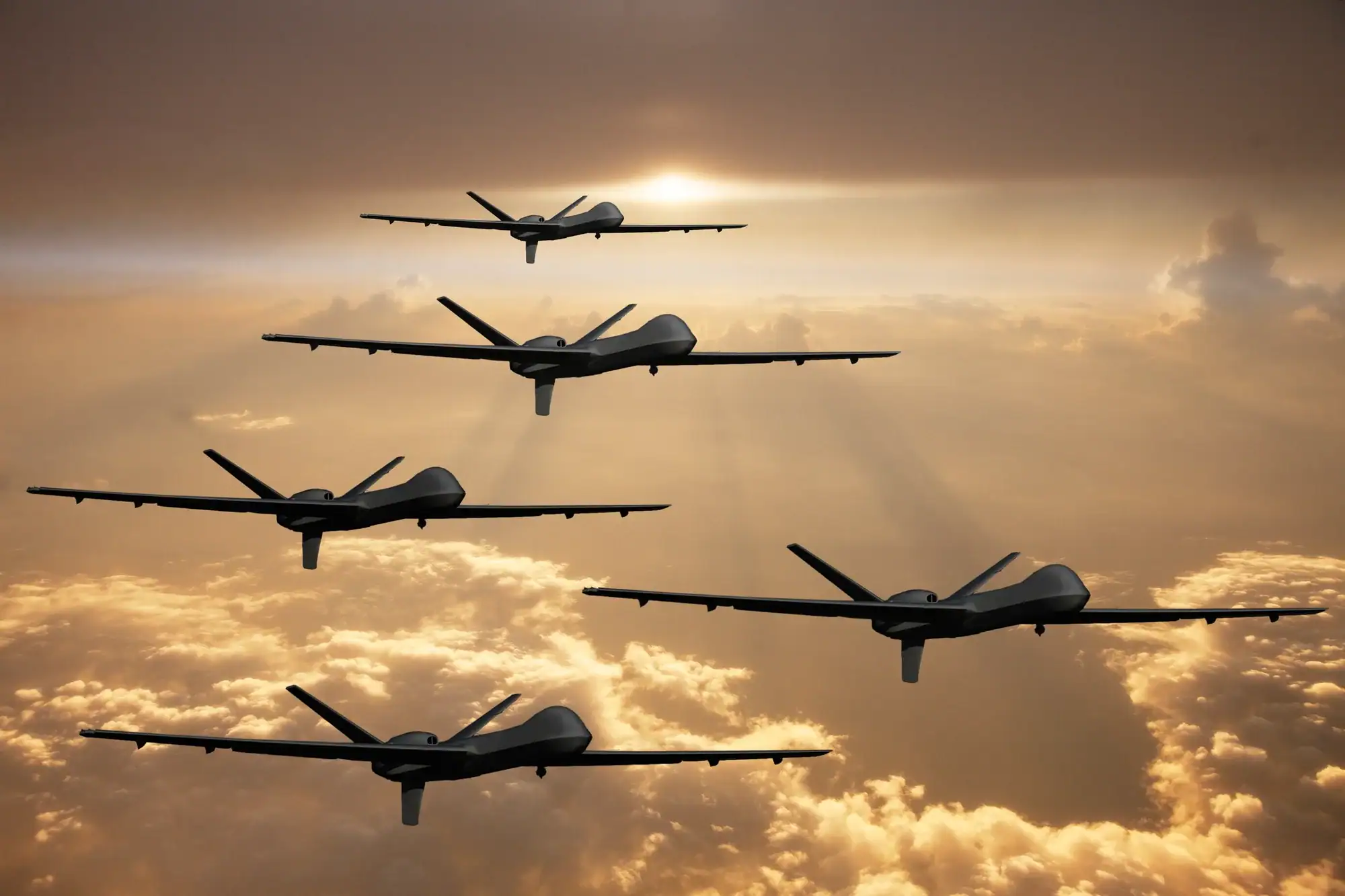
Drone Warfare in the 21st Century: How Technology is Redefining Battlefields- The 21st century has witnessed a profound transformation in warfare. Traditional battlefields dominated by tanks, fighter jets, and artillery are being overtaken by drone technology, which is reshaping military strategy and tactics. Modern conflicts increasingly rely on unmanned systems, ranging from small reconnaissance drones to long-range attack UAVs and autonomous naval drones, making warfare faster, more precise, and more unpredictable.
The ongoing Russia‑Ukraine conflict and the escalating tensions involving Iran, Israel, and the United States demonstrate how drones have become central to modern combat. These conflicts highlight the tactical advantages, strategic impact, and complex challenges of integrating unmanned systems into military operations.
From Reconnaissance to Lethal Force
Military drones initially served primarily as surveillance tools, providing real-time intelligence while keeping pilots out of harm’s way. Platforms such as early reconnaissance UAVs proved invaluable for monitoring enemy movements and adjusting battlefield strategy without risking human lives.
Over time, drones have evolved into fully offensive systems. They now carry missiles, bombs, and guided munitions capable of targeting enemy positions with precision. Swarm tactics enable groups of drones to coordinate attacks, overwhelm defenses, and execute complex missions autonomously. Modern drones also vary in size and function—from small tactical UAVs to long-endurance attack platforms and even autonomous vessels that operate at sea, all contributing to a fundamentally new kind of warfare.
Drones in the Russia‑Ukraine Conflict
The war in Ukraine has become a vivid example of how drones are reshaping modern combat. Since 2022, both Ukrainian and Russian forces have heavily deployed unmanned aerial systems (UAS), integrating them into every aspect of military operations.
Massed Drone Strikes
Russian forces have launched repeated waves of drone attacks, often numbering in the hundreds, aimed at military installations, critical infrastructure, and civilian targets. These coordinated attacks test Ukraine’s air defenses, forcing the use of expensive interceptor missiles and creating opportunities for tactical advantage.
Ukraine has responded with innovative countermeasures, including domestically developed interceptor drone swarms capable of autonomously detecting and neutralizing threats. These systems help preserve expensive missile inventories while maintaining a robust defensive posture.
Integrated Battlefield Operations
In addition to large-scale strikes, drones serve as essential tools for reconnaissance, artillery targeting, and battlefield coordination. Small tactical drones scout enemy positions and relay real-time intelligence, while larger long-range UAVs strike deep behind enemy lines. This integration demonstrates how unmanned systems have become indispensable in modern conflict scenarios.
Drones in the Iran–Israel–US Conflict
The Middle East provides another clear example of drones’ growing strategic importance. In the ongoing tensions involving Iran, Israel, and the United States, UAVs are central to offensive and defensive operations.
Iran’s Drone Strategy
Iran has deployed drones extensively, including long-range attack UAVs capable of striking bases, military infrastructure, and regional targets. These drones allow Iran to exert pressure without expending more costly missile resources, demonstrating how inexpensive unmanned systems can deliver disproportionate strategic effects.
Responses from Israel and the United States
In response, the U.S. and Israel have developed low-cost attack drones modeled after some Iranian designs, enabling rapid deployment against similar threats. Additionally, unmanned naval vessels are now deployed in the Gulf region to conduct surveillance and strikes, expanding drone operations to maritime environments and further diversifying the modern battlefield.
Technological Trends Driving Drone Warfare
Several key trends are accelerating the impact of drones in modern warfare:
1. Mass Production and Cost Efficiency
Modern drones can be produced quickly and affordably, allowing forces to deploy large numbers without significant resource strain. This economic advantage enables militaries to saturate enemy defenses and create tactical leverage even against technically superior opponents.
2. AI and Autonomous Operations
Artificial intelligence enhances drone effectiveness by enabling autonomous navigation, threat detection, and mission adaptation. AI-powered swarms can operate collaboratively, responding in real time to dynamic battlefield conditions with minimal human intervention.
3. Multi-Domain Integration
Drones are increasingly integrated across air, land, and maritime domains. From small reconnaissance UAVs to autonomous naval vessels, unmanned systems now operate alongside traditional forces, creating a unified network of intelligence, surveillance, and strike capabilities.
Strategic and Ethical Challenges
While drones provide clear tactical advantages, they also raise complex strategic and ethical challenges:
- Escalation Risk: Rapid drone strikes can escalate conflicts quickly, especially when attribution is unclear. Misidentification or miscalculation could lead to broader confrontation.
- Civilian Risk: Operating drones in populated areas carries significant risks to civilians and essential infrastructure, necessitating careful targeting and accountability.
- Defense Costs: Countering massed drone attacks requires layered defenses, which can be expensive and technologically challenging, particularly when facing large numbers of low-cost UAVs.
The Future of Drone Warfare
Drone technology has fundamentally changed how modern wars are fought. From Ukraine to the Middle East, unmanned systems now play a pivotal role in reconnaissance, strike operations, and multi-domain coordination. The battlefield is increasingly defined not by the size of armies or the firepower of tanks, but by the ability to deploy scalable, intelligent, and adaptable unmanned systems effectively.
As drones become more autonomous, networked, and widespread, they will continue to dominate military planning and operational strategy. Warfare in the 21st century is no longer just about traditional kinetic force—it is about mastering the digital, aerial, and autonomous dimensions of combat.