Released on Thursday, November 12, 2026, the collection contains approximately 13 months of observations and an extraordinary 1.7 petabytes of information, equivalent to around 1.7 million gigabytes. The telescope has surveyed an area of the sky approximately 9,500 times larger than the apparent size of the Moon when viewed from Earth.
The mission has a much bigger objective than simply photographing distant galaxies. Scientists want to understand how the universe developed, how its enormous structures formed and what drives its continuing expansion. In particular, Euclid is expected to provide valuable evidence about two mysterious components that dominate the universe’s composition: dark matter and dark energy.
Although these invisible components cannot be directly observed, scientists believe they account for approximately 95% of everything in the universe. Understanding their behaviour could help answer some of the most fundamental questions about the origin, evolution and future of the cosmos.
Astrophysicist Valeria Pettorino, the European Space Agency’s Euclid project scientist, described the latest publication as a major milestone for the mission and the international scientific teams involved.
Previous releases from Euclid contained observations covering only a few days. The newly published collection is substantially larger, incorporating more than a year of observations and providing researchers with an opportunity to investigate cosmic structures on an unprecedented scale.
The ultimate ambition is to produce a three-dimensional atlas covering more than one-third of the sky by 2031.
Euclid is designed to do something more ambitious than capture distant galaxies: it will determine their positions in space and establish how their distribution has changed over billions of years.
Mapping the universe across space and time
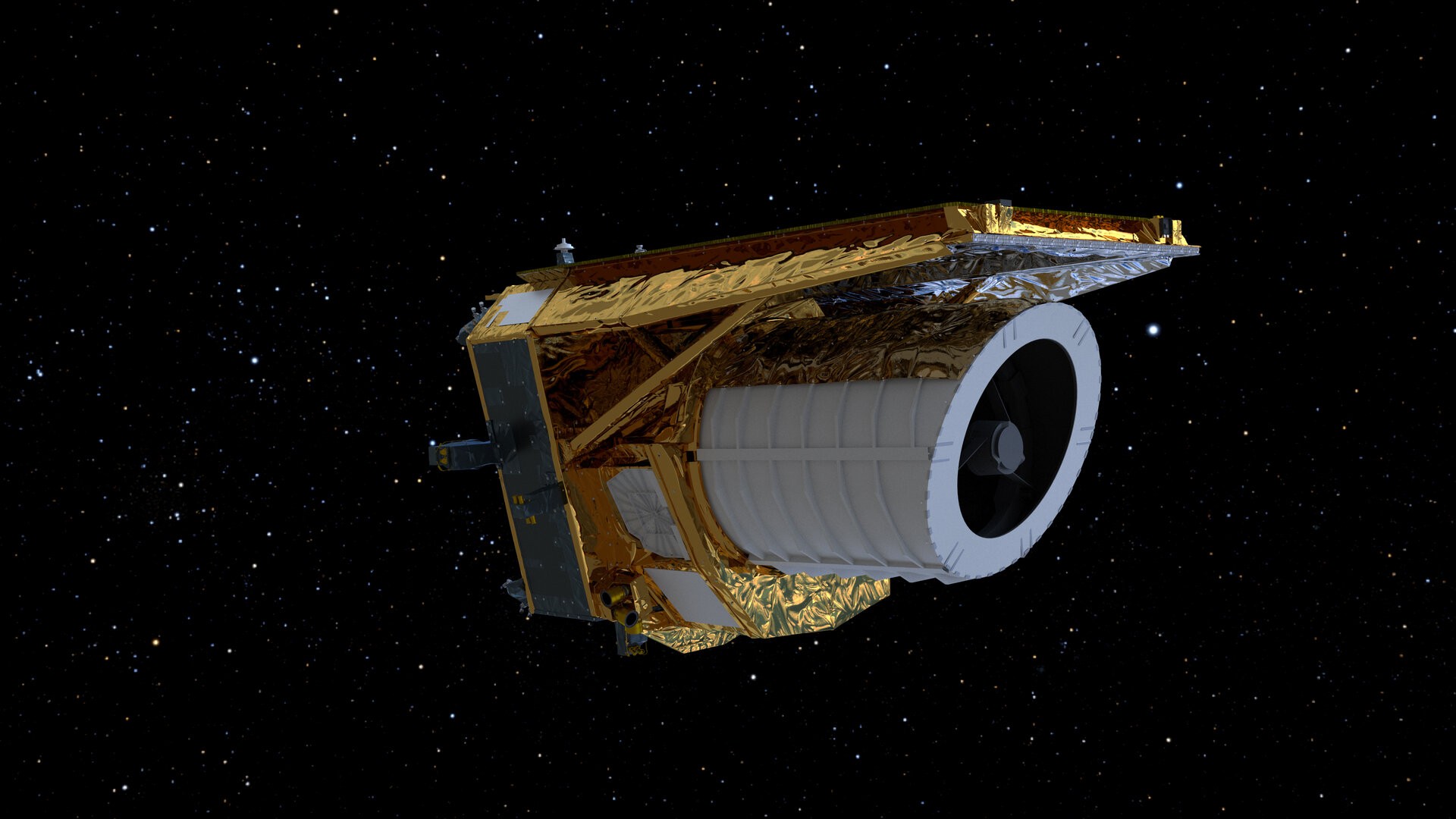
Launched from Florida in July 2023, the Euclid spacecraft was developed to investigate the large-scale structure of the universe and the forces responsible for its expansion.
Traditional astronomical images show celestial objects as they appear from Earth’s perspective. However, understanding the evolution of the universe requires more than knowing where galaxies are located in the sky.
Euclid combines detailed observations with measurements that help scientists estimate the distances of galaxies. This allows researchers to construct a three-dimensional picture of the cosmos rather than relying entirely on flat, two-dimensional images.
The distinction is important because looking farther into space also means looking further back in time. Light takes time to travel across enormous cosmic distances, meaning astronomers observe distant galaxies as they existed millions or billions of years ago.
By studying galaxies at different distances, Euclid can help scientists reconstruct how the universe developed over approximately 10 billion years of cosmic history.
Pettorino explained that galaxies are not distributed randomly throughout space. Instead, they gather along enormous filaments, forming clusters and interconnected structures separated by vast regions containing relatively little matter.
Scientists call this enormous interconnected arrangement the cosmic web.
Euclid will examine the distribution of galaxies within this network, including the number of galaxy clusters, the size of empty regions and the way these structures have changed over time.
These measurements are particularly important because the development of the cosmic web is influenced by the properties of dark matter and dark energy. Understanding its evolution could therefore provide scientists with new ways to investigate both mysterious components.
What are dark matter and dark energy?
One of the biggest surprises in modern astronomy is that ordinary matter, which includes everything humans can directly observe, represents only a small portion of the universe.
According to the standard cosmological model, the universe’s composition can be divided into three principal categories.
Ordinary matter accounts for approximately 5% of the universe. It includes stars, planets, galaxies, gas, dust and everything found on Earth.
Dark matter represents roughly 27%. It is an invisible form of matter that does not emit or absorb light but exerts gravitational influence. Scientists believe it plays a crucial role in holding galaxies together and shaping large cosmic structures.
Dark energy makes up approximately 68%. It is associated with the accelerated expansion of the universe, although its actual physical nature remains unknown.
Dark matter and dark energy are two different scientific concepts, even though both remain poorly understood.
Evidence for dark matter comes from observations of galaxies and galaxy clusters. Scientists have discovered that the gravitational behaviour of these systems cannot be adequately explained by the visible matter alone.
For example, stars in the outer regions of galaxies often move faster than expected based on the gravitational influence of the stars and gas that astronomers can observe. The presence of additional invisible mass provides a possible explanation.
Dark energy became a major subject of scientific investigation after astronomers discovered in the late 1990s that the universe’s expansion was accelerating.
Before that discovery, many scientists expected gravity to gradually slow the expansion of the cosmos. Instead, observations indicated that the expansion was speeding up.
Researchers introduced dark energy as a possible explanation for this unexpected behaviour.
Euclid’s observations could help determine whether dark matter and dark energy behave according to existing scientific theories or whether our understanding of the universe needs to change.
Gravitational lensing provides clues about invisible matter
One of the most important techniques being used by Euclid to investigate dark matter is a phenomenon known as gravitational lensing.
According to Albert Einstein’s general theory of relativity, massive objects can bend the path of light because gravity influences the structure of space-time.
When light from a distant galaxy travels towards Earth, the gravitational field of a massive object located between that galaxy and the observer can distort its appearance.
The foreground object effectively acts as a natural magnifying glass, bending and sometimes magnifying the light coming from the more distant galaxy.
This effect is especially useful for investigating dark matter because its gravitational influence can bend light even though the material itself cannot be directly observed.
By measuring the distortions in distant galaxies, astronomers can estimate how mass is distributed throughout the foreground structures, including invisible dark matter.
The latest Euclid dataset contains approximately 15,000 candidates for strong gravitational lensing, exceeding the total number identified during the previous 50 years.
Natalie Lines, a doctoral student in astrophysics at the University of Portsmouth in England and a member of the Euclid Consortium, described gravitational lenses as nature’s own weighing scales.
She explained that the degree of light distortion provides information about the amount of matter associated with a galaxy, including components that remain invisible to conventional telescopes.
Having thousands of potential gravitational lenses available for investigation will allow scientists to examine dark matter distribution across a much larger population of galaxies.
The quality and scale of Euclid’s observations are particularly important for this research.
Earth-based telescopes can examine extensive portions of the sky, but their images are affected by atmospheric disturbances. Space observatories such as Hubble and James Webb produce exceptionally detailed images, although they generally concentrate on much smaller areas.
Euclid combines sharp imaging with a much wider observational coverage, making it particularly effective at identifying rare astronomical objects such as strong gravitational lenses.
Telescope identifies 60 million quasars from the distant universe
Another significant discovery in the dataset involves quasars, extremely bright objects located at the centres of certain galaxies.
Euclid has identified approximately 60 million of these objects, including some that existed during the earliest stages of cosmic history.
Quasars are powered by supermassive black holes surrounded by rapidly rotating disks of gas and dust. As material falls towards these black holes, it becomes extremely hot and releases enormous amounts of energy.
The resulting brightness allows quasars to be detected across extraordinary distances, making them valuable targets for studying the early universe.
Some of the quasars identified by Euclid date back to a period when the universe was only about 5% of its current age.
Given that the universe is approximately 13.8 billion years old, their light began travelling towards Earth roughly 13 billion years ago.
These observations could help astronomers understand how the earliest supermassive black holes formed and grew, as well as how the first generations of galaxies developed.
The discovery of millions of quasars across such an extensive area also gives researchers a much larger collection of objects to study than would be available through smaller observational surveys.
The biggest three-dimensional cosmic map is still being developed
Despite the enormous amount of information released this week, Euclid has completed only a fraction of its planned observations.
The current dataset covers approximately 14% of the total sky area the telescope is expected to survey during its six-year programme.
The broader mission aims to map more than one-third of the sky using visible and near-infrared light. By combining these observations with measurements of galaxy distances, scientists hope to construct an extensive three-dimensional catalogue of cosmic structures.
The next major milestone is expected in 2027, when the European Space Agency plans to publish additional observations alongside the first scientific results specifically examining dark matter and dark energy.
These findings could help researchers test existing cosmological theories and investigate whether the mysterious forces shaping the universe have behaved consistently throughout its history.
The project also represents a major international scientific collaboration, involving researchers and institutions working together through the Euclid Consortium.
Its enormous dataset is expected to support research into several areas of astronomy, including galaxy formation, the evolution of cosmic structures, gravitational lensing and the development of supermassive black holes.
Ultimately, Euclid is attempting to answer one of modern science’s biggest questions: What is the universe really made of, and what determines how it will evolve?
The discovery of more than 900 million galaxies represents an extraordinary achievement, but the real scientific value will emerge from studying their distribution, distances and movements across cosmic history.
If future observations reveal unexpected patterns in the cosmic web or differences in the behaviour of dark energy, scientists may have to reconsider some of the fundamental assumptions underlying modern cosmology.
For now, Euclid continues its ambitious survey, gradually building a map that could transform humanity’s understanding of the universe and the invisible forces that govern it.