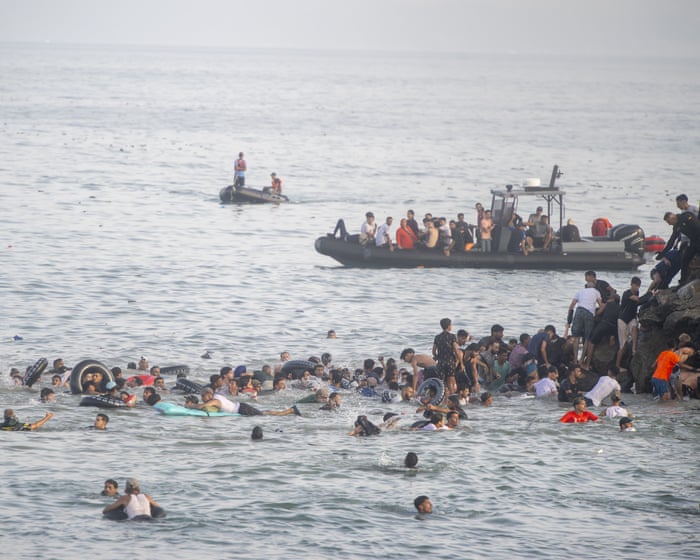
Spain Faces Major Migrant Surge as 60,000 Cross Into Ceuta in Just 24 Hours: Spain is grappling with one of the largest migration surges in recent years after approximately 60,000 migrants crossed from Morocco into the Spanish territory of Ceuta within 24 hours, overwhelming local authorities and prompting an emergency response from the government.
The sudden influx is extraordinary for Ceuta, a small Spanish autonomous city on the northern coast of Africa with a population of around 85,000 people. The number of arrivals is equivalent to roughly 70% of the city’s population, creating an immediate humanitarian and security challenge.
Thousands Return Voluntarily
Spanish officials said the situation eased somewhat after nearly half of the migrants voluntarily returned to Morocco shortly after crossing the border.
Even so, tens of thousands remained in Ceuta, placing immense pressure on emergency shelters, healthcare services, law enforcement, and local infrastructure. Authorities worked throughout the day to provide food, medical care, and temporary accommodation while trying to restore order.
Spain Deploys Military
In response to the unprecedented migration wave, Spain deployed members of its armed forces alongside additional National Police and Civil Guard units to reinforce security in Ceuta.
The military presence was aimed at supporting local authorities, protecting key infrastructure, and helping manage the large crowds gathered throughout the city.
Ceuta President Juan Jesús Vivas described the crisis as unsustainable.
“The situation that Ceuta is going through is absolutely unsustainable,” he told reporters.
Violence at the Border
The crisis also turned deadly.
According to officials, at least 41 migrants lost their lives during attempts to reach Spanish territory. Some reportedly drowned while trying to swim around border barriers, while others died in a stampede near a breakwater checkpoint separating Morocco from Ceuta.
On the Moroccan side of the border, security forces clashed with groups attempting to cross into Ceuta.
Meanwhile, similar scenes unfolded near Melilla, Spain’s second North African enclave, where migrants also attempted to breach border defenses and confronted police.
Prime Minister Visits Ceuta
Spanish Prime Minister Pedro Sánchez traveled to Ceuta to assess the situation firsthand.
He condemned the large-scale border crossing, describing it as a violation of Spain’s territorial integrity, and pledged that the government would restore order while protecting the country’s external border.
Sánchez also blamed organized human smuggling networks for encouraging dangerous migration attempts.
He said traffickers exploit vulnerable people by offering false promises of a better future while exposing them to life-threatening journeys across land and sea.
Humanitarian Concerns
Aid organizations expressed growing concern over the humanitarian conditions created by the mass arrival.
Emergency shelters quickly filled beyond capacity, while volunteers and relief agencies worked to distribute food, drinking water, clothing, and medical assistance.
Authorities also faced the challenge of identifying vulnerable migrants, including children, families, and individuals requiring urgent medical treatment.
Ceuta’s Strategic Importance
Ceuta and Melilla are the European Union’s only land borders with Africa, making them frequent focal points for migration into Europe.
The territories are protected by extensive border fences, surveillance systems, and security personnel, but they have periodically experienced large-scale crossing attempts during periods of heightened migration pressure.
Because Ceuta is part of Spain and the European Union, reaching the territory can provide migrants an opportunity to seek asylum or other forms of legal protection under Spanish and EU law.
Broader Migration Challenge
The latest events highlight the continuing migration pressures facing southern Europe and the complex relationship between Spain and Morocco on border management.
Spanish authorities are expected to continue coordinating with Moroccan officials while strengthening security measures and expanding humanitarian assistance for those remaining in Ceuta.
The incident also renews debate across Europe over migration policy, border security, international cooperation, and the need to combat human trafficking networks that continue to profit from dangerous and often deadly migration routes.