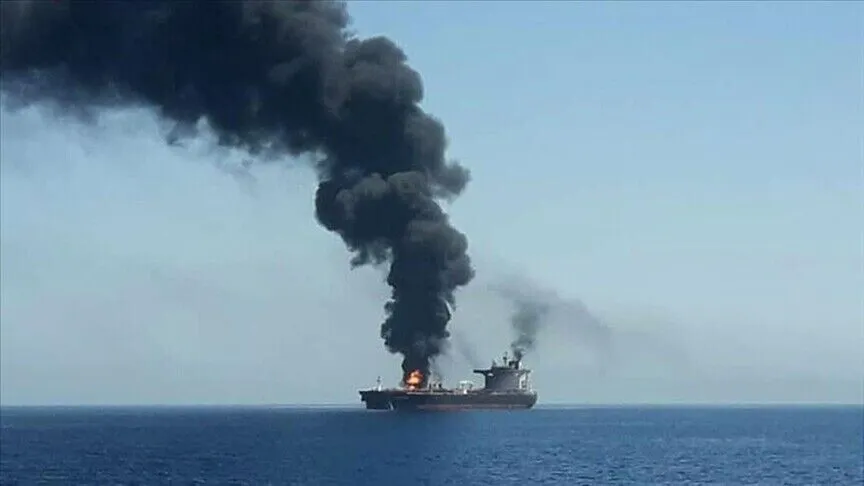
Tanker Hit by Missile Off Oman Coast, UK Maritime Agency Says: A commercial oil tanker was struck by a missile while sailing off the coast of Oman, according to the United Kingdom Maritime Trade Operations (UKMTO), in a fresh incident that underscores growing security risks in the Strait of Hormuz amid heightened tensions involving Iran and the United States.
UKMTO said it received a report from a vessel that had come under attack approximately 13 nautical miles southeast of Limah, Oman. The tanker was travelling along the southern outbound shipping lane when it was reportedly hit by a missile. The agency confirmed that the incident has been reported to the relevant authorities, who have launched an investigation.
At the time of writing, officials have not released the name or flag of the tanker involved. There has also been no official confirmation regarding the extent of the damage, whether any crew members were injured, or if the vessel remains operational. Authorities have yet to identify who was responsible for the strike.
The attack comes at a time of heightened military activity in and around the Strait of Hormuz, one of the world’s most strategically significant maritime corridors. The narrow waterway connects the Persian Gulf with the Gulf of Oman and the Arabian Sea, serving as a crucial route for global oil and liquefied natural gas exports. Any disruption in the area has the potential to affect international shipping, energy markets and regional security.
Maritime security experts have repeatedly warned that commercial vessels navigating the Strait of Hormuz face increasing risks whenever regional tensions escalate. Shipping companies operating in the area have been closely monitoring security advisories, with many implementing additional safety measures for vessels transiting the route.
The reported missile strike follows a period of escalating confrontation between Iran and the United States, raising concerns that commercial shipping could increasingly become caught in the crossfire. Although no official link has been established between the latest incident and the wider regional conflict, the attack is likely to intensify concerns among international shipping operators and governments with strategic interests in the Gulf.
The Strait of Hormuz remains one of the busiest maritime chokepoints in the world, with millions of barrels of crude oil and petroleum products transported through it every day. Any threat to freedom of navigation in the region has immediate implications for global energy supplies, insurance costs and shipping operations.
Maritime authorities have urged vessels operating in the area to remain vigilant and follow the latest navigational and security guidance. Previous incidents involving merchant ships in the Gulf have prompted warnings from international naval forces, which regularly monitor commercial traffic through the region.
The latest attack is expected to renew discussions over maritime security and the protection of commercial vessels passing through the Gulf. International observers have warned that further attacks on civilian shipping could increase the risk of broader regional instability and disrupt global trade flows.
The missile strike also comes as diplomatic and military activity across the Middle East continues to intensify. Reports indicate that senior officials from the United States are holding a series of high-level meetings with counterparts from Iraq, Jordan, Lebanon and Israel to assess the rapidly evolving security situation. Meanwhile, another round of talks between Israel and Lebanon is scheduled to take place in Rome as diplomatic efforts continue alongside rising regional tensions.
Despite the growing number of security incidents in the Gulf, investigators have so far released few details about Tuesday’s attack. Officials have not disclosed whether the missile struck the vessel directly, whether it was able to continue its voyage after the incident, or if naval assets were deployed to assist the ship.
As authorities continue their investigation, the international shipping industry is expected to closely monitor developments. Markets will also be watching for any impact on energy supplies or shipping routes, particularly if security conditions in the Strait of Hormuz deteriorate further.
For now, the missile strike serves as another reminder of the fragile security environment surrounding one of the world’s most critical maritime trade routes. With tensions remaining high and investigations still underway, further updates are expected as more information becomes available from maritime authorities and regional officials. Markets Open Deep in the Red on West Asia Conflict, Oil Price Spike | Maya