
Taylor Swift Is Not an AI Property, and She Has the Trademark to Prove It
There was a time when protecting yourself from impersonators meant hiring a lawyer to send a strongly worded cease-and-desist letter. In 2026, it means filing trademark applications for the sound of your own voice. Taylor Swift has done exactly that — and in doing so, she has stepped into the vanguard of a growing legal movement that could fundamentally reshape how celebrity identity is protected in the age of artificial intelligence.
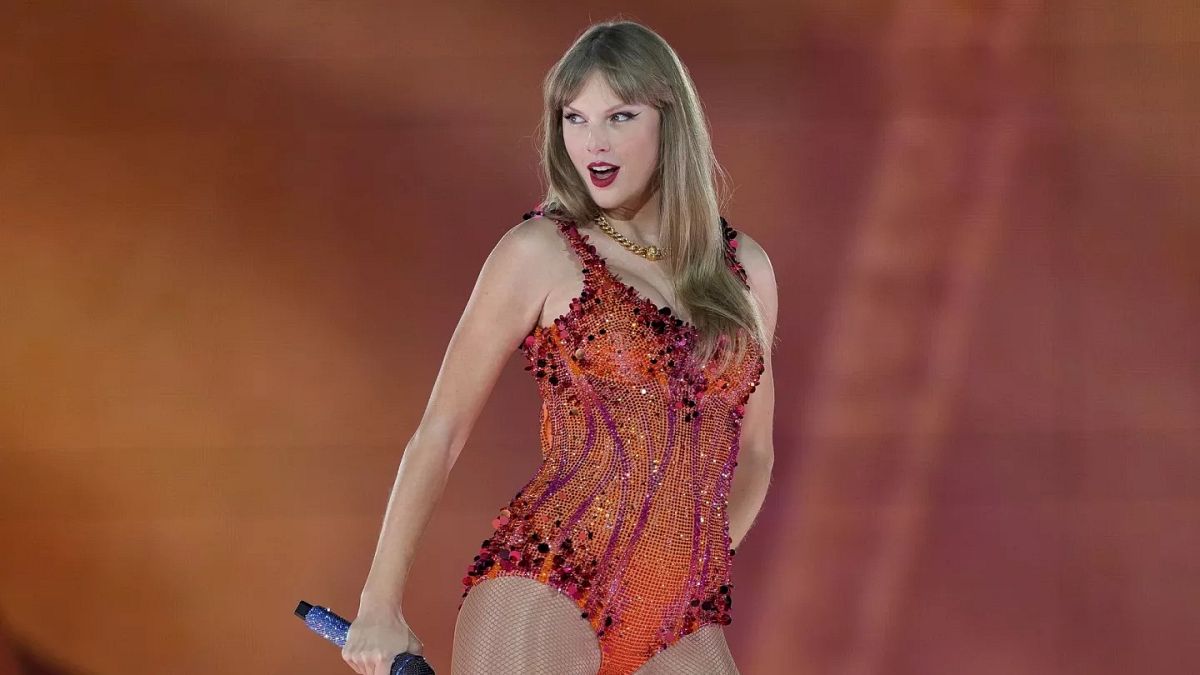
On April 24, Swift’s company TAS Rights Management filed three trademark applications with the U.S. Patent and Trademark Office. Two of them are “sound marks” — a relatively rare but legally recognized category of trademark — covering audio clips of Swift introducing herself. In one recording, she promotes her new album by name on a streaming platform. In another, captured in a noticeably lower register, she simply says, “Hey, it’s Taylor.” The third application is visual, protecting a specific onstage image: Swift in a multicolored bodysuit, strumming a pink guitar with a black strap — a look immediately recognizable from her recent performances.
The filings may seem narrow, but the legal logic behind them is anything but. Registering those spoken phrases isn’t merely about protecting a few words. It’s about anchoring federal protection to the voice itself. If anyone uses an AI-generated replica of that voice — even to say something entirely different — Swift’s legal team could argue it constitutes trademark infringement. The same principle extends to the image filing. A generated visual that evokes her silhouette, her outfit, her guitar, could now be challenged under federal trademark law, not just state publicity rights.
This matters because copyright — the traditional weapon of choice for artists — has a gap that AI has ruthlessly exploited. AI tools now allow users to generate entirely new content that mimics an artist’s voice without copying a single second of any existing recording. Copyright protects what already exists. Trademarks, by contrast, can stop anything confusingly similar — a much broader net that can catch AI clones even when they don’t replicate one note of original audio.
The Pioneer: Matthew McConaughey
Swift didn’t invent this strategy. She followed the trail blazed by Matthew McConaughey, who has emerged as the unlikely architect of the “trademark yourself” movement in Hollywood. McConaughey’s legal team began filing applications in December 2023 for his famous “Alright, alright, alright” catchphrase from the 1993 film Dazed and Confused, with the USPTO granting approval in December 2025 — eight trademarks in total, covering sound, image, and video.
The precision of those filings is striking. The sound mark is described in detail that reads like an audio fingerprint: a man delivering the phrase with the first syllable of the first two words at a lower pitch than the second syllable, and the first syllable of the final word pitched higher than the last. It is not trademarking a catchphrase. It is trademarking a specific vocal performance — the particular cadence, tone, and delivery that the public has come to associate with one human being.
McConaughey has been candid about his motivations, telling the Wall Street Journal that he wants to establish a clear boundary around ownership, with consent and attribution becoming the standard in an AI-driven world. He is also an investor in ElevenLabs, an AI voice company — signaling he is not anti-technology but firmly pro-consent when it comes to whose voice gets replicated and how.
Why Trademark Law, and Why Now
Individual states like New York and California already have right-of-publicity laws barring unauthorized commercial use of a person’s image and likeness. But those protections are geographically limited. Trademark infringement lawsuits, on the other hand, can be filed in federal court and carry weight across all fifty states — a critical advantage when AI-generated content spreads across borders in seconds.
There’s also a corporate precedent that makes the strategy look increasingly viable. When Disney discovered in late 2025 that Google’s Gemini AI was being used to generate unauthorized copies of its trademarked characters, it sent a cease-and-desist letter. Within twenty-four hours, the videos were gone. If trademark law can move that swiftly at the studio level, celebrities want the same enforcement power over their own identities.
The Broader Legal Landscape
While individual celebrities build their legal defenses, legislators are working — slowly — to construct something more systematic. Tennessee’s ELVIS Act, passed in 2024, was the first state law to explicitly extend right-of-publicity protections to AI-generated voice clones, making unauthorized digital replication of someone’s voice both a civil and criminal matter. California, New York, Texas, and Illinois have since introduced or tightened their own statutes targeting synthetic media.
At the federal level, the NO FAKES Act — which would create nationally uniform protections against voice cloning and deepfakes — was reintroduced in Congress in April 2025 with bipartisan backing. It has not yet come to a vote, leaving a fragmented patchwork of state laws as the only existing framework. In that vacuum, celebrities like Swift are doing what they’ve always done: taking matters into their own hands.
What Comes Next
The honest answer is that nobody knows. The “trademark yourself” strategy has not yet been tested in court in the context of AI. Trademark law was designed to protect consumers from marketplace confusion, not to function as a personal identity shield, and legal scholars have long warned that courts resist attempts to trademark an entire persona. These are real limitations, and they will eventually be litigated.
But the entertainment industry rarely waits for legal certainty before acting. Swift’s filings are almost certain to trigger a wave of similar applications across Hollywood and the music world. The playbook has been written. The question now is how many celebrities pick it up — and how quickly courts decide whether it holds.
What is already clear is that passive IP protection belongs to a different era. In the AI age, your identity is only as secure as the legal architecture you build around it. Taylor Swift, it turns out, is very good at building walls.
Apple’s Leadership Shift Signals a Hardware-First AI Future | Maya


