Valve’s Steam Controller Is Back — and This Time, It Means Business- After months of leaks, speculation, and waiting, Valve has finally broken its hardware silence. The company’s first new device since the Steam Deck OLED is here: a redesigned Steam Controller, priced at $99 and set to launch on May 4, 2026. It’s a gamepad built to bring the full input experience of the Steam Deck to your living room TV — and to work with any device that runs Steam, whether that’s a Windows PC, a Mac, a Linux machine, a tablet, a smartphone, or the Steam Deck itself.
The controller is also being positioned as a companion to Valve’s upcoming hardware — the Steam Machine and Steam Frame — though it’s arriving ahead of both. That means it’s entering the market on its own terms, into a space already dominated by Xbox controllers and, increasingly, Sony’s DualSense, which has earned strong support from PC gamers over recent years. Valve’s argument is that neither of those options can do what the Steam Deck does — and that a meaningful number of players actually want that.
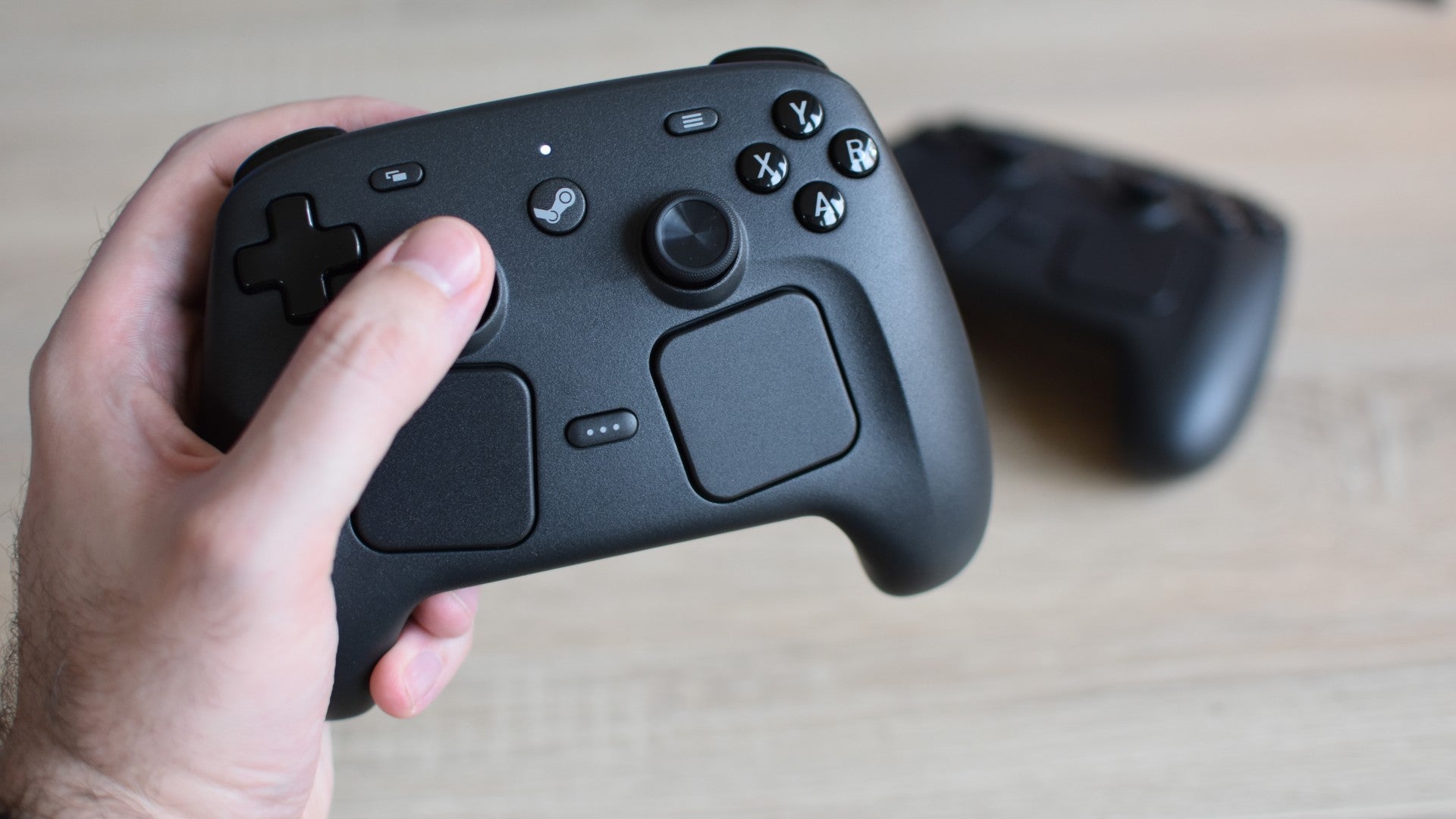
The origin story of the controller is straightforward. Steam Deck owners were docking their handhelds to TVs in large numbers, and once they did, they lost access to the trackpads, gyro, and other inputs that made the device distinctive. Valve programmer Pierre-Loup Griffais described it as a gap that needed closing. Players loved the Steam Deck experience — the quick-access menus, the seamless library navigation, the ability to run keyboard-and-mouse games from the couch — but docking stripped away the very inputs that made that possible. The Steam Controller, in Griffais’s words, was “a logical next step.” The layout mirrors the Steam Deck almost exactly, with the same arrangement of inputs that Deck owners are already familiar with, plus a set of refinements on top.
Those refinements are worth paying attention to. The new controller uses TMR magnetic thumbsticks — a technology similar to Hall Effect sensors but with even lower power draw and better long-term reliability. Traditional potentiometer-based thumbsticks, the kind used by Sony, Microsoft, and Nintendo in their first-party controllers, are a well-known source of stick drift over time. The TMR sticks are designed to outlast them significantly. The controller also carries over the dual trackpads from the original Steam Controller, now measuring 34.5mm square with high-definition haptic feedback built in, allowing for the kind of mouse-precision control that makes strategy games and fast-paced shooters playable without a keyboard. A six-axis gyro system adds motion control support, and four programmable grip buttons on the back round out an input set that has no direct equivalent among standard controllers on the market.
There are other details worth noting. The thumbstick capacitive touch sensors can trigger gyro controls automatically when you rest your thumb on the stick, a feature carried over from the Steam Deck. Grip Sense sensors on the handles detect when you’re actively holding the controller and can be mapped to custom functions. Battery life is rated at up to 35 hours, with slightly more headroom if haptics are disabled. The controller ships with a magnetic charging puck that doubles as a 2.4GHz wireless receiver — plug it into a PC and Steam detects the controller automatically, no traditional Bluetooth pairing required. USB-C and standard Bluetooth are also supported for those who prefer them.
Connectivity within Valve’s own hardware ecosystem is seamless by design. The Steam Machine has a built-in wireless adapter for direct pairing, and the controller can remotely wake the system. A dedicated Steam button handles power and doubles as a shortcut into the library, store, and settings. A quick-access menu covers notifications, the friends list, and Steam Chat — the same UI navigation Steam Deck users already know.
Where the controller sits in the broader market is interesting. At $99, it costs roughly twice as much as a standard DualSense or a well-regarded third-party option like the 8BitDo Ultimate 2. But it undercuts the premium tier considerably — the Xbox Elite Series 2 runs $179, and the DualSense Edge sits at a similar level. Both of those higher-priced controllers offer features the Steam Controller doesn’t, such as swappable thumbstick modules, hair-trigger locks, and extensive physical customization. What the Steam Controller offers instead is a wider range of input types, deeper software-level customization through Steam Input, and compatibility with the entire Steam ecosystem out of the box.
For Steam Deck owners who dock regularly, the pitch is clear. For PC gamers who’ve been playing with an Xbox controller and want more without going full Elite, it’s a compelling middle option. For everyone else, the $99 price will require some justification — but then, that’s always been the challenge Valve faces when it asks people to care about hardware. The Steam Deck eventually won that argument. The question now is whether the Steam Controller can do the same.
Michael Biopic Moonwalks to $97M Opening, Breaks Records | Maya