
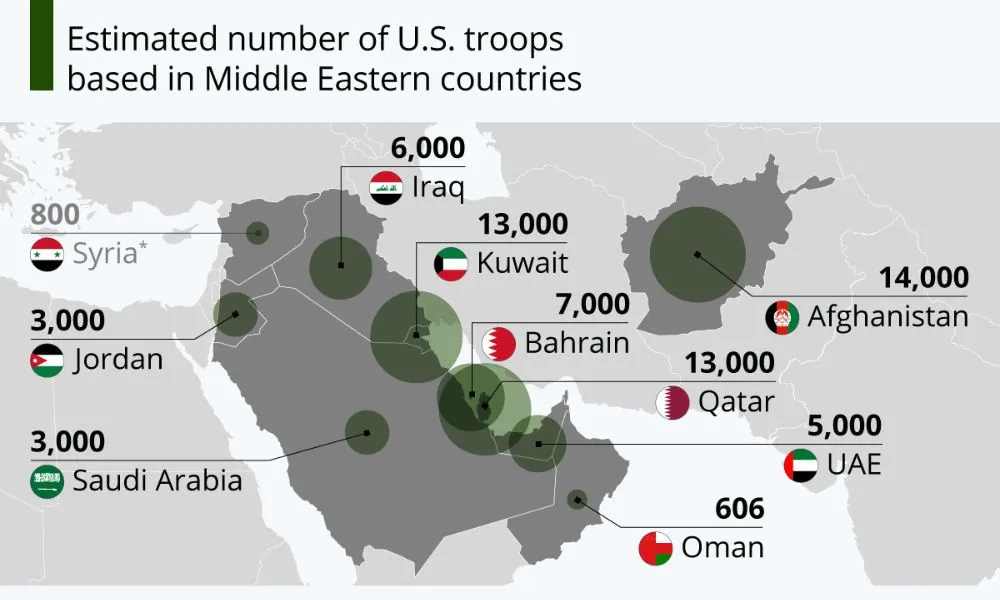
US May Scale Back Middle East Bases if Iran War Comes to an End: The United States could be preparing for a significant shift in its military posture in the Middle East if the conflict with Iran comes to a lasting end. According to multiple reports, senior officials within the Pentagon and the U.S. intelligence community have quietly begun discussing the possibility of reducing the number of American troops, military bases, and intelligence facilities across the region should security conditions improve. The discussions remain in their early stages, and no final decisions have been announced.
While Washington continues to maintain a substantial military presence across the Gulf, officials are reportedly examining what a post-conflict strategy could look like. Such a move would represent one of the biggest changes to U.S. military policy in the Middle East in decades.
Quiet Planning Inside Washington
According to people familiar with the discussions, defense planners are evaluating whether certain military installations could be consolidated, downsized, or eventually closed if the threat posed by Iran decreases significantly. Intelligence agencies are also reviewing whether some surveillance and operational assets currently spread across the region could be relocated or reduced.
The conversations are described as preliminary rather than official policy. Any drawdown would depend on several conditions, including a durable end to hostilities, improved regional stability, and confidence that Iran or its allied militias would not resume attacks on American personnel or allies.
Why the U.S. Has So Many Bases in the Middle East
America’s military presence in the Middle East did not develop overnight. It has evolved over more than seven decades, shaped by wars, regional conflicts, terrorism, and the importance of global energy supplies.
During the Cold War, the United States gradually strengthened ties with Gulf nations to counter Soviet influence. However, the American military footprint remained relatively limited until the late twentieth century.
The turning point came in 1990 when Iraq invaded Kuwait. In response, the U.S. deployed hundreds of thousands of troops to Saudi Arabia and neighboring countries during Operation Desert Shield, followed by Operation Desert Storm in 1991. The Gulf War demonstrated the strategic importance of maintaining forces close to potential conflict zones.
Following the war, Washington kept thousands of troops in the Gulf to enforce sanctions on Iraq and protect regional allies.
The Impact of 9/11
The September 11, 2001 terrorist attacks transformed America’s military strategy.
After launching operations in Afghanistan against al-Qaeda and later invading Iraq in 2003, the United States dramatically expanded its network of military bases across the Middle East.
Large installations were developed or expanded in countries such as Bahrain, Qatar, Kuwait, the United Arab Emirates, Jordan, Saudi Arabia, and Iraq. These bases supported combat operations, logistics, intelligence gathering, air operations, naval patrols, and counterterrorism missions.
Over time, the region became one of the largest overseas concentrations of U.S. military power.
Key American Bases Across the Region
Today, the United States maintains military facilities across multiple Middle Eastern countries.
Bahrain hosts the headquarters of the U.S. Navy’s Fifth Fleet, which plays a critical role in securing maritime routes through the Persian Gulf.
Qatar is home to Al Udeid Air Base, one of America’s largest overseas military installations and a major command center for operations across the Middle East.
Kuwait serves as an important logistics hub supporting troop movements and equipment.
The United Arab Emirates hosts advanced air and naval facilities, while Jordan provides strategic support for regional security operations.
Iraq and Syria continue to host smaller American forces focused primarily on counterterrorism missions against ISIS and supporting local partner forces.
Iran Has Long Been at the Center of U.S. Strategy
Relations between Washington and Tehran have remained tense since Iran’s 1979 Islamic Revolution.
The relationship deteriorated further following disputes over Iran’s nuclear program, regional influence, and support for armed groups across the Middle East.
The Trump administration withdrew from the 2015 Iran nuclear agreement during Trump’s first term and restored its “maximum pressure” sanctions campaign. Since then, military tensions have periodically escalated through attacks on shipping, missile launches, and strikes involving Iranian-backed groups.
These security concerns have been one of the primary reasons the United States has continued maintaining a significant military presence throughout the Gulf.
What Could Change After the Conflict?
If fighting with Iran ends through a stable agreement, American defense officials may begin reassessing whether current troop levels remain necessary.
Possible changes being discussed reportedly include reducing troop deployments, consolidating overlapping facilities, lowering operational costs, and shifting military resources toward other strategic priorities.
A smaller presence could also lessen the burden on American service members, many of whom have experienced repeated deployments throughout the Middle East over the past two decades.
However, analysts note that a reduction would almost certainly be gradual rather than immediate.
Why Washington May Still Keep Forces in the Region
Even if relations with Iran improve, the Middle East remains strategically important for several reasons.
The region contains some of the world’s largest oil and natural gas reserves, and the Strait of Hormuz remains one of the busiest energy shipping routes on Earth. Any disruption to maritime traffic can quickly affect global energy prices.
The United States also maintains security partnerships with Israel, Saudi Arabia, Qatar, Bahrain, Kuwait, Jordan, and the United Arab Emirates. These alliances require ongoing military cooperation, joint exercises, intelligence sharing, and missile defense capabilities.
Counterterrorism operations against extremist groups also continue in parts of Iraq and Syria.
For these reasons, many experts believe any future reduction would likely involve resizing rather than abandoning America’s regional military network.
Challenges to Any Drawdown
Reducing military deployments is rarely straightforward.
American officials would need assurances that Iran would not resume attacks or accelerate activities viewed as threatening regional security.
There are also concerns about Iran-backed armed groups operating in Iraq, Syria, Lebanon, and Yemen, which could continue posing risks even if direct U.S.-Iran hostilities decline.
Regional allies may also seek continued American security guarantees before supporting any major withdrawal.
Domestic Considerations
Maintaining a large overseas military presence requires significant financial resources.
Supporters of a drawdown argue that reducing overseas deployments could save billions of dollars over time while allowing the Pentagon to focus more heavily on emerging challenges in the Indo-Pacific, cybersecurity, and advanced military technologies.
Others caution that reducing America’s presence too quickly could create security gaps that rival powers or militant organizations might exploit.
The debate reflects a broader discussion within Washington about balancing military commitments around the world.
No Final Decision Yet
Despite reports of internal planning, the United States has not announced any official timetable for reducing troops or closing bases in the Middle East. The discussions remain contingent on how the Iran conflict develops and whether a lasting political settlement can be achieved.
For now, American forces continue operating across the region while policymakers prepare for multiple possible outcomes. If peace proves durable, the Middle East could witness one of the most significant changes in the U.S. military posture since the end of the Iraq War. Whether that transition becomes reality will depend not only on diplomacy with Iran but also on the broader security landscape across one of the world’s most strategically important regions.

