Why do space missions sometimes cause radio blackouts on Earth? When people hear the phrase “radio blackout,” it can sound dramatic, like all communication on Earth suddenly stops. In reality, these events are usually temporary, localized, and tied to what is happening in space weather or during specific stages of space missions. The interesting part is that space missions don’t usually “create” blackouts in a direct way. Instead, they can experience or coincide with conditions that disturb radio signals between Earth and space.
To understand this properly, we need to look at how radio communication works, what space missions are doing when blackouts happen, and how the Sun plays a much bigger role than most people expect.
What is a radio blackout?
A radio blackout refers to a temporary disruption in radio communication. This can affect:
- Satellite communications
- GPS signals
- Shortwave radio used by aircraft and ships
- Communications with spacecraft or astronauts
It does not mean all communication on Earth stops. Instead, it usually affects specific frequency ranges or regions of the planet.
The most common cause is not space missions themselves, but changes in Earth’s upper atmosphere triggered by solar activity.
How radio signals normally travel
To understand why blackouts happen, we need a basic idea of how radio waves move.
Radio signals travel through space and Earth’s atmosphere. For most satellite communication, signals pass through a region called the ionosphere. This is a layer of Earth’s upper atmosphere filled with charged particles created by solar radiation.
The ionosphere is important because it can:
- Reflect radio waves (helping long-distance communication)
- Absorb or distort signals under certain conditions
- Change density depending on solar activity
In normal conditions, it acts like a stable medium that allows communication systems to function smoothly.
The real main cause: the Sun
Most radio blackouts are caused by solar activity, not spacecraft.
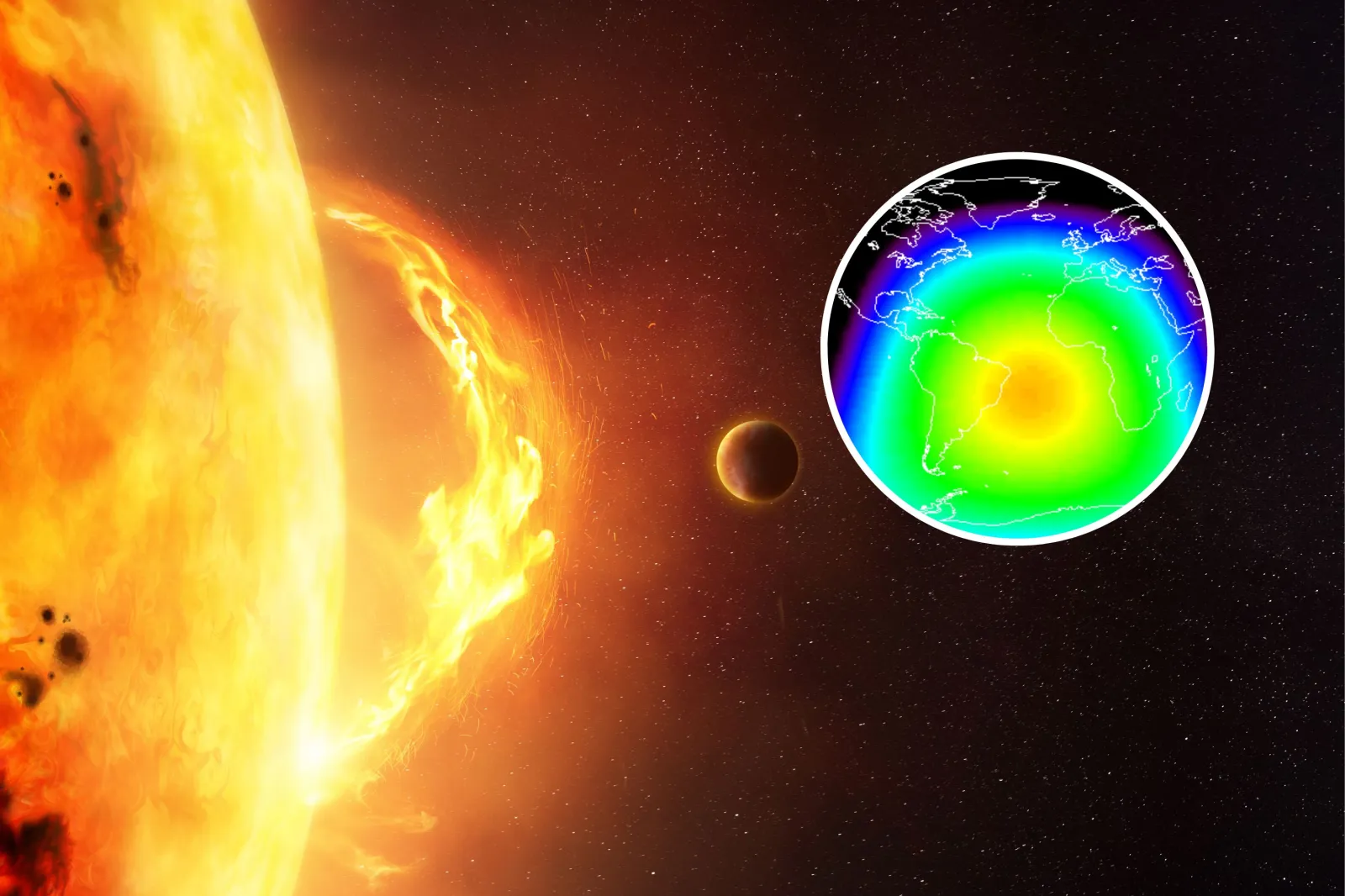
The Sun occasionally releases bursts of energy known as solar flares and coronal mass ejections (CMEs). These events send large amounts of radiation and charged particles toward Earth.
When this happens:
- The ionosphere becomes highly ionized
- Electrical properties of the upper atmosphere change rapidly
- Radio waves get absorbed or scattered
This can lead to communication disruptions, especially on the sunlit side of Earth.
One of the key regions affected is the D-layer of the ionosphere, which becomes more dense during solar flares. This layer absorbs high-frequency radio waves instead of reflecting them, causing what is known as a radio blackout.
So where do space missions fit in?
Space missions are not the cause of these blackouts, but they are often affected by the same conditions. In fact, spacecraft are some of the first systems to notice changes in space weather.
There are three main ways space missions are connected to radio blackouts:
1. Space weather affects spacecraft communication
When a solar flare occurs, spacecraft communication can become unstable or temporarily lost.
For example:
- Signals between ground stations and satellites may weaken
- Data transmission may slow down or pause
- Commands sent to spacecraft may be delayed
This happens because the same ionospheric disturbance that affects Earth-based radio systems also interferes with signal paths between satellites and ground stations.
Space agencies like NASA and ISRO constantly monitor solar activity for this reason. For example, missions involving the International Space Station must consider space weather forecasts before sensitive operations like spacewalks or docking.
2. Launches and re-entries can cause brief local effects
During rocket launches, a spacecraft passes through the ionosphere. The exhaust gases from rockets can temporarily disturb the local plasma environment.
This can cause:
- Small, short-lived changes in ionospheric density
- Minor signal interference in nearby regions
- Localized radio disturbances near the launch trajectory
However, these effects are very brief and limited in scale. They do not cause global blackouts.
Similarly, when spacecraft re-enter the atmosphere, they create ionized trails as they burn up. These trails can briefly scatter radio waves, but again, the effect is temporary and localized.
3. Spacecraft rely on radio systems that are sensitive to space weather
Space missions depend heavily on radio communication. This includes:
- Telemetry (data from spacecraft to Earth)
- Tracking and navigation signals
- Remote commands from mission control
Because these systems operate through the ionosphere, they are directly exposed to solar-driven disruptions.
For example:
- GPS satellites can experience reduced accuracy
- Deep-space probes may need to pause data transmission
- Communication delays can occur during strong solar storms
In this sense, space missions do not cause radio blackouts—they suffer from them and sometimes help scientists detect them earlier.
Why solar activity affects radio signals so strongly
To understand this, imagine the ionosphere as a flexible, invisible layer that radio waves must pass through. When solar radiation increases, this layer becomes:
- More electrically charged
- More unstable in density
- More reflective or more absorbent depending on frequency
High-frequency radio waves (used for long-distance communication) are especially sensitive. When they hit a heavily ionized layer, they may be absorbed instead of bouncing back to Earth.
This is why aviation and maritime communication systems sometimes switch frequencies during solar storms.
Types of radio blackouts
Scientists classify radio blackouts based on severity:
Mild disturbances
- Slight signal degradation
- Minor GPS errors
- Short interruptions in communication
Moderate blackouts
- Loss of high-frequency radio communication in some regions
- Reduced satellite signal quality
Severe blackouts
- Complete loss of high-frequency radio communication on the sunlit side of Earth
- Significant GPS disruption
- Spacecraft communication interruptions
Severe events usually occur during strong solar flares.
Why space missions notice them first
Space missions operate above or within regions affected directly by space weather, so they often detect changes before ground systems do.
Satellites carry instruments that monitor:
- Solar radiation
- Charged particle density
- Magnetic field changes
Because of this, spacecraft act like early warning systems for Earth. When they detect disturbances, agencies can issue alerts for potential radio blackouts.
The role of Earth’s magnetic field
Earth has a magnetic field that protects us from most solar particles. However, during intense solar events, this shield can become temporarily disturbed.
When this happens:
- Charged particles penetrate deeper into the atmosphere
- The ionosphere becomes more unstable
- Radio wave paths become unpredictable
This interaction between solar wind and Earth’s magnetic field is a major reason why radio blackouts are sometimes sudden and widespread.
Why space missions are designed to handle this
Because space weather is unavoidable, spacecraft are built with protective systems such as:
- Redundant communication channels
- Backup data storage systems
- Radiation-hardened electronics
- Safe-mode operations during solar storms
For example, during strong solar activity, the International Space Station may adjust operations to reduce risk to astronauts and equipment.
A simple way to understand it
Think of radio communication like talking across a calm lake.
- In normal conditions, the water is smooth and your voice carries clearly.
- During a solar storm, it is like the lake suddenly becomes stormy and full of waves.
- Your voice (radio signal) gets distorted, scattered, or absorbed.
Space missions are not causing the storm. They are simply trying to communicate through it, just like everyone else.
Are humans ever the cause of radio blackouts?
In space science, human activity can cause very small local disturbances, but these are not responsible for major blackouts. The scale of solar energy interacting with Earth’s atmosphere is far greater than any human-made signal or exhaust effect.
So while rockets and satellites interact with the ionosphere, the Sun remains the dominant force behind radio disruptions.
Conclusion
Space missions are not the cause of radio blackouts on Earth. Instead, both spacecraft and Earth-based systems are affected by changes in the ionosphere driven mainly by solar activity.
Solar flares and charged particle storms temporarily change the electrical structure of Earth’s upper atmosphere, which interferes with radio wave propagation. Space missions experience these disruptions directly because they rely heavily on radio communication and operate within or above the affected regions.
In simple terms, radio blackouts are not created by spacecraft, but by space weather. Space missions simply help us observe, understand, and sometimes predict them more accurately.
Are There Hidden Cultural Links Between Mexico and the USA? | Maya
:max_bytes(150000):strip_icc()/GettyImages-151541875-adcfc13d221e40e4946f571b57180f3d.jpg "How Sputnik 1 Sparked the Space Race")