
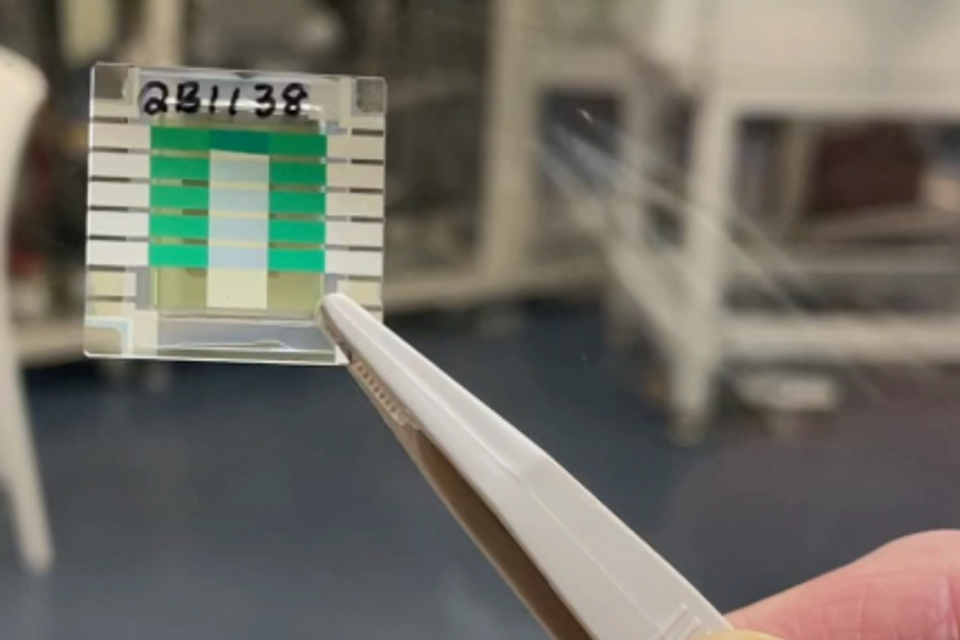
World’s First Quantum Battery Prototype Could Revolutionize Future Energy Storage- Scientists in Australia have unveiled what they describe as the world’s first working quantum battery prototype, marking a major milestone in the future of energy storage. Unlike today’s lithium-ion batteries, which take longer to charge as they become larger, this experimental battery displays a remarkable quantum property—it charges faster as its size increases. While the technology is still in its infancy, researchers believe it could one day transform quantum computing, wireless energy transfer, and even consumer electronics.
The breakthrough comes from researchers at CSIRO, the University of Melbourne, and RMIT University, who successfully built a proof-of-concept device capable of completing a full battery cycle: charging, storing, and discharging energy. This is the first time scientists have demonstrated all three functions in a quantum battery, taking the concept from theory into practical experimentation.
Unlike conventional batteries that store energy through chemical reactions, quantum batteries rely on the unusual laws of quantum mechanics. They exploit phenomena such as quantum coherence and collective interactions between particles. Instead of each energy cell charging independently, the cells work together in a coordinated way, allowing the entire system to absorb energy more efficiently. This effect, known as superabsorption, means that adding more cells actually speeds up charging rather than slowing it down.
To demonstrate the technology, the researchers engineered a tiny device made from organic semiconductor materials enclosed within a microscopic optical cavity. The battery is charged wirelessly using an ultrafast laser, which excites the material almost instantly. Laboratory tests showed the battery could charge in femtoseconds—quadrillionths of a second—and retain that energy for nanoseconds, which is millions of times longer than the charging process itself. Although that storage time is still far too short for everyday use, it proves that the underlying concept works.
The prototype stores only a tiny amount of energy—far too little to power a smartphone, laptop, or electric vehicle. Researchers stress that this is a scientific demonstration rather than a commercial product. Their next challenge is extending how long the battery can retain energy while also increasing its storage capacity. If those hurdles can be overcome, quantum batteries could eventually become practical for real-world applications.
One of the most promising uses for quantum batteries is in quantum computing. Quantum computers require extremely stable and efficient energy sources that introduce minimal interference with fragile quantum states. Because quantum batteries operate using similar quantum principles, they could provide a more compatible power source for future quantum processors than today’s conventional batteries. Many researchers believe this is likely to be the technology’s first commercial application.
Looking further ahead, scientists envision much broader possibilities. Future versions of quantum batteries could enable wireless charging over long distances, allowing drones to recharge while flying or electric vehicles to receive power without plugging in. Some researchers even imagine smartphones that recharge almost instantly. However, these ideas remain long-term ambitions and will require significant engineering breakthroughs before they become reality.
Despite the excitement, experts caution that quantum batteries are still years—perhaps decades—away from widespread use. The current prototype is extremely small and stores only a fraction of the energy required for consumer devices. Challenges such as improving storage time, increasing energy density, maintaining quantum coherence, and manufacturing larger systems must all be solved before the technology becomes commercially viable.
Even so, the achievement represents an important step forward. For more than a decade, quantum batteries existed largely as theoretical concepts. By demonstrating a working prototype that can charge, store, and release energy while displaying unique quantum advantages, researchers have opened a new chapter in energy science. Whether the first practical applications appear in quantum computers, medical devices, satellites, or eventually smartphones and electric vehicles, this breakthrough suggests that the future of batteries may be governed not by chemistry alone, but by the strange and powerful rules of quantum physics.


