Himalayan Disaster Tests Nepal, China as Flash Flood Turns Deadly- A catastrophic flash flood along the Nepal–Tibet border has triggered one of the worst humanitarian disasters to strike the Himalayan region in more than a decade. At least 95 people have been confirmed dead, while hundreds remain missing after a massive wall of water, mud, and debris swept through mountain communities, border crossings, and key transport routes. The disaster has also left hundreds of foreign tourists unaccounted for, including more than 100 Indians and several British nationals, raising fears that the death toll could rise significantly as rescue operations continue.
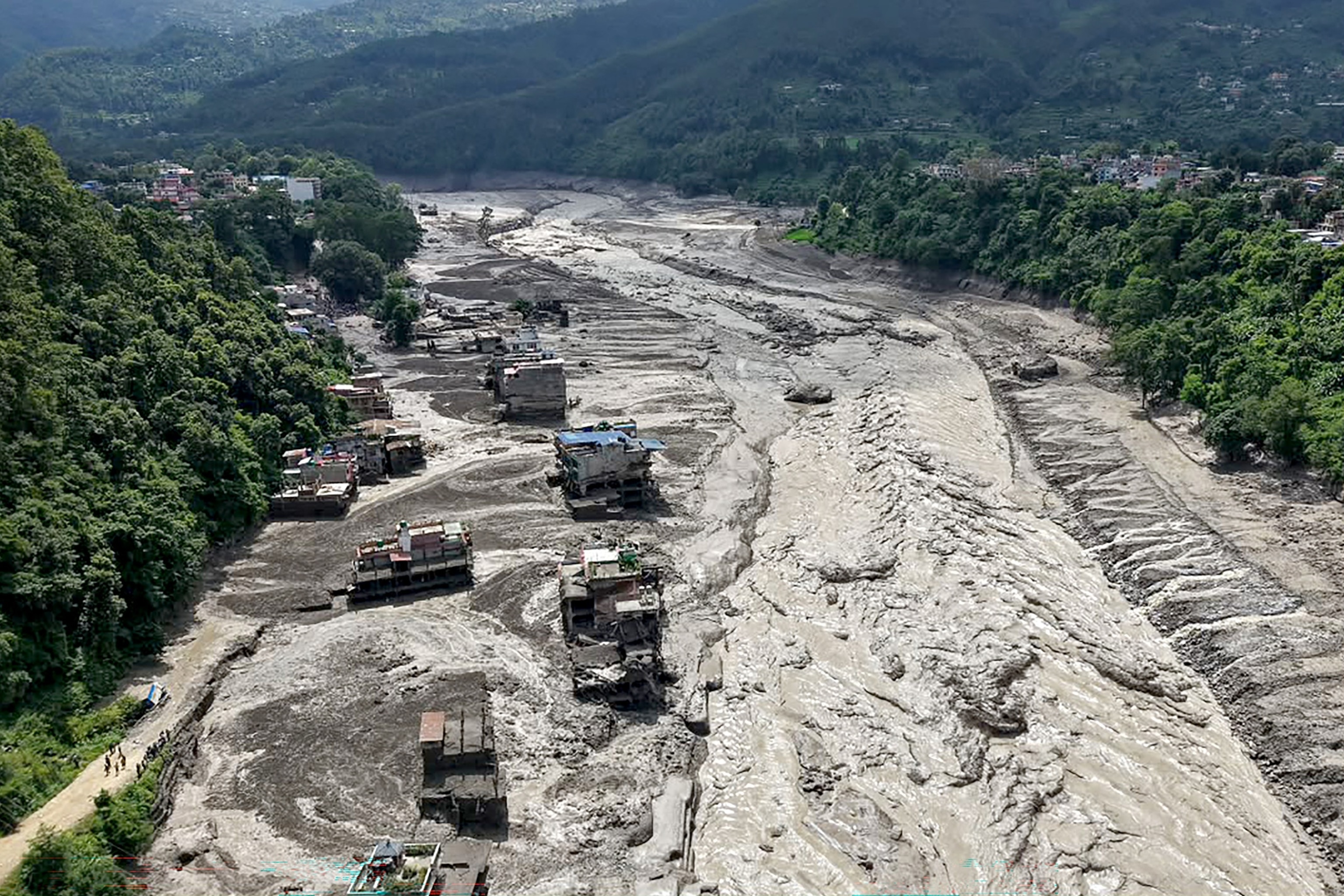
The flood struck the mountainous border region with extraordinary force, destroying homes, bridges, roads, and hydropower infrastructure within minutes. Security camera footage from the Tibetan side captured the terrifying moment when a torrent of muddy water surged through the Gyirong border crossing, sweeping away buildings and vehicles. On the Nepalese side, residents and travelers were seen running for higher ground as rivers burst beyond their banks, leaving entire settlements buried under mud and rock.
The region is a major gateway for pilgrims traveling to Mount Kailash and Lake Manasarovar, making it particularly crowded during this season. According to Nepal’s tourism authorities, more than 380 travelers are currently unaccounted for, including tourists from India, the United Kingdom, the United States, South Korea, Malaysia, Australia, and several other countries. Many had been trekking or participating in religious pilgrimages when disaster struck.
Authorities are still investigating what triggered the devastating flood. Nepal’s foreign minister has suggested that a 4.4-magnitude earthquake may have caused an avalanche or landslide high in the Himalayas, temporarily blocking a river before releasing a destructive surge downstream. Scientists are also examining whether glacial instability or the sudden collapse of an ice-dammed lake contributed to the catastrophe, a growing concern as climate change accelerates glacier melt across the Himalayan region.
The disaster has prompted an unprecedented emergency response from both Nepal and China. Chinese President Xi Jinping personally ordered an all-out rescue operation and instructed authorities to strengthen monitoring for additional geological hazards. Such direct intervention by China’s top leadership typically reflects the seriousness of the crisis. On the Nepalese side, the army, police, and emergency responders have been deployed alongside helicopters and specialized rescue teams. However, damaged roads, collapsed bridges, unstable terrain, and poor weather continue to hamper efforts to reach isolated communities.
The flood has also exposed the vulnerability of critical infrastructure along the Himalayan frontier. Several hydropower projects have suffered extensive damage, while cross-border trade routes between Nepal and China have been disrupted. The destruction of transport links could have significant economic consequences, delaying commerce and tourism while affecting local communities that depend on cross-border trade for their livelihoods.
Beyond the immediate humanitarian crisis, the disaster has renewed concerns about the increasing frequency of extreme weather events in the Himalayas. Scientists have repeatedly warned that rising temperatures are destabilizing glaciers, increasing the risk of glacial lake outburst floods, avalanches, and landslides. Combined with intense monsoon rainfall and seismic activity, these factors are making mountain communities increasingly vulnerable to sudden disasters that offer little or no warning.
For Nepal, the tragedy is being compared to the devastating 2015 earthquake that claimed nearly 9,000 lives. Although the causes differ, both disasters demonstrate how quickly natural hazards can overwhelm mountainous regions where rescue access is limited and infrastructure remains fragile. The latest flood has once again highlighted the need for improved early warning systems, better cross-border disaster coordination, and stronger climate resilience measures across the Himalayan region.
Search and recovery operations continue around the clock as families wait for news of missing relatives. Authorities fear additional flooding if debris blocking rivers upstream suddenly gives way, forcing nearby communities to remain on high alert. With hundreds still missing and rescue teams racing against time, the Nepal–Tibet border remains the focus of one of Asia’s most challenging disaster response efforts in recent years. The unfolding tragedy serves as a stark reminder that the Himalayas, despite their breathtaking beauty, remain one of the world’s most unpredictable and fragile environments.