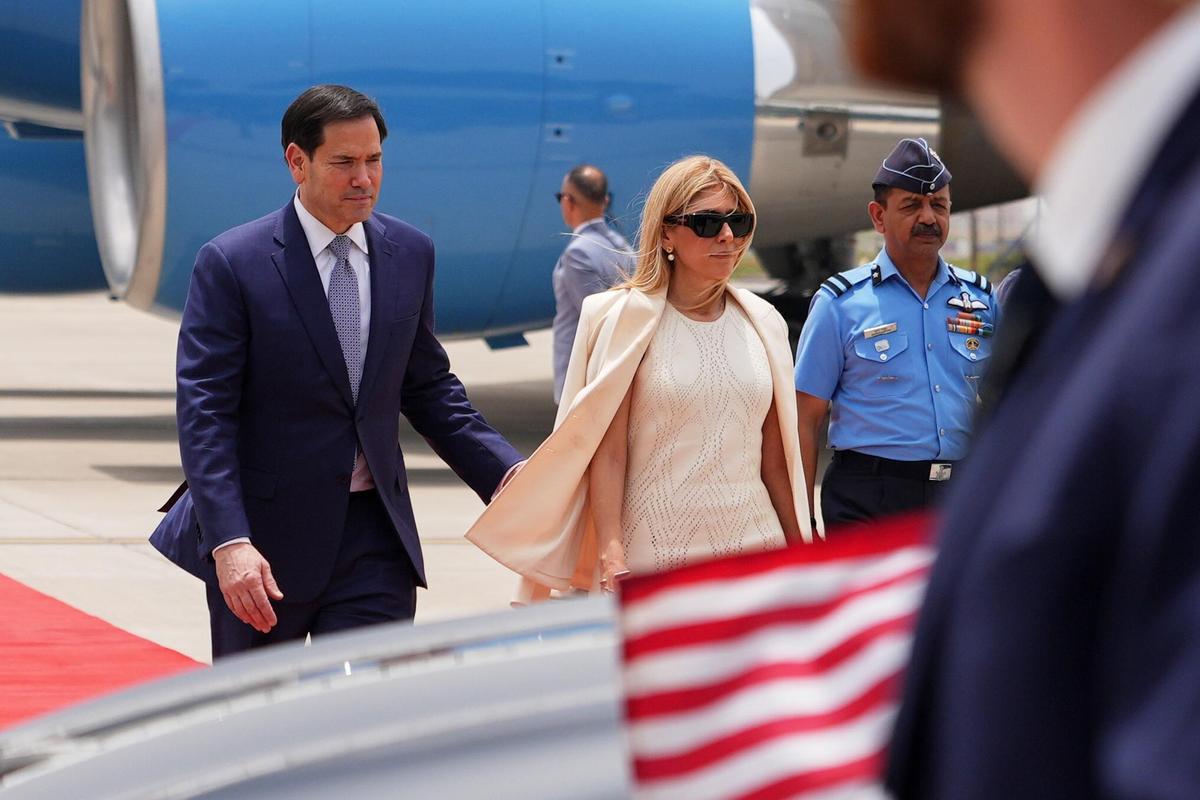
Can Rubio’s Visit Reset Washington–Delhi Relations? At a time when global politics is increasingly shaped by strategic competition, the relationship between the United States and India stands at an important crossroads. Over the last few years, observers on both sides have argued that ties between Washington and New Delhi have lost momentum. Trade disputes, disagreements over sanctions, and differing regional priorities have created the impression that the partnership is drifting without a clear direction. Against this backdrop, US Secretary of State Marco Rubio’s visit to India could become a defining moment in rebuilding confidence and restoring ambition in one of the world’s most consequential bilateral relationships.
The significance of the visit lies not merely in diplomatic symbolism but in timing. The global order is undergoing rapid transformation. China’s expanding influence, instability in supply chains, the race for artificial intelligence, and competition over advanced technologies have forced major powers to rethink their alliances and strategic priorities. In such an environment, cooperation between the world’s two largest democracies carries enormous geopolitical value.
For years, India and the United States have steadily deepened cooperation in defence, trade, technology, and regional security. Yet the relationship has often struggled with inconsistency. Washington’s sanctions policies and occasional outreach toward Pakistan have generated unease in New Delhi, while India’s strategic autonomy and independent foreign policy positions have sometimes frustrated American policymakers. Despite these differences, both nations understand that their long-term interests increasingly converge.
Rubio’s visit offers an opportunity to shift the relationship from cautious engagement to purposeful collaboration.
One of the most promising areas for deeper cooperation is critical minerals. The modern global economy depends heavily on resources such as lithium, cobalt, copper, and rare earth elements. These minerals are essential for semiconductors, electric vehicles, military equipment, renewable energy systems, and AI infrastructure. At present, global supply chains remain heavily dependent on China, creating vulnerabilities for both India and the United States.
A coordinated US-India strategy on critical minerals could therefore become a major pillar of future cooperation. By jointly identifying supply opportunities in regions such as Africa and Latin America, the two countries can diversify supply chains and reduce strategic dependence. Investments in copper mining in Zambia or specialized minerals in Chile, for example, could support industries ranging from clean energy to advanced aerospace manufacturing. More importantly, coordinated government support could encourage private companies from both countries to participate in long-term extraction, refining, and processing projects.
Another key area where the partnership can evolve is energy cooperation, particularly in nuclear power and digital infrastructure. The rapid expansion of artificial intelligence and cloud computing has dramatically increased the demand for energy-intensive data centres. Both India and the United States are racing to expand their digital economies, but sustaining this growth requires reliable and large-scale power generation.
This is where civilian nuclear energy can play a transformative role. India’s recent legal and regulatory changes have opened new possibilities for foreign participation in nuclear projects, including opportunities for American firms. Collaboration in this sector would not only strengthen clean energy production but also support the development of massive AI-driven data infrastructure. Nuclear-powered data centres may soon become an essential feature of future economies, and India-US cooperation could place both countries at the forefront of this transition.
Technology, however, remains the real centrepiece of the evolving partnership.
The growing focus on strategic technology cooperation reflects a recognition that the next phase of global competition will be determined not only by military strength but also by innovation. Artificial intelligence, quantum computing, semiconductor manufacturing, cybersecurity, and digital governance are rapidly becoming instruments of geopolitical influence.
India possesses a unique advantage in digital public infrastructure. Initiatives such as digital identity systems, online payment architecture, and large-scale public technology platforms have demonstrated India’s ability to implement technology at population scale. The United States, meanwhile, continues to lead in frontier innovation, advanced AI research, and venture capital ecosystems. Combining these strengths could create a mutually beneficial framework for technological growth.
The concept of “TRUST” — Transforming Relationship Utilising Strategic Technology — captures this broader vision. Under such an approach, India could integrate advanced American AI technologies into its rapidly expanding digital ecosystem, while US firms gain access to one of the world’s largest and fastest-growing technology markets. This would strengthen innovation, economic growth, and strategic alignment simultaneously.
The visit also has broader implications for regional security, especially through the Quad grouping involving India, the United States, Japan, and Australia. The Quad has emerged as a crucial platform for maintaining stability in the Indo-Pacific region, yet momentum within the grouping has slowed over the past year. Rubio’s participation in high-level discussions could help revive the initiative and reaffirm a shared commitment to a free, open, and rules-based Indo-Pacific.
Ultimately, the success of Rubio’s visit will depend on whether both sides can move beyond ceremonial diplomacy and focus on practical, long-term cooperation. Symbolic gestures alone will not redefine the partnership. What matters is whether Washington and New Delhi can build trust through sustained collaboration in technology, energy, trade, defence, and supply chains.
The US-India relationship today is not merely a bilateral partnership; it is increasingly a strategic necessity shaped by the realities of a changing world order. Rubio’s visit may not resolve every disagreement overnight, but it can provide the momentum needed to reset priorities and inject fresh ambition into a relationship that will play a decisive role in shaping the future global balance of power.