How Nvidia and Microsoft Are Re-Architecting the Personal Computer: The tech industry is standing on the precipice of its most significant architectural shift since the transition from command-line interfaces to the graphical user interface. For decades, the personal computer ecosystem has relied on a reliable, comfortable duopoly: Microsoft provided the operating system, and Intel (with AMD in close pursuit) provided the x86 processor architecture. This layout formed the backbone of the enterprise and consumer computing world.
That era is ending.
A series of deliberately cryptic social media posts from industry leaders has signaled that Nvidia—the current juggernaut of global technology—is poised to enter the consumer PC processor market. By teaming up with Microsoft, Nvidia is not just launching a new product; it is attempting to rescue Microsoft’s stumbling artificial intelligence PC strategy. Together, they aim to transition the industry away from traditional x86 processors toward a local, agent-driven AI ecosystem powered by Arm-based architecture.
The Breadcrumbs: Teasers and Coordinates
The public framing for this shift began with a calculated sequence of executive “vagueposting.” Nvidia published a teaser on X (formerly Twitter) declaring “A new era of PC,” accompanied by geographic coordinates. Industry observers quickly noted that these coordinates map directly to a location in Taiwan, signaling a major reveal at the upcoming Computex trade show in Taipei.
Nvidia Coordinates Target ➔ Computex (Taipei, Taiwan)
Microsoft Developer Teaser ➔ Build Conference (San Francisco, CA)
Simultaneously, Pavan Davuluri, the head of Microsoft’s Windows division, engaged in his own digital choreography. “Something new is coming for developers,” he posted. “And no, it’s not a new OS version. See you at Build next week!”
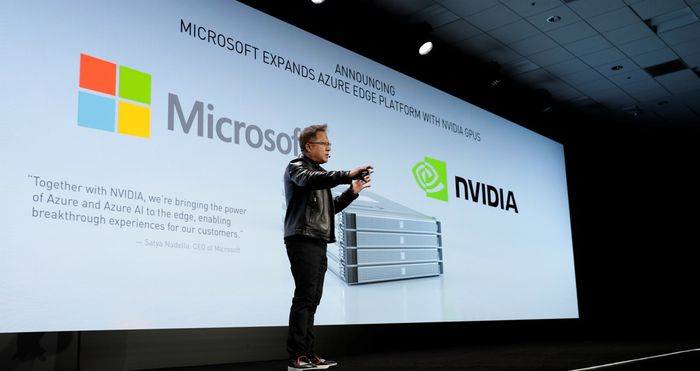
Behind these public hints lies a unified rollout plan. Sources indicate that Nvidia and Microsoft will officially unveil their joint hardware efforts across two core industry pillars: Microsoft’s Build developer conference in San Francisco and the Computex trade show in Taiwan.
Crucially, this is not a limited, experimental hardware pilot. The new Nvidia-powered chips are expected to debut not only inside Microsoft’s homegrown Surface hardware lineup but across major enterprise and consumer OEMs (Original Equipment Manufacturers), including Dell. By securing Day 1 commitments from massive volume shippers like Dell, Microsoft and Nvidia are signaling to software developers that this new silicon platform will immediately possess a viable, scalable install base.
Why the Second Wave of the AI PC Matters
To understand why an Nvidia-designed PC processor is such a seismic event, one must look at the immediate history of Microsoft’s recent hardware strategies. Microsoft’s initial push into the “AI PC” market via its Copilot+ branding was widely seen as a fragmented, problematic launch.
The initial Copilot+ PCs relied heavily on Qualcomm’s Snapdragon X Elite processors. While the hardware proved highly efficient, the software ecosystem stumbled out of the gate. The launch was severely marred by security and privacy backlashes surrounding its flagship feature, “Recall”—a tool designed to take constant, searchable screenshots of a user’s local activity. Security researchers quickly demonstrated that these screenshots were stored in unencrypted databases, forcing Microsoft to pull the feature back into testing, delay its wide release, and rethink its core implementation.
Furthermore, early emulation layers for legacy x86 software on these new Arm chips caused friction for enterprise buyers. The momentum slowed.
Nvidia’s arrival changes the power dynamic entirely.
Nvidia is not just a hardware manufacturer; it is the definitive economic engine of the modern AI ecosystem. Its CUDA software platform is the industry standard for AI developers worldwide. By attaching Nvidia’s brand, engineering resources, and developer mindshare to the Windows-on-Arm ecosystem, Microsoft gains immediate market credibility. If the first wave of the AI PC felt like a tentative experiment, this second wave represents an industrialized, heavily fortified assault on the market status quo.
Turning AI Inward: The Shift to Local Agents
The primary technological catalyst driving this partnership is a shift in how artificial intelligence operates. To date, the vast majority of consumer and enterprise AI interactions have occurred in the cloud. When a user prompts a chatbot or generates an image, that request travels over the internet to massive, liquid-cooled data centers packed with Nvidia enterprise GPUs (like the H100 or Blackwell architectures), processes the data, and returns the result.
This cloud-centric model is hitting a hard economic wall.
Cloud-Centric AI Model:  User ➔ Internet ➔ Data Center (Massive Server Costs) ➔ User
Local Agent AI Model:  User ➔ On-Chip Neural Processing Unit (Zero Cloud Cost)
As the tech industry transitions from passive, conversational chatbots to autonomous AI agents—software systems that can independently execute multi-step workflows, manage file structures, write code, and navigate applications—the computing costs are compounding exponentially. A chatbot requires computing power only when a user types a prompt. An autonomous agent running in the cloud, constantly evaluating its own outputs and executing tasks over hours, generates massive, continuous cloud-computing bills.
For enterprise businesses, these open-ended operating costs are unsustainable. The solution is local processing. If an enterprise can run these autonomous agents directly on the employee’s physical laptop, the marginal cost of running that AI drops to zero.
To facilitate this, Microsoft is preparing to debut deep operating system integrations designed specifically for local agent execution. The company has quietly built out a specialized internal team led by veteran systems engineer Omar Shahine. Additionally, Microsoft has deeply aligned itself with OpenClaw, an open-source framework designed to standardize and optimize how AI agents interact with local operating systems and applications. By scheduling OpenClaw founder Peter Steinberger (who currently works with OpenAI) to lead core developer breakout sessions at the Build conference, Microsoft is signaling to the global software engineering community exactly where it wants them to build: on top of local Windows APIs, accelerated by local silicon.
The Silicon Matrix: A Rising Tide for Arm Architecture
Nvidia’s entry into the consumer PC processor market does not merely threaten Intel and AMD; it fundamentally alters the competitive environment for its rivals, particularly Qualcomm.
Traditional PC chips use the x86 instruction set architecture, championed by Intel and AMD. Nvidia’s incoming PC chip, much like Qualcomm’s Snapdragon series and Apple’s highly successful M-series chips, utilizes the Arm architecture. Arm chips process instructions differently, prioritizing energy efficiency, thermal management, and highly specialized, heterogeneous computing blocks—such as dedicated Neural Processing Units (NPUs) and onboard graphics engines.
+-------------------------------------------------------------+
|                      THE PC CHIP LANDSCAPE                  |
+-------------------------------------------------------------+
|  Traditional Architecture (x86)   |  Modern AI Architecture (Arm) |
+-----------------------------------+-------------------------+
|  • Intel                          |  • Qualcomm             |
|  • AMD                            |  • Apple (macOS)        |
|                                   |  • Nvidia (Incoming)    |
+-----------------------------------+-------------------------+
Historically, Windows on Arm suffered from a classic “chicken-and-egg” problem: software developers refused to optimize their apps for Arm because the user base was too small, and consumers refused to buy Arm-based Windows PCs because their favorite apps ran poorly through translation layers.
When Qualcomm launched its latest chips, it began to crack this problem. However, Nvidia’s entry could shatter it completely. Nvidia brings unmatched graphics pedigree and a massive, loyal developer ecosystem. If Nvidia enters the Arm-based PC space, software developers can no longer treat Windows-on-Arm as a secondary niche. They will be forced to compile their applications natively for Arm to ensure compatibility with what will likely become premium enterprise and gaming tiers of Windows hardware.
Consequently, Nvidia’s entry provides immense structural validation for Qualcomm’s architecture. It shifts the industry narrative from “Qualcomm is trying to make an alternative type of Windows laptop” to “The entire premium Windows ecosystem is moving to Arm silicon.”
The Strategic Outlook
For Nvidia, this move represents the closing of a historical circle. The company built its multi-trillion-dollar valuation on graphics cards designed to sit next to other companies’ central processors. By designing the primary PC processor itself, Nvidia assumes full ownership of the compute stack inside the device, replicating the end-to-end hardware control that has made Apple so successful with its silicon strategy.
For Microsoft, this partnership provides the raw processing power and architectural stability required to realize its vision of an agent-driven operating system. It allows the company to move past the stumbling blocks of its initial Copilot+ launch and present enterprise clients with a clear, cost-effective roadmap for deploying local AI scale.
The upcoming presentations at Build and Computex are more than standard product announcements. They represent the formal opening of a new front in the silicon wars—one where traditional processor dominance is discarded in favor of architectural efficiency, local agent autonomy, and the undeniable market gravity of Nvidia. How Did Anthropic Reach a $965 Billion Valuation So Quickly? | Maya