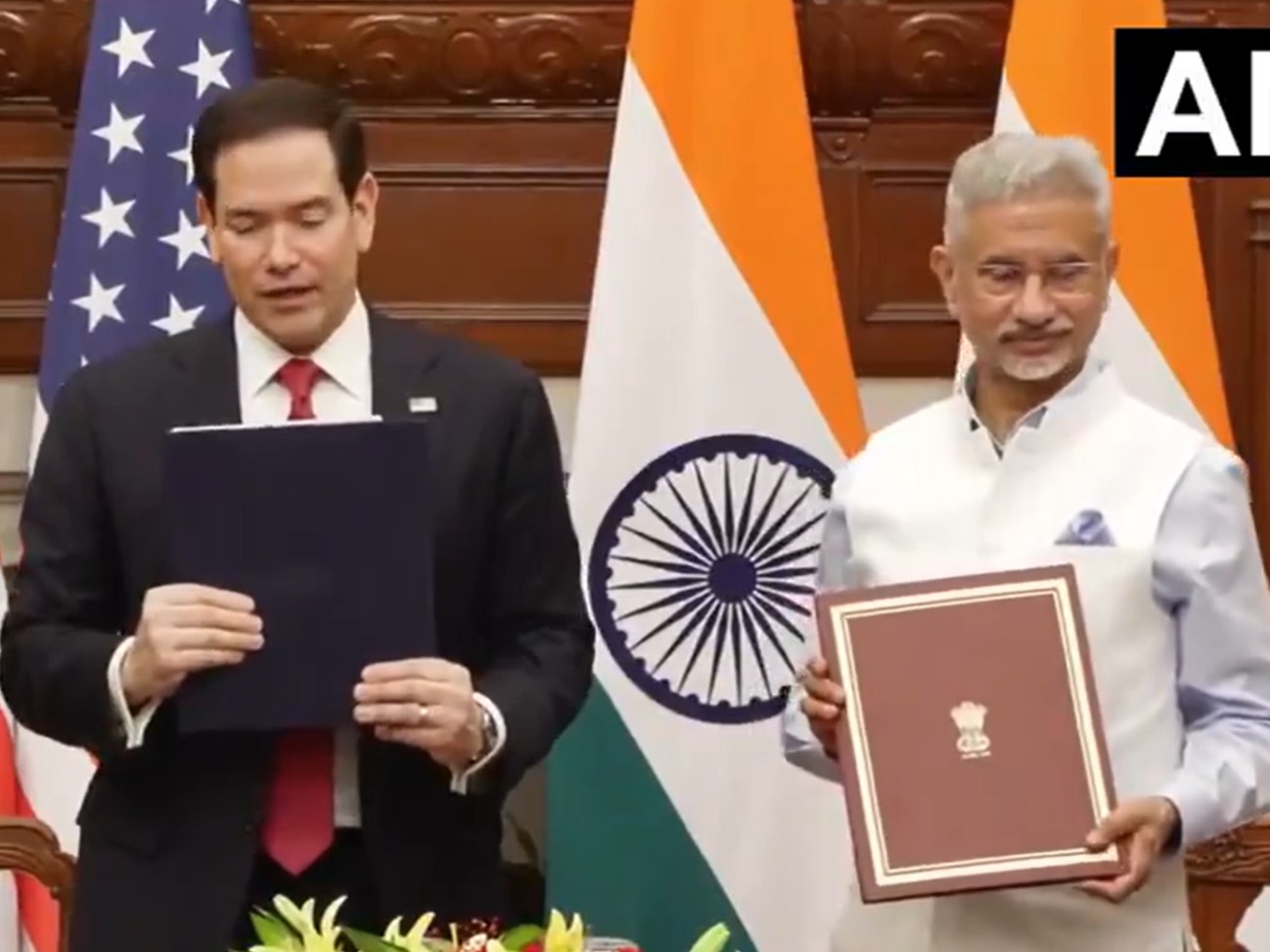
India and U.S. Sign Critical Minerals Framework Amid China Concerns- India and the United States have signed a major framework agreement on critical minerals cooperation, marking a significant step toward strengthening supply chain security and reducing global dependence on China for rare earths and strategic resources. The agreement was announced during the Quad Foreign Ministers’ meeting held in New Delhi, where leaders from India, the U.S., Japan, and Australia discussed economic security, maritime cooperation, and regional stability in the Indo-Pacific.
The new framework focuses on securing supplies of critical minerals that are essential for modern industries, including electric vehicles, semiconductors, renewable energy systems, telecommunications, and defense manufacturing. The move reflects growing global concern over China’s overwhelming dominance in the mining, refining, and processing of rare earth elements and other strategic minerals.
Officials from both countries described the agreement as a long-term partnership aimed at building resilient and diversified supply chains. The pact is expected to encourage investments in mineral exploration, processing infrastructure, recycling technologies, and advanced manufacturing.
Why Critical Minerals Matter
Critical minerals such as lithium, cobalt, graphite, nickel, and rare earth elements have become the backbone of the global clean energy transition and advanced technology sectors. These minerals are required to manufacture batteries for electric vehicles, solar panels, wind turbines, smartphones, aerospace equipment, and military hardware.
Over the last decade, China has emerged as the dominant force in the critical minerals ecosystem. Beijing controls a large share of the world’s rare earth mining and an even greater portion of refining and processing capacity. This concentration has created strategic vulnerabilities for countries that rely heavily on imports for industrial production and technological development.
Recent export restrictions imposed by China on certain minerals and processing technologies have intensified fears of supply disruptions. As geopolitical tensions continue to rise, countries are now racing to secure alternative supply chains and reduce strategic dependence on a single nation.
India-U.S. Partnership Gains Strategic Importance
The agreement between India and the U.S. comes at a time when both nations are expanding cooperation across defense, trade, technology, and energy sectors. Analysts believe the critical minerals framework adds a new dimension to the growing strategic partnership between New Delhi and Washington.
India possesses untapped reserves of several important minerals and has been working to strengthen domestic mining and processing capabilities. However, the country still depends significantly on imports for many critical resources needed for its rapidly expanding clean energy and electronics sectors.
The partnership with the United States is expected to provide India with technological expertise, investment opportunities, and access to advanced processing methods. In return, the U.S. gains a trusted partner in diversifying supply chains away from China and building a more secure Indo-Pacific economic network.
The framework also aligns with India’s larger economic ambitions, including boosting domestic manufacturing under the “Make in India” initiative and accelerating its transition toward green energy and electric mobility.
Quad’s Broader Economic Vision
The critical minerals agreement is also closely linked to the broader objectives of the Quad grouping, which includes India, the United States, Japan, and Australia. Originally focused on maritime security and strategic coordination, the Quad has increasingly expanded into areas such as technology, infrastructure, cybersecurity, climate action, and supply chain resilience.
During the New Delhi meeting, Quad leaders emphasized the need for trusted and transparent supply chains in strategic sectors. The grouping is reportedly exploring plans to mobilize billions of dollars in public and private investments for mining, refining, and logistics projects related to critical minerals.
Australia, which is rich in lithium and rare earth resources, and Japan, known for advanced technology and manufacturing, are expected to play important roles in future collaborative initiatives under the Quad framework.
Experts say the initiative could eventually lead to the creation of an alternative global minerals network capable of competing with China’s existing dominance.
Economic and Geopolitical Impact
The India-U.S. framework is likely to have both economic and geopolitical consequences. Economically, it could accelerate investment flows into mining, processing plants, and clean technology industries across India and other partner nations. It may also help stabilize supply chains for industries facing uncertainty over access to key raw materials.
Geopolitically, the agreement sends a strong message about the growing alignment among Quad nations on strategic economic issues. It reflects a broader international effort to reduce vulnerabilities in sectors considered critical for national security and future technological leadership.
For India, the deal strengthens its role as an emerging global manufacturing and technology hub. For the United States, it supports ongoing efforts to reduce reliance on Chinese-controlled supply networks.
As competition over resources increasingly shapes global politics, critical minerals are rapidly becoming one of the defining strategic assets of the 21st century. The India-U.S. partnership signals that both countries are preparing for a future where control over mineral supply chains could prove as important as oil and energy security were in previous decades. Huawei Introduces ‘Tau Scaling Law’ to Challenge Moore’s Law in Semiconductor Race | Maya