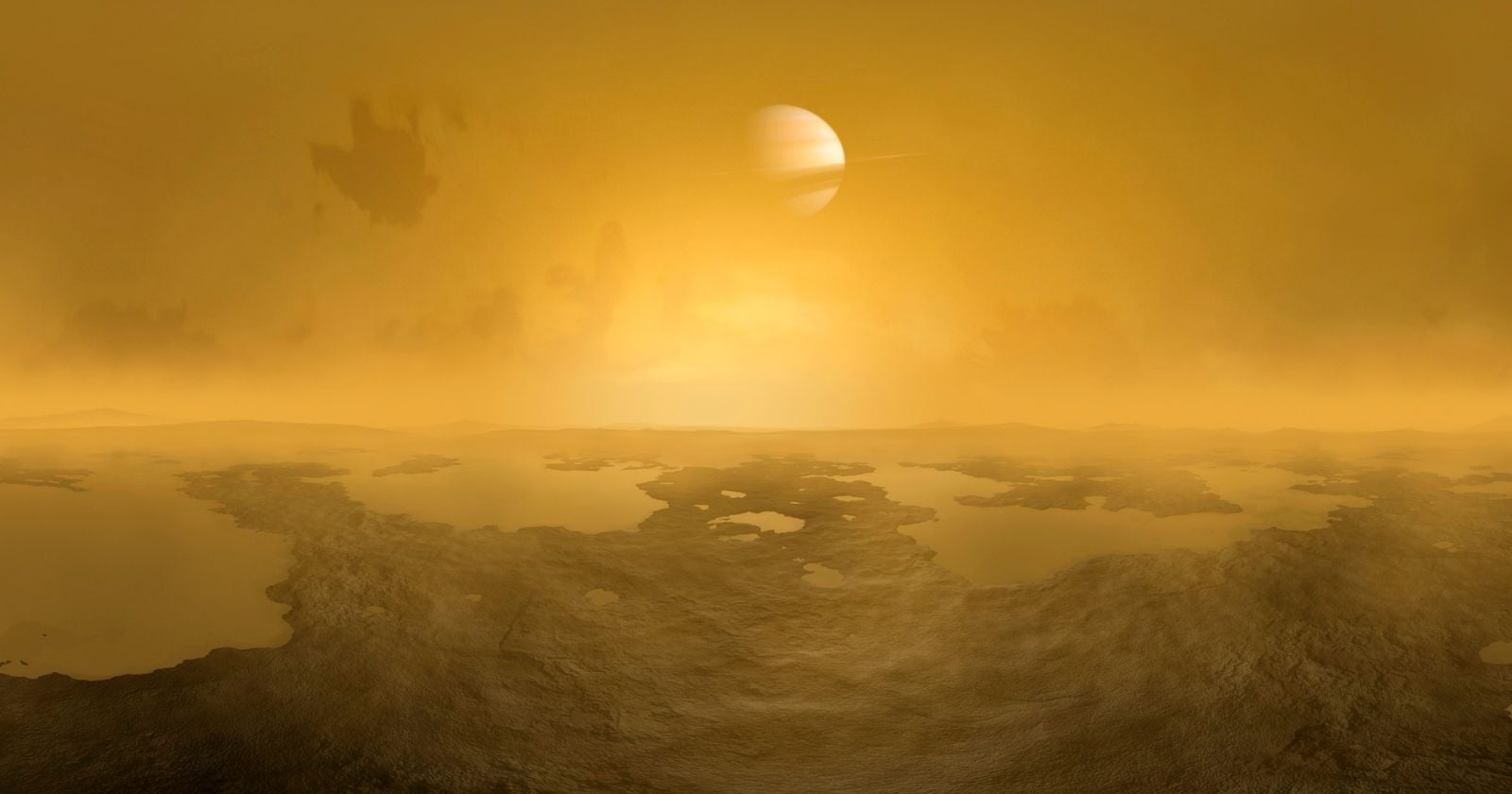
The Methane Seas of Titan: Why Saturn’s Moon Runs on Liquid Natural Gas — and What It Means for Life
A World That Shouldn’t Exist
Before 2004, planetary scientists weren’t sure what they would find beneath the orange smog of Titan. Saturn’s largest moon was wrapped in a dense nitrogen atmosphere thicker than Earth’s, yet it orbited nearly a billion miles from the Sun in a realm of deep freeze. Telescopes couldn’t penetrate the haze. Theoretical models suggested something strange — that a moon so cold its surface temperature hovers around minus 290 degrees Fahrenheit might have oceans. Not of water, which would be frozen as hard as granite, but of something else entirely.
When NASA’s Cassini spacecraft arrived at Saturn and began piercing Titan’s clouds with radar, the images that came back were startlingly familiar. Shorelines. River valleys. Dark, smooth patches nestled in topographic lows near the poles. By 2007, the verdict was in: Titan had lakes. Dozens of them. Some were small, crater-bound pools just a few miles across. Others were seas vast enough to dwarf the Great Lakes — Kraken Mare alone sprawled across an area comparable to the Caspian Sea.
But these were not water worlds. They were reservoirs of liquid methane and ethane, the same hydrocarbons we burn as natural gas, pooled on the surface of a moon where the chemistry of life as we know it should be impossible.
Titan had become the only place beyond Earth known to host stable liquid on its surface. And in doing so, it opened one of the most provocative questions in astrobiology: could a world running on liquid natural gas teach us how life begins?
The Cold Equation
To understand why Titan’s lakes are made of methane, you have to understand just how cold it is out there.
Titan orbits Saturn at an average distance of roughly 886 million miles from the Sun. At that remove, solar radiation arrives as a faint whisper — about one percent of the intensity we feel on Earth. The moon’s surface temperature sits at a steady minus 179 degrees Celsius. In that deep freeze, water isn’t a liquid. It’s bedrock. The mountains and plains of Titan are built from water ice frozen so hard it behaves like rock, eroding under rainfall and cracking under tectonic stress just as granite does on Earth.
But methane freezes at minus 296 degrees Fahrenheit, and ethane at minus 297. On Titan, both are comfortably liquid. They exist as fluids that can evaporate, condense into clouds, fall as rain, carve river channels, and pool in polar basins — a complete hydrological cycle, just with a different solvent.
Titan’s atmosphere is roughly 95 percent nitrogen, with the remaining five percent mostly methane. That methane is the engine of the entire system. Solar ultraviolet radiation and charged particles from Saturn’s magnetosphere continuously break apart methane molecules high in the atmosphere. The fragments recombine into a dizzying array of organic compounds — ethane, propane, acetylene, benzene, hydrogen cyanide, and complex tar-like molecules called tholins. These heavier organics drift downward, coating the surface in a thick layer of hydrocarbon snow and sediment. Over billions of years, the photochemical factory in Titan’s sky has manufactured more organic material than all of Earth’s known coal and oil reserves combined.
The lakes themselves are a blend. Radar and infrared measurements suggest the polar seas are dominated by ethane — perhaps three-quarters of the volume — mixed with methane, propane, dissolved nitrogen, and trace nitriles. In some places, the liquid is so still and viscous that Cassini detected no waves at all, even where calculations suggested wind should be stirring the surface. The lakes are eerily calm, their surfaces as smooth as glass, possibly skinned with films of solidifying organics or floating rafts of hydrocarbon ice.
The Cycle That Mimics Earth
The parallels to our own planet are uncanny. On Earth, water evaporates from oceans, rises into the atmosphere, condenses into clouds, and falls as rain, replenishing lakes and rivers before the cycle repeats. On Titan, the same choreography plays out with methane.
Solar energy, weak as it is, warms the surface just enough to drive evaporation. Methane vapor rises through the dense nitrogen air, cools, and condenses into clouds that drift across the sky. Cassini observed methane rain falling in the equatorial regions, carving channels into the water-ice bedrock. The liquid flows downhill, feeding river networks that terminate in the polar seas. There, in the relative darkness of the poles, evaporation is slow enough that the lakes persist as permanent reservoirs.
But the cycle is lopsided. Saturn’s orbit around the Sun takes nearly thirty Earth years, and Titan’s seasons shift accordingly. The northern hemisphere experiences a longer summer than the south because of the orbital eccentricity, which means more methane rain falls in the north over the course of a Saturnian year. This explains why the vast majority of Titan’s lakes — about 97 percent — cluster near the north pole, while the southern polar region is comparatively dry.
Some lakes appear to be fed not just by rainfall but by subsurface reservoirs, hydrocarbon aquifers seeping upward through fractures in the icy crust. Others sit in steep-walled depressions that may have formed through cryovolcanism or the explosive vaporization of subsurface nitrogen. The geology is alien, but the principle is recognizable: where liquid collects, it reshapes the world.
The Question of Life in a Natural Gas Ocean
Here is where Titan becomes more than a geological curiosity. It becomes a laboratory for the origin of life — one that operates on rules we barely understand.
On Earth, life requires liquid water. Water is a polar solvent, meaning it dissolves salts and minerals, transports nutrients, and provides a medium for the complex chemical reactions that build proteins, DNA, and cells. At minus 290 degrees, those reactions are frozen in place. Titan’s surface is far too cold for life as we know it. No organism built from Earthly biochemistry could survive in a methane lake.
And yet, the ingredients are all there. Organic molecules rain from the sky. Energy sources abound — solar radiation, Saturn’s magnetospheric particles, and potentially hydrothermal chemistry deep within the moon’s interior. The surface is a canvas of carbon-rich material. The only missing piece, from an Earth-centric perspective, is liquid water.
But what if life doesn’t require water? What if it can use liquid hydrocarbons instead?
In 2005, chemist Steven Benner and his colleagues proposed that the organic reactivity possible in hydrocarbon solvents is no less versatile than in water. On Earth, many critical biological reactions actually require the absence of water to proceed. A cell membrane, for instance, must keep its interior aqueous environment sealed off from the outside world. Hydrocarbon solvents could theoretically support their own biochemistry — one built from different building blocks, operating at different temperatures, following different rules.
This is the tantalizing possibility of “life, but not as we know it” — organisms that might drink methane instead of water, build membranes from acetylene instead of phospholipids, and metabolize ethane instead of glucose. We have no evidence such life exists. But Titan is the one place in the solar system where the physical conditions allow us to seriously ask the question.
Protocells in a Methane Raindrop
In July 2025, a study published in the International Journal of Astrobiology added a new layer of intrigue. Researchers from NASA’s Goddard Space Flight Center and the University of Duisburg-Essen proposed a mechanism by which cell-like structures — vesicles — could form naturally in Titan’s hydrocarbon lakes.
On Earth, vesicles form when amphiphile molecules self-organize into spherical membranes in water. These structures are considered a crucial step toward the origin of life, providing compartments that can concentrate chemicals and protect reactions from the outside environment. The researchers asked whether a similar process could occur in liquid methane.
Their model suggests it can. In Titan’s lakes, organic molecules produced by atmospheric chemistry could accumulate as surface films. When methane raindrops splash into the lakes — and Cassini has observed rain on Titan — the impacts would throw up a mist of tiny droplets coated in these organic films. As the droplets fall back to the surface and sink, the surface film and the droplet’s own coating could merge, forming a double-layered membrane around the droplet. The result would be a stable vesicle: a hollow sphere with an internal pocket of liquid, floating in the hydrocarbon sea.
These would not be alive. They would be protocells — primitive containers that represent an increase in chemical order and complexity. But if such structures can form spontaneously on Titan, they would demonstrate that the first steps toward life-like organization are possible even in a methane world.
As NASA planetary scientist Conor Nixon noted, the existence of any vesicles on Titan would show “an increase in order and complexity, which are conditions necessary for the origin of life.” It would mean the path from simple chemistry to organized structures is not unique to watery worlds.
The Dragonfly and the Two Questions
The search for answers is about to get a lot more concrete. NASA’s Dragonfly mission, a car-sized nuclear-powered rotorcraft, is scheduled to launch no earlier than 2028 and arrive at Titan in the mid-2030s. It will fly through the dense atmosphere from site to site, sampling the surface and atmosphere with a suite of instruments designed to probe the moon’s chemistry.
Dragonfly’s primary target is Selk Crater, an 80-kilometer-wide impact scar near the equator. The impact that formed Selk would have melted Titan’s water-ice bedrock, creating a pool of liquid water that could have persisted for thousands of years beneath an insulating crust. If ammonia or other natural antifreezes were present, the pool might have remained liquid even longer — long enough for the organic material raining down from the atmosphere to mix with liquid water and undergo the kind of prebiotic chemistry that may have sparked life on Earth.
“Titan allows us to uncover some of the steps” toward life, says Zibi Turtle, Dragonfly’s principal investigator. “On Earth, life has reshaped nearly everything, burying its chemical forebears beneath eons of evolution. On Titan, we can explore the chemical processes that may have led to life without life complicating the picture.”
The mission will look for two kinds of biosignatures. The first is chemical evidence of water-based life, either from the ancient impact melt at Selk or from a hypothesized subsurface ocean that may exist deep beneath Titan’s icy crust. The second is far more exotic: chemical patterns that might indicate a hydrocarbon-based biochemistry operating in the lakes or subsurface aquifers.
Dragonfly’s mass spectrometer will search not for specific molecules but for patterns of complexity — the kind of molecular distributions that, on Earth, only biology produces. Amino acids, for instance, appear in characteristic ratios when life is involved. A sterile world would manufacture only the simplest ones. If Titan’s organic chemistry has progressed beyond randomness into organized complexity, the instrument may detect the signature.
What Titan Is Really Teaching Us
Titan’s methane lakes are not a second Earth. They are something stranger and, in some ways, more valuable. They show us that the physical machinery of a world — evaporation, precipitation, erosion, sedimentation — can operate with different working fluids and still produce landscapes that look eerily familiar. Shorelines are shorelines, whether the liquid lapping at them is water or ethane. River deltas form by the same laws of gravity and fluid dynamics regardless of the chemistry.
But the deeper lesson is about the flexibility of nature’s rules. We have spent decades searching for habitable worlds by following the water, assuming that liquid H2O is the non-negotiable prerequisite for life. Titan challenges that assumption not by proving life can exist without water, but by proving that complex organic chemistry, active cycles, and even precellular structures can arise in an environment we would have written off as sterile.
If life is a phenomenon that can organize itself in multiple solvents, at multiple temperatures, using multiple chemical alphabets, then Titan expands the habitable frontier of the universe in ways we are only beginning to grasp. And if life turns out to be impossible there — if billions of years of organic rain and liquid methane have produced nothing more than complex tar — then Titan becomes a cautionary tale. It tells us that ingredients and time are not always enough. That the leap from chemistry to biology may require something more specific, more fragile, more miraculous than we hoped.
Either way, the answer matters. Either way, the methane seas of Titan hold a mirror up to our own origins.
When Dragonfly touches down in the equatorial dunes and begins its long flight toward Selk Crater, it will be exploring a world where natural gas flows like water, where ice is bedrock, and where the sky rains organic molecules onto a frozen landscape that resembles a young Earth in deep winter. It will be searching for the boundary between what is merely chemistry and what becomes alive.
The lakes of Titan are not alive. But they may be the closest thing we have found to a cradle — a cold, dark, hydrocarbon cradle, waiting to tell us whether the spark of life is a universal constant or a singular accident that happened once, in a warm pool, on a small blue planet, a very long time ago. Why do space missions sometimes cause radio blackouts on Earth? | Maya