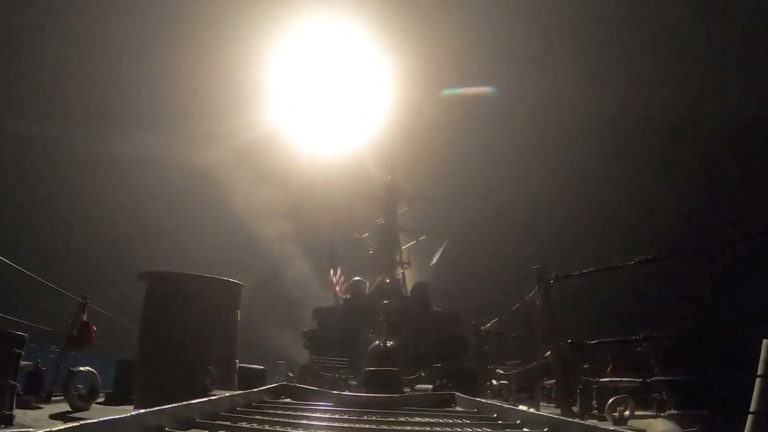
US Launches Seventh Straight Night of Strikes on Iran as Tensions Rise Around Strait of Hormuz: The United States carried out a seventh consecutive night of military strikes on Iran late Friday, intensifying a conflict that has increasingly focused on the strategically vital Strait of Hormuz, one of the world’s busiest oil shipping routes.
The U.S. military said the latest operation began at around 7 p.m. GMT and targeted sites linked to Iran’s military infrastructure. According to U.S. Central Command (CENTCOM), the strikes were intended to “continue degrading Iranian military capabilities” as Washington presses its campaign against Tehran.
Iranian state-affiliated media reported explosions in several parts of the country, including the cities of Sirik, Ahvaz and Yazd. While officials acknowledged the attacks, they did not immediately provide details on casualties or the extent of the damage.
The latest strikes mark the seventh consecutive night of U.S. military action, underscoring the rapid escalation in hostilities between the two countries. The sustained campaign has heightened concerns that the conflict could spread beyond direct military exchanges and disrupt regional stability.
Attention has increasingly shifted to the Strait of Hormuz, the narrow waterway connecting the Persian Gulf with the Gulf of Oman and the Arabian Sea. Roughly one-fifth of the world’s seaborne oil passes through the strategic chokepoint, making any disruption a major concern for global energy markets.
Late Friday, Iran’s Islamic Revolutionary Guard Corps (IRGC) claimed that two oil tankers had struck naval mines in the Strait of Hormuz and exploded. The announcement raised immediate fears that commercial shipping in the area could be under threat.
However, the U.S. military quickly rejected the claim, calling it false and saying there was no evidence that such an incident had occurred. American officials accused Iran of spreading misinformation at a time of heightened regional tensions.
The conflicting accounts could not be independently verified, leaving uncertainty over the situation in one of the world’s most strategically important maritime corridors.
The Strait of Hormuz has long been a flashpoint in regional security. Previous confrontations involving Iran, the United States and commercial vessels have led to temporary disruptions in shipping and increased insurance costs for cargo passing through the area. Analysts warn that any confirmed attack on oil tankers could have immediate consequences for global crude prices and international trade.
Military analysts say the continued U.S. air campaign suggests Washington is seeking to weaken Iran’s military capabilities while attempting to deter further retaliation. At the same time, the repeated strikes risk prompting a broader response from Tehran or its regional allies, raising fears of a wider conflict across the Middle East.
Governments and shipping companies are closely monitoring developments around the Strait of Hormuz, with several maritime security agencies urging vessels operating in the region to remain on high alert.
As the conflict enters its second week of sustained U.S. military operations, international concern continues to grow over the possibility of further escalation and its potential impact on regional security, global energy supplies and international commerce.