Where History Happened: 15 Great Destinations and the Powers That Ruled Them Longest- Standing in the Colosseum is a different experience when you know who built it, who watched from the stands, and who took its marble for other buildings a thousand years later. Most cities are layered like this. The people who held a place longest usually shaped its streets, religion, food, and language the most, and that is who you meet when you visit.
This guide covers fifteen of the world’s great historic destinations, in rough geographic order. Each entry gives you the essential story, the longest-ruling power or ruler, and what to look for when you get there. Dates for ancient events are approximate, and in a few cases “longest ruler” depends on how you count. I’ve flagged those.
Europe
1. Rome, Italy
The story: According to tradition, Rome was founded in 753 BC. It grew from a small city-state into a republic (509 BC) and then an empire (27 BC), eventually ruling the entire Mediterranean world. The Western Roman Empire ended in AD 476, but the city did not fade away. It became the center of the Catholic Church, and the popes governed Rome and surrounding lands as the Papal States for over a thousand years, until Italy’s unification in 1870. Rome became the Italian capital in 1871.
Ruled longest: Roman rule of the city spans roughly 1,200 years from the Republic to 476, though the papacy’s control of Rome (from the 8th century to 1870) is also enormous. The longest-reigning emperor was Augustus, who ruled for about 41 years (27 BC to AD 14) and turned a violent republic into a stable empire.
What to see: The Colosseum (opened AD 80), the Roman Forum, the Pantheon (rebuilt under Hadrian around AD 126, still the world’s largest unreinforced concrete dome), and Vatican City with St. Peter’s Basilica. Tip: look at how many ancient columns were reused in churches. Rome constantly recycled itself.
2. Athens, Greece
The story: Athens’ golden age came in the 5th century BC, when it developed democracy, theater, philosophy, and the architecture that defines the city today. The Parthenon was built between 447 and 432 BC under the statesman Pericles. After Athens lost its power, it passed through Macedonian, Roman, Byzantine, and Frankish hands.
Ruled longest: The Ottoman Empire, which held Athens from 1458 until Greek independence in the 1830s, about 375 years (with a short Venetian interruption in the 1680s). Ottomans even used the Parthenon as a mosque and, at one point, a gunpowder store. In 1687, a Venetian shell ignited the powder and blew out the middle of the building, which is why it is a ruin today.
What to see: The Acropolis and the Acropolis Museum, the ancient Agora, and the old Plaka district, where Ottoman-era houses survive. The debate over the Parthenon sculptures held in London is a living part of the story.
3. Istanbul, Türkiye
The story: Few cities have been a capital of two world empires. The Roman emperor Constantine dedicated the city as his new capital in AD 330, and it became Constantinople, heart of the Byzantine Empire. In 537, Emperor Justinian completed the Hagia Sophia, the largest cathedral in the world for nearly a thousand years. In 1453, the Ottoman sultan Mehmed II conquered the city, and it remained the Ottoman capital until the empire collapsed in the early 1920s.
Ruled longest: The Byzantine Empire held the city for about 1,120 years (330 to 1453). The longest-reigning Byzantine emperor was Basil II, who ruled for nearly half a century (976 to 1025) and expanded the empire to its greatest medieval strength. The Ottoman dynasty then held the city for about 470 years.
What to see: Hagia Sophia (cathedral, then mosque, then museum, now a mosque again), the Blue Mosque, Topkapı Palace (begun by Mehmed II in the 1450s), the Basilica Cistern, and the Theodosian land walls that protected Constantinople for a thousand years.
4. Paris and Versailles, France
The story: Paris began as a Roman settlement on an island in the Seine and became the French capital under medieval kings. Notre-Dame was begun in 1163, and the Louvre started as a fortress around 1190 before becoming a palace and later a museum. Royal power peaked under Louis XIV, who moved the court to the vast palace at Versailles. The French Revolution (1789) ended the absolute monarchy and reshaped modern politics.
Ruled longest: Louis XIV, the “Sun King,” reigned for 72 years (1643 to 1715), the longest verified reign of any monarch of a sovereign country in European history. He became king at four years old.
What to see: The Palace of Versailles and its Hall of Mirrors, Notre-Dame (reopened after the 2019 fire), the Louvre, the Conciergerie, where Marie Antoinette was held, and the Panthéon.
5. London, England
The story: The Romans founded Londinium in AD 43, and it was abandoned and revived over the following centuries. After William the Conqueror’s invasion in 1066, he built the White Tower, the core of the Tower of London, to overawe the city. London later became the center of a global empire, survived the Great Fire of 1666 and the bombing of the Second World War, and is still the capital of the United Kingdom.
Ruled longest: Queen Elizabeth II, who reigned for 70 years and 214 days (1952 to 2022), the longest-reigning British monarch. Before her, Queen Victoria held the record at 63 years. Roman rule over Britain lasted about 370 years.
What to see: The Tower of London, Westminster Abbey (every coronation since 1066), the Houses of Parliament, St Paul’s Cathedral (rebuilt by Christopher Wren after the Great Fire), and the British Museum.
6. Granada and Córdoba, Spain
The story: In 711, Muslim armies crossed from North Africa into Iberia, beginning al-Andalus. For centuries, it was one of the most advanced civilizations in Europe, with libraries, science, and architecture that influenced the continent. Córdoba’s Great Mosque was begun around 785 and became the heart of a caliphate. Granada was the last Muslim kingdom, falling to Ferdinand and Isabella in January 1492.
Ruled longest: Muslim rule in Iberia lasted nearly 800 years overall. In Granada itself, the Nasrid dynasty ruled from the 13th century until 1492, roughly 250 years, and built the Alhambra palaces.
What to see: The Alhambra and Generalife gardens in Granada, the forest of arches in Córdoba’s Mezquita-Catedral (a cathedral built inside a mosque), and Seville’s Alcázar.
The Middle East and Africa
7. Egypt: Giza, Luxor, and Cairo
The story: Pharaonic Egypt lasted roughly 3,000 years, from unification around 3100 BC to Cleopatra’s death in 30 BC. The Great Pyramid of Giza was built for Pharaoh Khufu around 2560 BC and was the tallest human-made structure on Earth for nearly 4,000 years. Later rulers included Persians, Greeks (the Ptolemies), Romans, Arab conquerors (from AD 641), Mamluks, Ottomans (from 1517), and the dynasty of Muhammad Ali (1805 to 1953).
Ruled longest: Ancient Egypt’s pharaohs collectively. Among individuals, Ramesses II ruled for about 66 years (c. 1279 to 1213 BC) and built Abu Simbel. Tradition credits Pepi II with an even longer reign, possibly over 90 years, but historians dispute the figure.
What to see: The Giza pyramids and Sphinx, the Egyptian Museum and the Grand Egyptian Museum area, Luxor’s Karnak Temple and the Valley of the Kings, and Islamic Cairo for its Mamluk-era mosques.
8. Jerusalem
The story: Few cities carry as much religious weight for so many people. Jews trace it to the Temples of Solomon and the Second Temple, destroyed by Rome in AD 70. Christians revere it as the site of Jesus’ crucifixion and resurrection, and Muslims as the place of the Prophet’s Night Journey. The Dome of the Rock was completed in 691 to 692 under the Umayyad caliph Abd al-Malik. Crusaders held the city from 1099 to 1187, until Saladin recaptured it.
Ruled longest: The Ottoman Empire, from 1517 to 1917, about 400 years. The walls of the Old City that you see today were rebuilt by Sultan Suleiman the Magnificent in the 1530s.
What to see: The Western Wall, the Church of the Holy Sepulchre, the Dome of the Rock and Al-Aqsa Mosque, and the Old City’s four quarters. Check current travel conditions and access rules before you go, as these can change quickly.
Asia
9. Delhi and Agra, India
The story: Delhi has been a capital repeatedly. The Delhi Sultanate ruled from 1206, and the Qutb Minar was begun around 1199. Then the Mughals took over after 1526 and shaped the north Indian world. Emperor Shah Jahan built the Red Fort (1639 to 1648) and, in Agra, the Taj Mahal (begun 1632) in memory of his wife Mumtaz Mahal. After the 1857 uprising, the British ended Mughal rule, shifted their capital from Calcutta to Delhi in 1911, and inaugurated New Delhi in 1931.
Ruled longest: The Mughal dynasty, about 330 years nominally (1526 to 1857), though real power faded long before the end. The longest-reigning emperors were Akbar (1556 to 1605) and Aurangzeb (1658 to 1707), each around 49 years. Akbar is remembered for his administration and religious tolerance. Aurangzeb expanded the empire to its largest extent.
What to see: The Red Fort, Humayun’s Tomb (an early model for the Taj), Qutb Minar, Jama Masjid, and the Taj Mahal and Agra Fort in Agra.
10. Beijing, China
The story: Beijing has been a capital for much of the last 800 years. The Mongol Yuan dynasty built Dadu here in the 13th century. After the Ming dynasty (founded 1368) first ruled from Nanjing, the Yongle Emperor moved the capital to Beijing and built the Forbidden City between 1406 and 1420. The Qing dynasty took over in 1644, and the last emperor abdicated in 1912.
Ruled longest: The Qing dynasty held Beijing for about 268 years, slightly longer than the Ming in Beijing (about 220 years). The Kangxi Emperor (1661 to 1722) reigned for 61 years, the longest of any Chinese emperor in the traditional record.
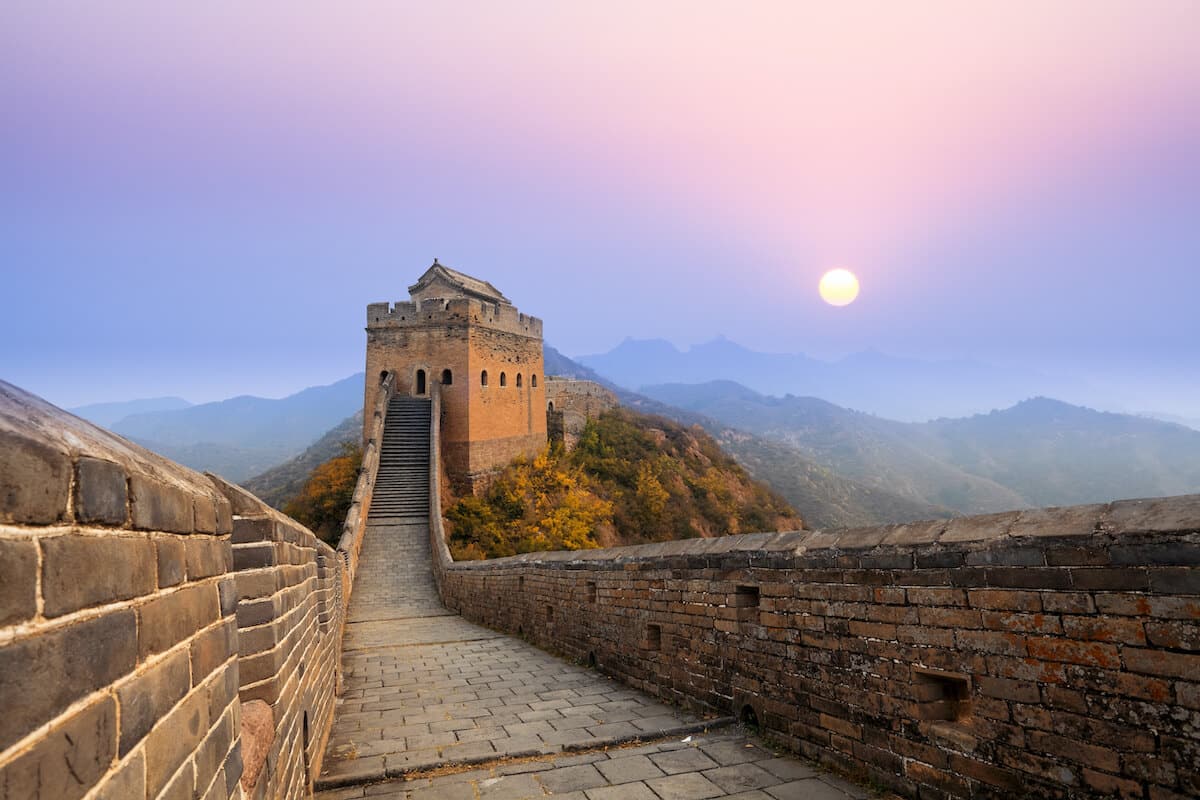
What to see: The Forbidden City, the Temple of Heaven, the Summer Palace, and the Great Wall at Mutianyu or Badaling. Most of the best-preserved Great Wall sections you’ll walk are Ming-era rebuilds, not the earliest walls.
11. Kyoto, Japan
The story: Kyoto, then called Heian-kyō, became the imperial capital in 794 and stayed so for over a thousand years until the emperor moved to Tokyo in 1868. Because of that, Kyoto holds an extraordinary number of temples, shrines, and gardens. Its political reality was more complicated. From the 12th century, military shoguns held real power, and the emperor was often a ceremonial figure.
Ruled longest: The imperial line reigned in Kyoto for about 1,070 years, though often without real power. The shogunate with the longest effective rule was the Tokugawa, from 1603 to 1868 (about 265 years), who governed from Edo (now Tokyo) but built Nijō Castle in Kyoto.
What to see: Kinkaku-ji (the Golden Pavilion, 1397), Fushimi Inari’s thousands of gates, Kiyomizu-dera, Nijō Castle, and the old Gion district.
12. Angkor, Cambodia
The story: The Khmer Empire was founded in 802 and, over six centuries, built the largest pre-industrial city in the world around what is now Siem Reap. Suryavarman II built Angkor Wat in the early 12th century as a Hindu temple. A century later, Jayavarman VII, a Buddhist king, built Angkor Thom and the smiling faces of the Bayon. The Khmer capital shifted south after the 1400s, but Angkor Wat was never fully forgotten. It stayed a Buddhist pilgrimage site. France ran Cambodia as a protectorate from 1863 to 1953.
Ruled longest: The Khmer Empire held Angkor for roughly 600 years.
What to see: Angkor Wat at sunrise, the Bayon, Ta Prohm (wrapped in tree roots), and Banteay Srei. Buy a multi-day pass, since one day is not enough.
The Americas
13. Mexico City, Mexico
The story: The Mexica (Aztecs) founded Tenochtitlan on an island in Lake Texcoco in 1325. By the early 1500s, it was one of the largest cities in the world. In 1519, Hernán Cortés arrived with Spanish forces and many indigenous allies, and the city fell in 1521. The Spanish built Mexico City on top of it, and it became the capital of the Viceroyalty of New Spain.
Ruled longest: Spain, for about 300 years (1521 to 1821). The Aztec Triple Alliance itself dominated central Mexico for under a century (1428 to 1521).
What to see: The Templo Mayor ruins beside the Metropolitan Cathedral (built with stones from the temples), the National Museum of Anthropology, and the pyramids of Teotihuacan outside the city, a much older civilization that was already ancient when the Aztecs arrived.
14. Cusco and Machu Picchu, Peru
The story: Cusco was the capital of the Inca Empire, which grew rapidly under Pachacuti from about 1438 and became the largest empire in the Americas. Machu Picchu was built around 1450 as a royal estate. The Spanish conquistador Francisco Pizarro captured the Inca ruler Atahualpa in 1532, took Cusco in 1533, and the Inca state collapsed. Machu Picchu was abandoned and is not recorded in Spanish chronicles, which is a big reason it survived. It became known internationally after Hiram Bingham’s 1911 expedition.
Ruled longest: Spain, for nearly three centuries (1533 to the early 1820s). The Inca Empire was remarkably brief, roughly a century in its imperial form.
What to see: Machu Picchu, the Sacsayhuamán fortress above Cusco, and Cusco’s streets, where Spanish buildings sit on precisely cut Inca stone foundations. Acclimatize to the altitude first.
Reading a Place Like a Historian
A few habits will make every trip richer:
- Look for reuse. Columns in churches, mosque arches in cathedrals, and colonial buildings on temple platforms all show who came next and what they wanted to say.
- Ask who is missing. Many monuments celebrate winners. Local museums often tell the other side.
- Distinguish ruler from rule. Emperors and kings often reigned symbolically while others held real power, as with Japan’s emperors or the later Mughals.
- Trust the layers. Start with the oldest period and ask what each newcomer kept, destroyed, or renamed.
- Check current conditions. Opening hours, entry rules, and site access change, and some places, such as Hagia Sophia, have changed status in recent years. Check official sites before you travel.
A Note on “Longest Ruler”
“Who ruled longest” has a few catches. Dynasties are counted differently by different historians, early reign lengths in ancient records are sometimes legendary, and nominal rule (a title) is not the same as real control. I’ve used widely accepted figures, but you’ll find variations between sources.
Where to Begin
If you only have time for a few, an excellent first trio would be Rome for the classical world, Istanbul for a city that links Europe and Asia across two empires, and Delhi and Agra for the Mughal world. Add Kyoto and Cusco if you want to see very different civilizations on their own terms.
Wherever you go, the best question to ask is simple: who held this place the longest, and what did they leave behind? The answer is usually standing in front of you.