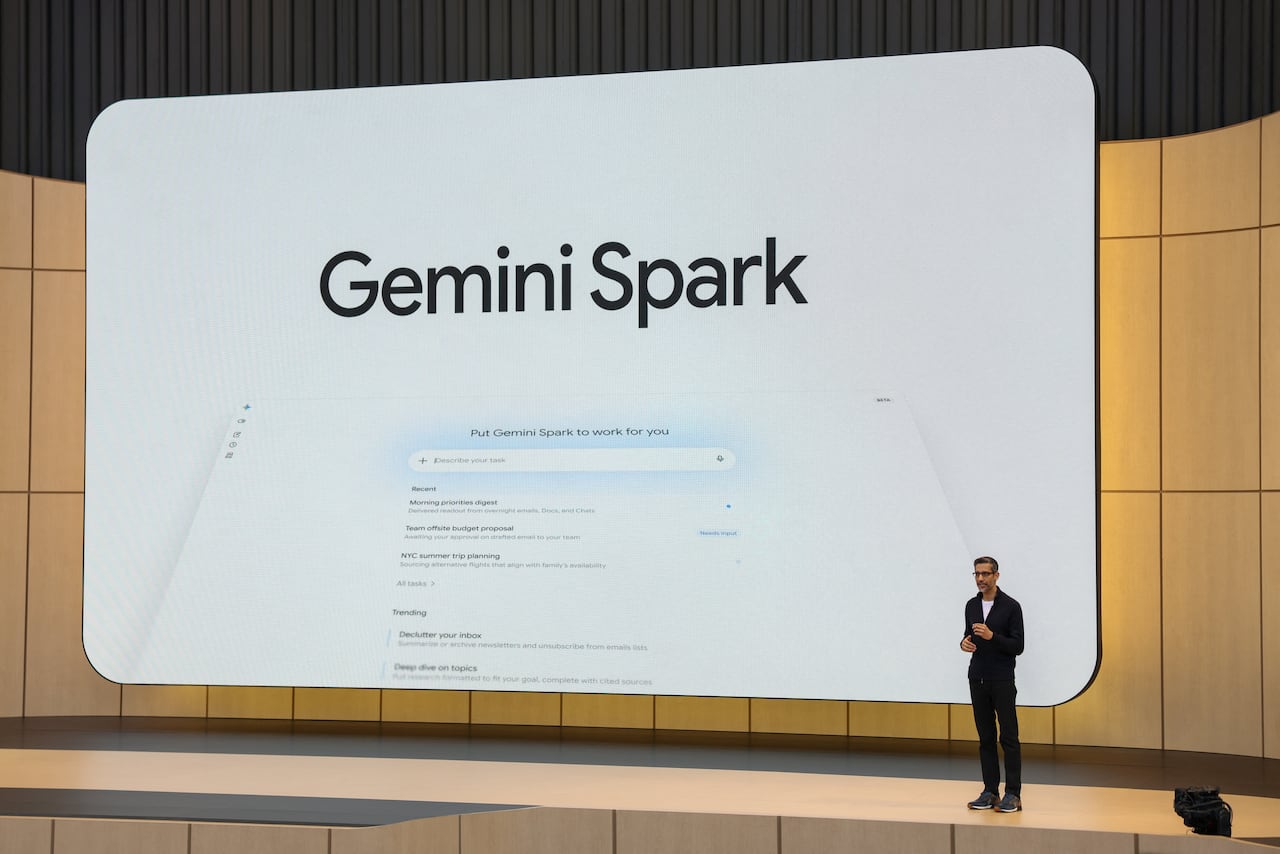
Google Reveals Next-Gen Gemini Models Amid Intensifying AI Race-Google has unveiled a sweeping new wave of artificial intelligence products and upgrades, signaling its strongest push yet to compete with rivals OpenAI and Anthropic in the rapidly evolving AI industry. At its annual Google I/O developer conference, the company introduced new Gemini models, advanced AI agents, and multimodal tools aimed at transforming how users interact with technology across search, productivity, video, and mobile platforms.
The announcements make one thing clear: Google is no longer treating AI as a side feature. The company now sees artificial intelligence as the foundation of its future ecosystem.
For the past two years, the AI race has largely been dominated by OpenAI, whose ChatGPT platform changed the way consumers use AI tools. Anthropic has also emerged as a serious challenger, especially among businesses and developers seeking advanced reasoning and coding capabilities. With pressure mounting from investors, competitors, and users, Google is now attempting to prove that it can lead the next phase of AI innovation.
At the center of Google’s latest strategy are three major developments — Gemini 3.5 Flash, Gemini Spark, and Gemini Omni.
Gemini 3.5 Flash Becomes Google’s Core AI Model
One of the biggest announcements at Google I/O was Gemini 3.5 Flash, a faster and more efficient version of the company’s AI model lineup. Google says the model is designed to deliver high-end AI performance while reducing costs and improving response speed.
According to the company, Gemini 3.5 Flash will now serve as the default model powering the Gemini app as well as AI features inside Google Search. The focus is on creating a system that responds quickly without sacrificing reasoning quality or accuracy.
Google executives described the model as one of the fastest in its category, capable of handling advanced tasks with significantly lower latency. The company also highlighted improvements in coding assistance, contextual understanding, and cybersecurity safeguards.
The launch reflects a larger industry trend where AI companies are no longer competing only on intelligence benchmarks. Speed, scalability, and affordability are becoming equally important as firms race to bring AI to billions of users.
Rather than building models that are only powerful in research settings, Google appears focused on practical deployment at massive scale.
Gemini Spark Introduces Google’s AI Agent Vision
Another major reveal was Gemini Spark, a new AI agent integrated directly into the Gemini app. Unlike traditional chatbots that simply answer questions, Spark is designed to complete actions on behalf of users.
Google says the system can interact across connected applications and services, helping users manage tasks with minimal input. The company envisions Spark assisting with scheduling, research, organization, productivity workflows, and digital task management.
This marks Google’s entry into what many industry experts call “agentic AI” — systems that move beyond conversation and begin acting more independently.
The idea of AI agents has quickly become one of the most competitive areas in the technology industry. OpenAI has already begun introducing more autonomous capabilities into ChatGPT, while Anthropic has focused heavily on long-form reasoning and workflow automation.
Google’s advantage may lie in its ecosystem. With billions of users already relying on Gmail, Android, Docs, Maps, and Chrome, the company has an opportunity to deeply integrate AI into products people already use every day.
If successful, Gemini Spark could eventually evolve from a chatbot into a digital assistant capable of managing significant parts of a user’s online activity.
Gemini Omni Expands Into World Modeling
Google also introduced Gemini Omni, a next-generation AI system designed to simulate physical environments and understand real-world interactions.
Known as a “world model,” Omni is built to process text, images, audio, and video together while predicting how objects, people, and environments behave over time.
This type of technology is considered highly important for the future of robotics, gaming, simulation, and AI-generated media.
Google demonstrated how Omni could edit videos using natural language prompts, allowing users to change actions within scenes, add objects or characters, and create more realistic visual environments.
Unlike earlier AI video systems that often struggled with consistency and motion accuracy, Omni is designed to better understand movement, timing, gravity, and cause-and-effect relationships.
The technology is expected to be integrated into products like Gemini, YouTube Shorts, and creative tools used for media generation.
The announcement places Google in more direct competition with companies developing advanced multimodal AI systems capable of generating realistic video and interactive environments.
Google Search Is Changing Rapidly
One of the most important themes from the conference was Google’s transformation of Search into a more AI-driven experience.
For years, Google Search primarily worked by directing users to websites through ranked links. But the rise of AI assistants has started to change how people search for information online.
More users are now turning to AI chatbots for tasks such as:
- Research
- Coding help
- Shopping advice
- Trip planning
- Writing support
- Learning new skills
Google is responding by embedding Gemini deeply into Search itself.
The company described the changes as one of the biggest shifts in Search in decades. AI-generated summaries, conversational responses, and contextual assistance are becoming central parts of the search experience.
This transition is critical for Google because its advertising business has long depended on traditional search behavior. If users begin relying more heavily on AI assistants instead of web searches, Google risks losing both traffic and influence.
By integrating Gemini directly into Search, the company hopes to keep users inside its ecosystem while making AI interactions feel seamless and familiar.
Rivals Continue To Push Aggressively
Google’s announcements come at a time when competition across the AI sector is intensifying rapidly.
OpenAI remains the most recognizable AI company globally due to the success of ChatGPT. The company continues expanding into enterprise software, multimodal AI, coding tools, and advanced assistants.
Anthropic, meanwhile, has gained strong momentum among developers and businesses because of its focus on AI safety, reasoning, and productivity workflows. Its Claude models are increasingly viewed as strong alternatives for enterprise users.
Reports surrounding Anthropic’s latest systems have drawn attention to the growing capabilities of frontier AI models, especially in areas like software engineering and vulnerability detection.
At the same time, Meta is continuing to invest heavily in open-source AI through its Llama models, while Microsoft, Amazon, and Apple are integrating generative AI into their own ecosystems and services.
The race is no longer just about building the smartest chatbot.
Technology companies are now competing across several critical areas:
- AI agents
- Multimodal systems
- AI-generated video
- Coding assistants
- Enterprise productivity
- Search integration
- Robotics
- Real-time reasoning
- Infrastructure efficiency
Google’s latest announcements suggest the company wants to compete in nearly all of these categories simultaneously.
The Future Of AI Is Becoming More Personal
The broader message from Google I/O was that AI is moving toward becoming more proactive, personalized, and deeply integrated into everyday digital life.
Instead of simply answering questions, future AI systems are expected to:
- Understand context continuously
- Work across multiple apps
- Perform tasks autonomously
- Generate multimedia content
- Assist with decision-making
- Act more like digital collaborators
Google believes Gemini can become the center of that future.
Whether the company can fully regain leadership in AI remains uncertain. OpenAI still dominates consumer attention, while Anthropic continues building credibility in enterprise AI. However, Google’s latest announcements show a company moving far more aggressively than before.
After years of appearing cautious in the public AI race, Google is now positioning Gemini not just as a chatbot, but as the core intelligence layer powering its entire ecosystem.
The next phase of the AI battle may no longer be about who builds the most impressive model. Instead, it could depend on which company succeeds in making AI useful, accessible, and deeply woven into everyday life. Sebastian Stan’s Cannes Speech Is Going Viral for One Reason | Maya