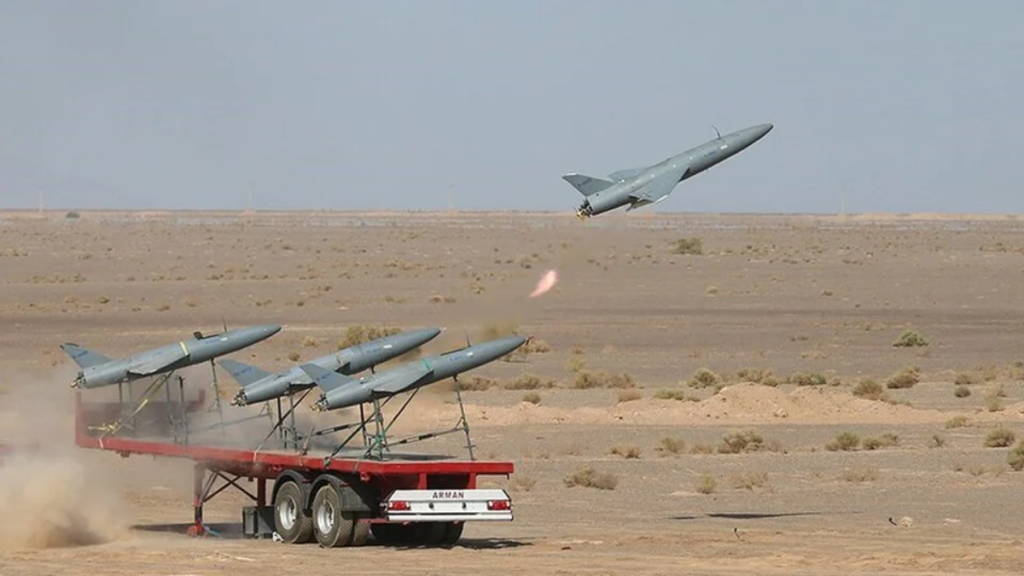
The Islamic Revolutionary Guard Corps (IRGC) claimed that it deployed six drones against an American air defence radar facility at al-Riffa air base on Sunday. Bahrain’s military, however, said its air defence network intercepted and destroyed all incoming threats before they could reach their intended targets.
The attack represents Iran’s second attempt to strike Bahrain within three days, raising concerns about the security of American military installations and neighbouring Gulf states.
As warning sirens sounded across Bahrain, the Interior Ministry urged residents to move to the nearest designated safe location. The authorities issued the warning as the country faced another round of Iranian attacks.
Bahrain’s Foreign Ministry responded by accusing Tehran of continuing its military aggression against the kingdom and warned that Iran would bear responsibility for the consequences.
In its statement, the ministry described the attacks as brutal and condemned what it called repeated violations of Bahrain’s sovereignty.
Iran, meanwhile, used the latest operation to deliver a direct warning to Washington. In a statement carried by Iranian state broadcaster, the IRGC declared that the Strait of Hormuz remained closed and threatened a stronger military response if the United States carried out further aggression.
The latest incident follows an earlier drone attack on Friday, when Iran also attempted to strike American military infrastructure in Bahrain. The IRGC subsequently claimed that it had hit a US early-warning radar system.
The American military disputed that account, saying Iranian forces had launched two one-way attack drones towards Bahrain. Both were intercepted by US forces, according to Washington, which reported no injuries or damage.
The repeated attacks indicate that American military infrastructure in Bahrain is becoming an increasingly important target in Tehran’s confrontation with Washington.
Strait of Hormuz Raises Stakes Across the Gulf
The escalating hostilities are closely connected to the dispute over the Strait of Hormuz, a narrow maritime passage through which approximately one-fifth of the world’s oil and gas supplies normally travel.
Commercial shipping through the waterway has been severely disrupted since the conflict began in February, creating uncertainty for energy exporters and international markets.
Iran maintains that it should control access to the strait and has targeted vessels it considers unauthorised. The United States, in contrast, has been deploying military protection for oil tankers travelling through the passage to safeguard exports from Gulf Arab countries.
The competing strategies have transformed the waterway into one of the most dangerous flashpoints in the conflict.
Tehran’s latest statement also suggested that it intends to maintain pressure on Washington through its control over maritime traffic. The IRGC warned that any further American military action would trigger a more forceful response.
US Strikes Iranian Island Near Strategic Waterway
Military operations have also extended to Iranian territory near the strait.
Earlier this week, American forces conducted strikes against targets on Qeshm Island, according to US officials who spoke to CBS News. The island occupies a strategically important position near the Strait of Hormuz.
The officials characterised the operation as limited and defensive, explaining that it was launched in response to an incident involving Iranian forces firing on a US aircraft.
Iranian state news agency IRNA reported explosions on the island on Monday. Although the IRGC did not directly address the American strikes, it claimed that Iranian forces had brought down three US drones in the surrounding area.
According to the Iranian military, two MQM-170 drones were destroyed south of Qeshm Island, while an MQ-9 drone was shot down east of the Strait of Hormuz.
The claims could not be independently verified, and the competing accounts from Washington and Tehran illustrate the growing difficulty of establishing what is happening during military operations in the region.
Diplomatic Efforts Struggle to Prevent Further Escalation
The latest confrontation has also complicated attempts to negotiate an end to the war.
The United States and Iran reached a preliminary understanding in June that was intended to stop the fighting and restore normal shipping through the Strait of Hormuz. However, the arrangement unravelled within weeks as attacks on commercial vessels resumed and Washington reinstated its naval blockade of Iranian ports.
Diplomatic contacts have continued through intermediaries, with Iranian negotiators reportedly presenting conditions for reopening the waterway.
Under a proposal discussed with mediators, Tehran could agree to restore access to the Strait of Hormuz within 48 hours if Washington accepts seven conditions. These reportedly include removing the naval blockade of Iranian ports and releasing frozen Iranian assets.
However, the renewed attacks on Bahrain suggest that military pressure remains an important part of Iran’s strategy while negotiations continue.
For the United States, protecting its military facilities and ensuring uninterrupted energy shipments through the Gulf remain major priorities. Iran, meanwhile, is attempting to use its geographical position around the Strait of Hormuz as leverage against American pressure.
With drone attacks continuing, American military operations expanding and diplomatic efforts struggling to gain momentum, the risk of a wider confrontation across the Gulf remains significant.