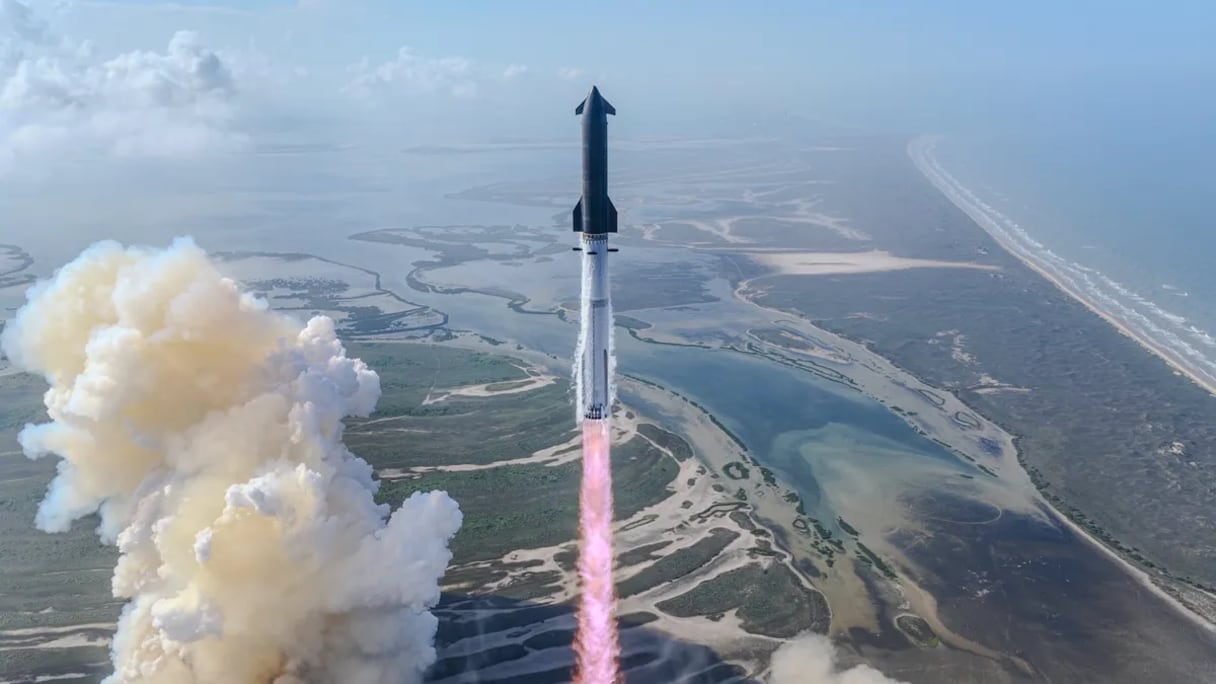
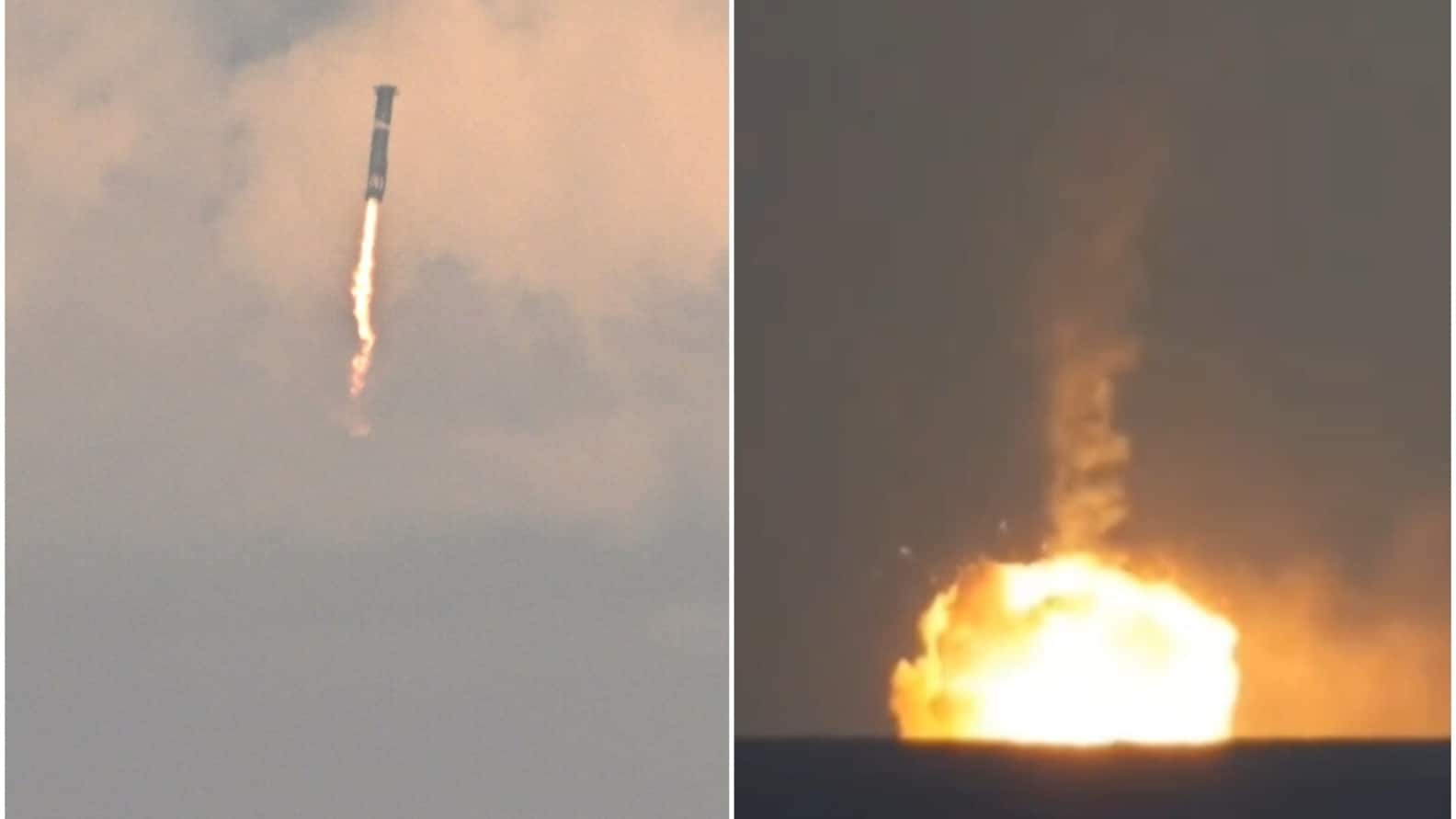
A Failed Catch, a Successful Orbit: Is SpaceX Still on Track for Mars? SpaceX’s ambitious Starship program has experienced another dramatic moment, with its latest test flight delivering both disappointment and significant progress. The company’s attempt to recover the entire rocket at its Texas launch site suffered a major setback when the Super Heavy booster fell into the Gulf of Mexico and exploded. However, the spacecraft successfully reached orbit, keeping alive the possibility of another major breakthrough in Elon Musk’s long-term vision of reaching the Moon and Mars.
Booster Recovery Attempt Ends in Failure
SpaceX had hoped to achieve a remarkable milestone by catching the Super Heavy booster using enormous mechanical arms attached to the launch tower at its Starbase facility in Texas.
The recovery technique, often described as a rocket catch, is central to the company’s strategy of making Starship completely reusable. Instead of allowing rocket stages to fall into the ocean after launch, SpaceX wants to bring them back to the ground, recover them and prepare them for another flight.
However, Friday’s attempt did not deliver the expected result. Rather than returning to the launch pad, the first-stage booster was diverted towards an offshore landing area in the Gulf of Mexico, where it eventually exploded.
The incident prevented SpaceX from achieving its planned double recovery. Nevertheless, the decision to divert the booster demonstrated that the company was prepared to prioritise launch-site safety rather than risk an uncontrolled return near its infrastructure.
SpaceX commentator Kate Tice acknowledged the disappointing outcome during the live broadcast, noting that the result was not what the team had hoped for.
The company did not immediately provide a detailed explanation of what caused the recovery attempt to be abandoned.
Starship Reaches Orbit Despite the Setback
While the booster recovery attracted attention, the spacecraft itself delivered an important achievement by successfully reaching orbit.
Shortly after reaching space, Starship deployed 26 of SpaceX’s advanced Starlink satellites, demonstrating its ability to carry and release payloads during an orbital mission.
The spacecraft was expected to complete approximately 15 revolutions around Earth at an altitude of roughly 170 miles (275 kilometres) before beginning its return journey.
The most significant part of the mission was still ahead. SpaceX planned to guide the spacecraft back towards its Texas launch facility and attempt to catch it using the mechanical arms attached to the launch tower.
If successful, this would mark the first time the company had recovered a Starship spacecraft directly at the launch site.
Unlike the booster, which had already been caught successfully on three previous occasions, the spacecraft had never completed such a recovery.
The outcome could therefore provide valuable information about the feasibility of recovering both stages of the world’s largest rocket.
Why Full Rocket Reusability Matters
SpaceX’s long-term ambitions depend heavily on making Starship rapidly reusable.
Traditional rockets are expensive partly because significant portions of their hardware are discarded after launch. Even SpaceX’s Falcon rockets, which have revolutionised the commercial launch industry through reusable first-stage boosters, still discard their upper stages.
Starship is designed to take reusability considerably further.
The company wants to recover both the Super Heavy booster and the Starship spacecraft after every mission. This approach could significantly reduce the cost of launching payloads into orbit and make frequent space travel more practical.
Elon Musk believes that fully reusable rockets could transform space transportation in much the same way that reusable aircraft transformed aviation.
The ultimate objective is to make launches increasingly frequent and affordable, creating the infrastructure required for large-scale satellite deployment, lunar exploration and eventually human settlements on Mars.
SpaceX executive Kiko Dontchev has also highlighted the importance of increasing launch frequency. Speaking at a NASA technology summit, he described a future in which the company could expand from a small number of annual launches to thousands or even tens of thousands.
Achieving that level of activity would require a fundamentally different approach to rocket manufacturing, recovery and refurbishment.
A New Generation of Starship for Moon and Mars Missions
Friday’s flight also involved an upgraded version of the Super Heavy booster.
Measuring approximately 236 feet (72 metres) in length, the booster represents the production configuration intended to support SpaceX’s future lunar and interplanetary missions.
The Starship spacecraft itself measures around 171 feet (52 metres).
Together, the two stages create a rocket approximately 407 feet (124 metres) tall, making it the largest and most powerful launch vehicle ever developed.
The scale of the system reflects the enormous ambitions behind the programme. SpaceX wants Starship to transport large quantities of cargo, satellites, equipment and eventually astronauts beyond Earth.
Previous Starship tests have produced mixed results. Some spacecraft were deliberately directed towards ocean landings, while others were lost following technical failures and explosions.
The September test flight had already demonstrated orbital capability, but SpaceX had not attempted to recover either stage during that mission.
The latest flight therefore represented another step towards testing the complete reusable launch system.
NASA’s Artemis Programme Depends on Starship
SpaceX’s Starship programme is not limited to commercial satellite launches or Musk’s Mars ambitions. It is also an important part of NASA’s plans to return astronauts to the lunar surface.
NASA has awarded SpaceX billions of dollars to develop a lunar landing system capable of transporting astronauts from lunar orbit to the Moon’s surface.
The spacecraft is expected to play a major role in the Artemis programme, which aims to establish a sustainable human presence around and eventually on the Moon.
Blue Origin, founded by Jeff Bezos, is also developing a lunar lander known as Blue Moon.
NASA expects to evaluate the competing systems before selecting the vehicle that will support the Artemis IV lunar landing.
Meanwhile, during the planned Artemis III mission, astronauts are expected to practise docking their spacecraft with both Blue Origin’s Blue Moon and SpaceX’s Starship in Earth orbit.
These demonstrations will help prepare the technology and procedures required for future lunar missions.
NASA Administrator Jared Isaacman welcomed Starship’s successful orbital achievement, highlighting the potential importance of its communications capabilities for Artemis III.
Can SpaceX Still Achieve Its Mars Ambitions?
Despite the failed booster recovery, the latest test flight represents meaningful progress for SpaceX.
Reaching orbit, deploying Starlink satellites and preparing for the first attempted orbital return of the spacecraft are all important developments.
However, significant challenges remain.
SpaceX must demonstrate that Starship can reliably complete orbital missions, safely return to Earth, survive repeated flights and undergo rapid refurbishment. It must also establish reliable systems for transferring propellant in space, an essential capability for missions requiring large quantities of fuel beyond Earth’s orbit.
These technologies are particularly important for Mars exploration, where spacecraft would need to travel enormous distances while carrying substantial cargo and life-support equipment.
A successful orbital flight alone does not mean Starship is ready to transport humans to Mars. The company still needs to prove the reliability and safety of several critical systems.
Nevertheless, every test provides engineering data that can help improve the next generation of the vehicle.
The Road Ahead
SpaceX‘s latest Starship flight illustrates the experimental nature of developing a completely reusable super-heavy rocket.
The loss of the booster was undoubtedly a setback, but the spacecraft’s successful journey into orbit demonstrated that the programme continues to make progress.
The next major milestone is proving that Starship can return from orbit and be recovered at the launch site. A successful spacecraft catch would represent a significant achievement and bring SpaceX closer to its goal of recovering the entire launch vehicle.
The dream of making humanity a multiplanetary civilisation remains a long-term ambition rather than an immediate reality. But with every test flight, SpaceX is gathering the experience needed to move closer to that objective.
For now, the failed booster catch has not ended the mission’s significance. Starship has reached orbit, and the next chapter of its journey could prove just as important as the launch itself.